Dentures in Dubai — Full and Partial Options 2026
Dentures remain one of the most common tooth replacement solutions in Dubai — affordable, non-surgical, and available in a wide range of types from basic acrylic to implant-supported overdentures. This guide covers every type of denture available in Dubai, with AED costs, a step-by-step process, an adjustment guide, and insurance information. For the implant alternative, see our implants vs dentures Dubai guide.
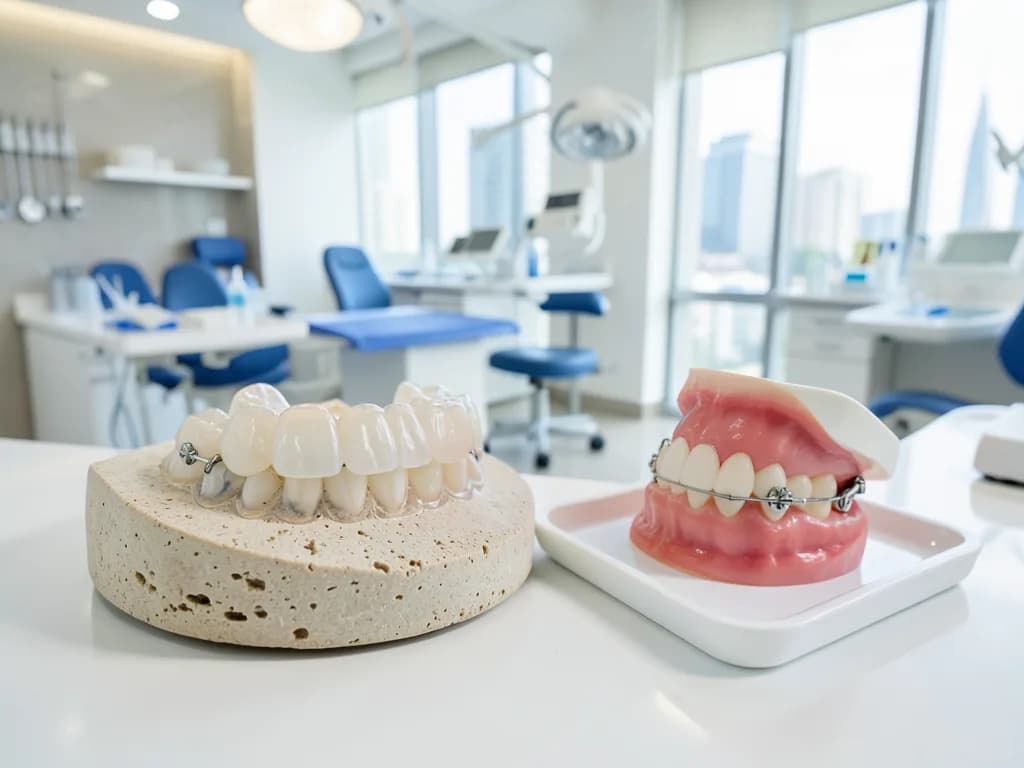
Types of Dentures Available in Dubai
Dubai clinics offer the full range of denture solutions from conventional acrylic to state-of-the-art implant-supported overdentures.
A removable acrylic prosthesis replacing all teeth in the upper or lower arch, resting on the gum ridge and palate (upper) or gum ridge only (lower). The most traditional form of full-arch tooth replacement. Modern full dentures can be highly aesthetic — the shape, shade and arrangement of the acrylic teeth is customised to suit the patient's facial proportions and former appearance.
Advantages
- ✓ Lowest cost full-arch replacement
- ✓ No surgery required
- ✓ Can replace all missing teeth in one arch
- ✓ Completed in 4–6 appointments
Limitations
- ✗ Must be removed at night for soaking
- ✗ Ongoing bone resorption causes loosening over time
- ✗ Only 20–30% of natural biting force
- ✗ Adhesives often required for stability
A removable prosthesis that replaces several missing teeth while retaining and using remaining natural teeth for stability. Metal clasps grip the adjacent natural teeth. A more affordable and faster option than a bridge when multiple teeth are missing in different areas of the arch. Chrome cobalt framework partial dentures are more durable than acrylic-only partials.
Advantages
- ✓ Cost-effective when multiple teeth are missing
- ✓ No surgery required
- ✓ Preserves remaining natural teeth
- ✓ Easily modified if more teeth are lost
Limitations
- ✗ Metal clasps may be visible
- ✗ Removable — must be taken out for cleaning
- ✗ Ongoing bone loss under the saddle areas
- ✗ May affect speech initially
A partial denture made from a flexible thermoplastic nylon material instead of acrylic or metal. The pink gum-coloured clasps blend naturally with the gum and are nearly invisible — making Valplast the aesthetic choice for partial dentures when visible metal clasps are unacceptable. Comfortable and lightweight, but cannot be easily relined as the jaw changes.
Advantages
- ✓ No visible metal clasps
- ✓ Lightweight and flexible — comfortable to wear
- ✓ Good aesthetics — pink clasps blend with gums
- ✓ Suitable for patients with metal sensitivities
Limitations
- ✗ Cannot be relined — must be remade as jaw changes
- ✗ Not suitable for all partial denture cases
- ✗ Less rigid than chrome cobalt — may flex under load
- ✗ Higher cost than standard acrylic partial
A denture fabricated before tooth extraction and inserted immediately after teeth are removed at the same appointment — so the patient is never without teeth. The denture is made using pre-extraction impressions and measurements. As the gum heals and shrinks over the following months, the immediate denture typically requires relining or replacement with a definitive denture.
Advantages
- ✓ Never without teeth — denture is in place from day one
- ✓ Protects extraction sockets during healing
- ✓ Psychologically easier — avoids edentulous period
- ✓ Can assess aesthetics immediately
Limitations
- ✗ May need relining or replacement as gum heals
- ✗ Fit may change significantly in first 6 months
- ✗ Higher total cost if a new definitive denture is also needed later
A removable denture anchored and stabilised by 2–4 dental implants using snap-on (ball attachment or locator) or bar-retained connectors. The denture clicks firmly onto the implants and can be removed for cleaning, but stays completely stable during eating and speaking. A transformative upgrade from conventional dentures — dramatically better function, aesthetics and quality of life.
Advantages
- ✓ Snaps firmly onto implants — no movement
- ✓ Preserves jawbone — implants stimulate bone
- ✓ Near-natural biting force
- ✓ No adhesives needed
- ✓ Still removable for easy cleaning
Limitations
- ✗ Requires implant surgery
- ✗ Higher cost than conventional denture
- ✗ 3–6 month healing before final overdenture
- ✗ Implant attachments need periodic replacement
Denture Prices in Dubai 2026
All prices in AED. Costs vary by type, material, clinic tier, and number of adjustment appointments included. See the full 2026 dental cost guide.
| Denture Type | AED Range | Notes |
|---|---|---|
| Complete full denture (per arch) | AED 2,000 – 6,000 | Acrylic teeth on acrylic base |
| Acrylic partial denture | AED 1,500 – 3,500 | Budget option, less durable |
| Chrome cobalt partial denture | AED 2,500 – 4,000 | Metal framework, more durable |
| Valplast flexible partial | AED 2,000 – 4,500 | No metal clasps, highly aesthetic |
| Immediate denture | AED 2,500 – 5,000 | Made before, fitted same day as extractions |
| Implant-supported overdenture (2 implants) | AED 8,000 – 14,000 | Snap-on type, lower arch standard |
| Implant-supported overdenture (4 implants) | AED 14,000 – 20,000 | Bar-retained, maximum stability |
| Denture relining | AED 500 – 1,500 | Every 2–3 years as jaw changes |
Prices from Dubai clinic surveys, February 2026. Specialist prosthodontist clinics typically charge 20–40% above general dentist rates.
For a full cost analysis including long-term expenses, see our dentures cost guide. Considering implant-supported options? Compare in our implant cost guide.
Budget clinics
AED 2,000 – 3,000
Standard acrylic; basic lab work
Mid-range clinics
AED 3,000 – 5,000
Premium acrylic teeth; better aesthetics
Specialist prosthodontist
AED 4,500 – 6,000+
Custom characterisation; best aesthetics and fit
The Denture Process Step by Step
A conventional full denture typically requires 4–6 appointments over 4–8 weeks.
Initial Assessment and Treatment Planning
Your dentist or prosthodontist examines the gum ridges, bone volume, remaining teeth (for partials), bite, and facial proportions. X-rays are taken if teeth need extracting before denture fabrication. The type of denture, shade of teeth, and timeline are decided. A referral to a specialist prosthodontist is recommended for complex cases, elderly patients, and all implant-supported overdentures.
Extractions and Healing (if Required)
For a conventional (non-immediate) full denture, all remaining teeth are extracted and the gum is allowed to heal for 6–8 weeks before impressions are taken. This allows the gum ridge to stabilise in its final shape. For an immediate denture, teeth are extracted and the denture is fitted on the same day from pre-fabricated impressions.
Impressions and Bite Registration
Detailed impressions of the upper and lower gum ridges are taken with impression trays. A custom impression tray may be fabricated first for greater precision. Bite registration records capture the correct relationship between the upper and lower jaws — this determines the height and position of the teeth in the denture, and getting it right is critical for comfort, function and appearance.
Wax Try-In
Before the final denture is processed, the teeth are set in wax on the denture base and tried in your mouth. This is your opportunity to assess the aesthetics — the tooth shade, shape, size, and the position of the midline. You can smile, speak and evaluate how you look. Adjustments are easy at this stage. Never skip the wax try-in appointment.
Final Denture Delivery and Adjustments
The finished denture is inserted and assessed for fit, aesthetics, speech, and comfort. Areas of pressure causing sore spots are identified and adjusted using articulating paper. Most patients require 2–4 adjustment appointments in the first month as the gum adapts to the new denture. These adjustment appointments are usually included in the denture fee.
Adjusting to New Dentures — What to Expect
Adapting to new dentures takes time and patience. Most patients achieve comfortable function within 4–8 weeks, with full adaptation taking up to 3 months. The following tips, used by prosthodontists across Dubai, accelerate the adaptation process.
Begin with soft foods for the first 4 weeks — yoghurt, scrambled eggs, fish, cooked vegetables
Cut food into small pieces and chew evenly on both sides simultaneously
Practise speaking aloud to speed up adaptation — reading, counting or singing
Expect increased saliva flow and a feeling of fullness for the first 2–4 weeks
Use denture fixative adhesive only if needed — it is not a long-term solution for a poor-fitting denture
Remove dentures at night and soak in a denture cleaning solution — never use toothpaste
Rinse the mouth and gums with warm water after removing dentures each night
Return for adjustment appointments — do not try to adjust the denture yourself
When to call your dentist: Soreness at the denture border or pressure spots on the gum are normal and expected. Call your clinic for an adjustment appointment — do not use over-the-counter denture adhesive as a substitute for a proper fit. Severe pain, bleeding, or persistent sores that do not improve within 24–48 hours after an adjustment should be reviewed promptly.
Denture Care and Maintenance
Daily routine
- ✓ Remove at night and soak in denture solution or cold water
- ✓ Brush denture with soft brush and denture cleaner — not toothpaste
- ✓ Rinse mouth with warm water after removing dentures
- ✓ Brush any remaining natural teeth as normal
- ✓ Handle over a folded towel or basin of water — prevent cracking if dropped
What to avoid
- ✗ Hot water — distorts the acrylic base permanently
- ✗ Toothpaste — too abrasive, scratches the denture surface
- ✗ Bleach products — bleaches and weakens pink acrylic
- ✗ Leaving denture to dry out — acrylic warps when dry
- ✗ Adjusting the denture yourself with tools
Considering upgrading from dentures to implants? The two-implant lower overdenture is the most cost-effective implant solution and transforms denture stability. For full-arch rehabilitation, the All-on-6 protocol offers maximum stability with six fixtures per arch. Even patients in their 70s and 80s can be suitable candidates. Ask your dentist or see our prosthodontist Dubai guide to find a specialist.
When Are Dentures the Best Choice?
Multiple missing teeth in different areas of the arch
Budget constraints making implants unaffordable
Medical conditions that make implant surgery higher risk
Elderly patients preferring simpler treatment
Significant bone loss making implant placement complex
Patients who want immediate results on the day of extraction
1–2 missing teeth in isolated positions
Young patients with good bone who can afford implants
Does UAE Insurance Cover Dentures?
Dentures are generally covered as major restorative
Most UAE health insurance plans cover conventional dentures under major restorative dental benefits, typically at 50–70% of cost after deductible, up to annual plan limits. Pre-authorisation is required by Daman, AXA, Bupa, MetLife, and NextCare before starting denture treatment. Standard coverage is for a basic acrylic denture — premium materials like Valplast or chrome cobalt frameworks may require an upgrade payment. Immediate dentures are typically covered on the same basis as conventional.
Implant-supported overdentures have partial coverage on some enhanced plans — check your specific policy. See our full dental insurance Dubai guide. Your general dentist can handle denture fabrication for most routine cases and refer you to a prosthodontist for complex needs.
All Denture Types at a Glance
Side-by-side comparison of every denture type available at Dubai prosthodontist clinics in 2026. All prices in AED.
| Type | Material | Price (AED) | Lifespan | Best For |
|---|---|---|---|---|
| Complete (full) acrylic denture | PMMA acrylic | AED 2,000–5,000 | 5–7 years | All teeth missing in one arch |
| Partial acrylic denture | Acrylic + metal clasps | AED 1,500–3,500 | 5–7 years | Multiple missing teeth, budget-conscious |
| Chrome cobalt partial | Metal framework + acrylic | AED 3,000–6,000 | 7–10 years | Robust partial with minimal bulk |
| Flexible (Valplast) | Nylon thermoplastic | AED 2,500–4,500 | 5–8 years | Metal-free option, high aesthetics |
| Immediate denture | Acrylic | AED 2,500–4,500 | Temporary (6–12 months) | Placed same day as extractions |
| Implant-supported overdenture (2 implants) | Acrylic over titanium bar | AED 9,000–15,000 | 10–15 years | Maximum stability for lower full arch |
| All-on-4 / All-on-6 fixed | Zirconia or acrylic bridge | AED 25,000–60,000 | 15–20 years | Fixed full-arch; nearest to natural teeth |
Prices from Dubai clinic surveys, February 2026. Implant costs exclude the fixture placement surgery fee.
Considering whether implants are better value long-term? Compare in our dentures vs implants guide. See all costs in our 2026 dental treatment cost guide.
Denture Risks and Complications
Dentures are a safe and well-established treatment. Complications are largely manageable and preventable with proper care and regular dental review. Understanding the potential issues helps patients make informed decisions and respond quickly when problems arise.
Short-Term Issues (First 4–8 Weeks)
- •Soreness at denture border and pressure points — normal; resolved by adjustment
- •Excess salivation — subsides as mouth adapts within weeks
- •Difficulty pronouncing certain sounds — improves with practice
- •Reduced chewing efficiency — temporary while muscles adapt
- •Gagging with upper full denture — sometimes resolved by palate trimming
Long-Term Complications
- •Bone resorption — jawbone shrinks over years under denture pressure
- •Loosening fit — direct result of bone loss; reline or rebase every 3–5 years
- •Denture stomatitis — fungal infection under ill-fitting denture; treat with antifungal and better hygiene
- •Epulis fissuratum — tissue overgrowth at overextended denture border
- •Increased decay risk for remaining natural teeth if partial denture clasps are not cleaned thoroughly
Immediate Denture Specific
- •Fit changes as extraction sites heal and shrink — relining needed at 3–6 months
- •Higher adjustment frequency compared to conventional dentures
- •Cannot be tried in before fitting — aesthetics may not meet expectations exactly
When to Return to Your Dentist Promptly
- •Persistent sores or bleeding gums that do not resolve in 48 hrs after an adjustment
- •Denture becomes loose suddenly — may indicate significant bone loss or fracture
- •Cracked or broken denture — do not attempt DIY repair with superglue
- •Pain on biting or chewing despite adjustments — bite registration may need rechecking
- •White patches or persistent redness under the denture
Regular 6-monthly dental reviews extend denture life, monitor bone levels, and catch problems early. Browse DHA-licensed clinics near you or read our prosthodontist Dubai guide for specialist denture care.
Modern Denture Technology in Dubai
Denture fabrication has undergone a technological revolution in the past decade. Dubai prosthodontists now have access to digital workflows that improve fit, aesthetics, and turnaround time compared to traditional impression-based methods.
Digital Dentures (CAD/CAM)
Digital impressions captured with an intraoral scanner replace traditional impression trays. The scan data is used to design the denture digitally in CAD software, then milled from a pre-polymerised acrylic block in a CAM milling unit. Benefits include superior fit accuracy, faster turnaround (often 5–7 working days), and a digital backup of the denture design that can be reprinted if the denture is lost or broken.
3D-Printed Dentures
SLA and DLP 3D printers produce trial dentures in hours — allowing patients to test the shape and aesthetics before the final device is fabricated. Some clinics print the final denture using high-performance resins that are biocompatible and highly polishable. 3D printing is particularly useful for immediate dentures where speed is essential.
Bite Registration Technology
Electronic bite registration systems (T-Scan) measure occlusal contact points with microsecond precision. This allows the prosthodontist to balance the denture bite with far greater accuracy than the traditional articulating paper method — reducing the number of adjustment visits and improving long-term comfort.
Implant Planning Software
For implant-supported overdentures, guided implant placement software (Simplant, coDiagnostiX) uses CBCT bone data to plan implant position virtually before surgery. Surgical guides printed from this data ensure implants are placed in the optimal position for overdenture retention — maximising success rates.
Ask your prosthodontist whether they offer digital dentures — they often cost a similar amount to conventional dentures but deliver a better fitting result. Find clinics with digital workflows in our dental specialists directory or compare all treatment options at dental treatments Dubai.
Dentures vs Dental Implants — Which is Better for You?
The choice between removable dentures and fixed dental implants is one of the most common decisions patients face after losing multiple teeth. Both are valid options — the right choice depends on your bone volume, overall health, budget, and lifestyle priorities.
| Factor | Dentures | Dental Implants |
|---|---|---|
| Initial cost (full arch) | AED 2,000–5,000 | AED 25,000–60,000 (All-on-4/6) |
| Long-term cost (10 years) | Moderate (relining, replacements) | Lower (minimal maintenance after 2 yrs) |
| Chewing efficiency | 30–50% of natural | 90–95% of natural |
| Bone preservation | No — continues to resorb | Yes — stimulates bone like natural root |
| Surgery required | No | Yes (dental implant surgery) |
| Treatment time | 4–8 weeks | 3–9 months (osseointegration) |
| Removable | Yes | No (fixed restoration) |
| Age suitability | All ages | 18+ (jaw growth complete) |
| Insurance coverage | Often 50–70% covered | Partial on enhanced plans only |
For patients who want the benefits of implant stability at a lower cost, the implant-supported overdenture (two implants, one removable denture) is the best of both worlds — dramatically improved retention at AED 9,000–15,000. Read our detailed implants vs dentures Dubai comparison or explore dental implant costs in Dubai.
Frequently Asked Questions
How long does it take to get used to dentures?
Most patients take 4–8 weeks to adapt to new dentures. In the first week, dentures typically feel foreign, bulky and uncomfortable — the tongue and cheeks must learn to work with the new shapes in the mouth. Speech may be affected, particularly sounds like 's', 'f' and 'th', but usually normalises within 2–4 weeks with practice. Eating takes longer to normalise — begin with soft foods, cut into small pieces, chewed equally on both sides, and gradually progress to firmer foods over 4–6 weeks. Sore spots develop where the denture base presses on the gum and these require adjustment visits — do not attempt to adjust the denture yourself. Call your clinic for an adjustment appointment whenever soreness develops.
How much do dentures cost in Dubai in 2026?
Complete full dentures cost AED 2,000–6,000 per arch at Dubai dental clinics, depending on the lab quality, materials used, and clinic tier. A chrome cobalt partial denture costs AED 2,500–4,000. Flexible Valplast partials range from AED 2,000–4,500. Immediate dentures (fitted same day as extraction) range from AED 2,500–5,000 and may require a new definitive denture after healing, adding to total cost. Implant-supported overdentures with two lower implants range from AED 8,000–14,000 total. Mid-range general dental clinics in Deira, Bur Dubai or Jumeirah tend to be more affordable than premium clinics in DIFC or Downtown Dubai.
What is the difference between a conventional denture and an overdenture?
A conventional denture rests on the gum ridge and is held in place by suction (upper) and gravity with gum contact (lower). The lower full denture is notoriously difficult to stabilise and often moves when eating or speaking. An overdenture uses 2–4 dental implants as anchors — the denture has plastic or metal attachments that click onto the implant abutments, holding the denture firmly in place. The overdenture is still removed for cleaning but is dramatically more stable than a conventional denture during use. Patients who upgrade from conventional to implant-retained overdentures report transformative improvements in confidence, speaking, eating, and quality of life. The lower jaw overdenture on two implants is the most cost-effective implant-based solution in dentistry and is considered the minimum standard of care by many prosthodontic organisations.
Can I sleep with my dentures in?
No — it is strongly recommended to remove dentures every night for soaking. This allows the gum tissues to breathe and recover from the pressure of the denture during the day. Research shows that patients who sleep with their dentures in have higher rates of denture stomatitis (a fungal infection of the gum under the denture), faster bone loss, and gum inflammation. Remove the denture, brush it gently with a soft brush and denture cleaner (not toothpaste — it is too abrasive), rinse your mouth with warm water, and soak the denture in a denture cleaning solution or plain cold water overnight. Never soak acrylic dentures in hot water as it can distort the base.
How often do dentures need to be replaced or relined?
Dentures should be relined every 2–3 years as the jawbone and gum ridge naturally resorb (shrink) after tooth extraction. As the ridges change shape, the denture no longer fits precisely and becomes loose — relining adds new material to the fitting surface of the denture to restore accurate contact with the gum. Relining in Dubai costs AED 500–1,500. Complete dentures typically need replacing every 7–10 years due to material wear and significant ridge resorption. Implant-supported overdentures may require replacement of the plastic retentive inserts (inside the denture) every 1–2 years, and the denture base itself every 5–7 years. Regular check-ups with your prosthodontist ensure the denture fit and function are monitored.
Are dentures covered by UAE health insurance?
Conventional dentures are covered by many UAE health insurance plans under major restorative benefits, typically at 50–70% of the cost up to annual plan limits. Pre-authorisation is usually required. The covered appliance is typically a standard acrylic denture — if you choose premium materials or implant-retained overdentures, you pay the difference or the full cost. Immediate dentures are generally coverable. Implant-supported overdentures are partially covered on enhanced dental plans — the implants themselves may have limited coverage (AED 3,000–8,000 per year maximum) while the denture superstructure may have separate coverage. Always confirm with your insurer before starting treatment. See our dental insurance Dubai guide for insurer-by-insurer details.
Find a Denture Specialist in Dubai
Compare verified prosthodontists and dental clinics in Dubai offering full, partial and implant-supported dentures. Check insurance acceptance and read patient reviews.
Use our explore dental options near you to compare clinics, read reviews, and book appointments.