All-on-6 Dental Implants in Dubai — The Complete 2026 Guide
All-on-6 dental implants use six strategically placed implants per arch to deliver a permanently fixed set of teeth with maximum stability and load distribution. This guide explains why some patients benefit from six implants over four, how the procedure works at Dubai clinics, what you should expect to pay, and how All-on-6 compares to All-on-4 implants, conventional implants, and dentures. For a full breakdown of implant pricing, see our dental implants cost guide.
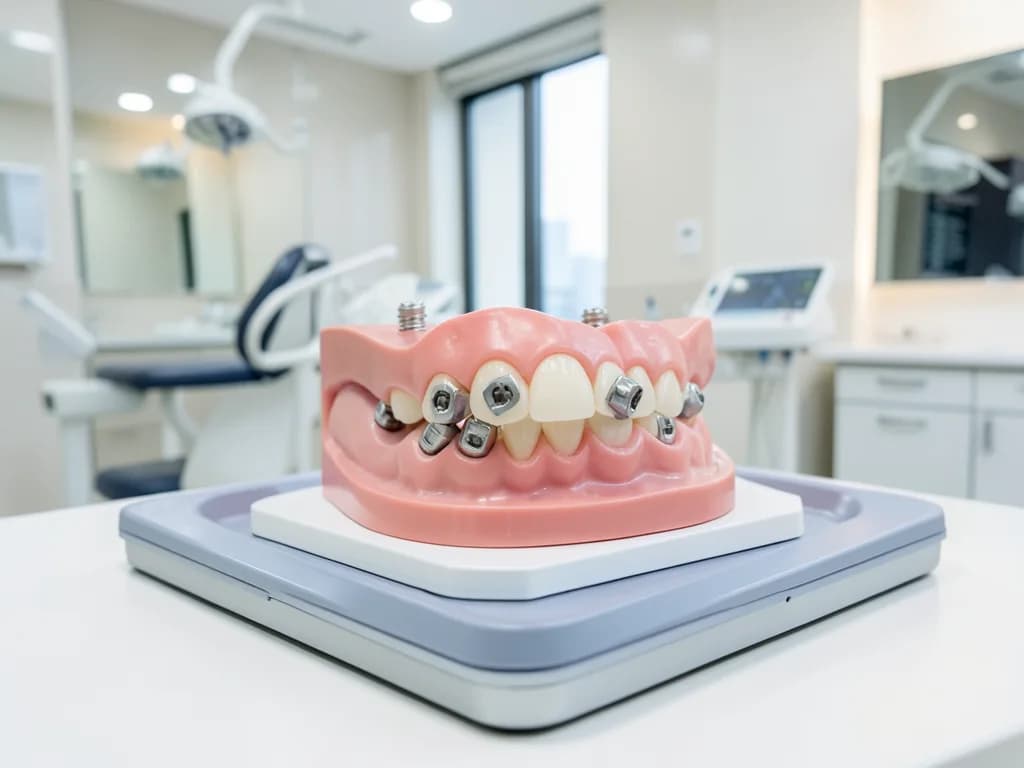
What Is All on 6 and How Does It Work?
All-on-6 is a full-arch dental implant protocol that uses six implants per jaw to support a complete fixed bridge of 12 to 14 prosthetic teeth. The concept evolved from the All-on-4 protocol developed by Dr. Paulo Malo, with the addition of two extra posterior implants to create a wider support polygon and reduce cantilever stress at the back of the bridge. Where All-on-4 relies on four implants with steep posterior tilting, All-on-6 distributes occlusal forces across six anchor points, lowering the load on each individual implant by approximately 30 to 40 percent.
The six implants are typically positioned as follows: two vertical implants in the anterior (front) region of the jaw where bone is naturally thickest, two slightly angled implants in the premolar region, and two moderately angled implants in the posterior region. The angulation of the posterior implants (15 to 35 degrees) is generally less aggressive than in All-on-4 (30 to 45 degrees), because the additional implants provide enough support without extreme tilting. This wider distribution of anchor points creates a more stable prosthetic platform that is particularly beneficial for patients with strong bite forces, bruxism, or those who want the highest possible long-term predictability.
Like All-on-4, the All-on-6 protocol allows for same-day teeth — a temporary fixed bridge is attached within hours of surgery, so you leave the clinic with a full set of functioning teeth on the day of your procedure. The final permanent bridge (typically monolithic zirconia) is fitted 4 to 6 months later once osseointegration is confirmed. For a complete overview of all implant options, see our dental implants Dubai guide.
Why Six Implants Instead of Four?
The addition of two posterior implants in All-on-6 reduces the cantilever (the unsupported extension of the bridge beyond the last implant) by approximately 50 percent compared to All-on-4. Shorter cantilevers mean less leverage, less stress on posterior implants, and a lower risk of prosthetic complications such as bridge fractures or screw loosening. This is especially important in the lower jaw, where bite forces can exceed 700 Newtons during clenching.
All on 6 vs All on 4 Detailed Comparison
Both protocols deliver excellent clinical outcomes. The right choice depends on your bone anatomy, bite force profile, and budget. See our All-on-4 guide for the full All-on-4 breakdown and our All-on-4 cost page for detailed pricing.
| Factor | All-on-4 | All-on-6 |
|---|---|---|
| Number of implants per arch | 4 | 6 |
| Posterior implant angulation | 30 to 45 degrees (steep tilt) | 15 to 35 degrees (moderate tilt) |
| Cost per arch (AED) | 25,000 – 45,000 | 40,000 – 65,000 |
| Bone graft requirement | Rarely needed | Occasionally needed |
| Load distribution | Forces across 4 anchor points | Forces across 6 anchor points |
| Ideal for bruxism (grinding) | Possible but higher stress per implant | Preferred due to better load spread |
| Teeth on the same day | Yes (temporary bridge) | Yes (temporary bridge) |
| Long term success rate | 95 to 98% at 10 years | 96 to 99% at 10 years |
| Minimum bone requirement | Lower (tilted implants bypass atrophied areas) | Moderate (needs bone in 6 positions) |
| Bridge span between supports | Longer cantilever at posterior | Shorter spans, less cantilever stress |
| Redundancy if one implant fails | Critical — only 3 remaining supports | Better — 5 supports still viable |
Clinical guidance: Your implant specialist will recommend All-on-4 or All-on-6 based on your CBCT scan findings, bone density measurements, and bite force assessment. The decision is not about which is universally "better" — it is about which protocol best fits your individual anatomy and clinical situation. An oral surgeon may also be involved in complex cases requiring bone grafting before implant placement.
The All on 6 Procedure Step by Step
From initial consultation to final permanent bridge, the complete All-on-6 journey spans 5 to 8 months across 8 phases.
Initial Consultation and CBCT Imaging
Your treatment begins with a comprehensive oral examination and a cone beam computed tomography (CBCT) scan. This 3D X-ray reveals the exact volume, density, and architecture of your jawbone, along with the precise location of nerves and sinus cavities. The implant surgeon uses this data to determine whether you are a candidate for All-on-6 or whether All-on-4 would be more appropriate. A detailed treatment plan is prepared, including a cost estimate, timeline, and discussion of implant brands and bridge material options. This consultation typically lasts 45 to 60 minutes and costs AED 500 to 800 for the CBCT scan.
Digital Treatment Planning and Surgical Guide Fabrication
Unlike All-on-4 where implants are often placed freehand, All-on-6 procedures at mid-range and premium clinics increasingly use fully guided digital surgery. Your CBCT data is imported into implant planning software (such as Nobel Clinician or coDiagnostiX), where the surgeon virtually places all six implants in optimal positions. A 3D-printed surgical guide is then fabricated — a custom stent that snaps over your jaw and contains drill sleeves at precisely the planned angles and depths. This guide reduces surgery time, minimises tissue trauma, and increases placement accuracy to within 0.5mm of the plan.
Extraction of Failing Teeth
Any remaining failing, infected, or non-restorable teeth in the treatment arch are extracted. In many cases, extractions and implant placement are performed in the same surgical session to avoid a separate healing phase. Your surgeon will advise whether same-session extraction is appropriate based on the level of infection present. If significant infection exists around the tooth roots, a short course of antibiotics may be prescribed before surgery, and extraction may be scheduled 4 to 6 weeks prior to implant placement to allow soft tissue healing.
Surgical Placement of Six Implants
Under local anaesthesia with optional intravenous (IV) sedation, six titanium implants are placed into your jawbone. The two anterior implants are positioned vertically in the dense front bone, while the four posterior implants are angled between 15 and 35 degrees to engage maximum bone contact and distribute occlusal forces evenly. If a surgical guide is used, the procedure involves small, punch-like incisions rather than full flap surgery, which reduces bleeding, swelling, and healing time. The entire surgery takes approximately 2.5 to 4 hours per arch depending on complexity.
Same Day Temporary Bridge Attachment
Within hours of surgery, multi-unit abutments are connected to each of the six implants. A prefabricated or chairside-milled temporary acrylic bridge — containing 12 to 14 teeth — is then screwed directly onto the abutments. You leave the clinic on the same day with a full set of fixed teeth. This temporary prosthesis is designed to be lighter than the final bridge, placing controlled load on the healing implants. You can eat soft foods within 48 hours, though a soft diet is recommended for the first 8 to 12 weeks. The temporary bridge looks natural and is colour-matched to your desired shade.
Osseointegration and Healing Period
Over the next 3 to 6 months, your six implants undergo osseointegration — a biological process where living bone cells grow into the micro-textured surface of the titanium implants, creating a permanent mechanical bond. During this phase, you attend periodic review appointments at 2 weeks, 6 weeks, and 3 months post-surgery. Your surgeon monitors healing through clinical examination and may perform implant stability quotient (ISQ) testing. A soft food diet progresses gradually toward normal foods as integration strengthens. Smoking must be strictly avoided during this period as it impairs blood supply and significantly increases failure risk.
Final Impression and Bridge Design
Once osseointegration is confirmed — typically at 4 to 6 months — your dentist takes a final impression of the implant positions using either a traditional polyvinyl siloxane impression or an intraoral digital scanner. This data is sent to the dental laboratory, where technicians design and fabricate your permanent full-arch bridge. Most patients choose monolithic zirconia for its combination of strength, natural translucency, and stain resistance. The bridge is designed with individual tooth anatomy, correct gingival contouring, and shade matching to deliver a natural appearance.
Final Permanent Bridge Delivery
The temporary acrylic bridge is removed and the final permanent bridge is tried in for fit, bite alignment, and aesthetics. Minor adjustments are made chairside. Once you and your surgeon are satisfied, the bridge is torqued onto the implant abutments at the manufacturer-specified force using a calibrated torque wrench. Access holes are sealed with composite resin, and a final panoramic X-ray or CBCT may be taken for the clinical record. You now have a permanent, fixed set of teeth supported by six implants — designed to last 15 to 25 years with proper care and regular maintenance visits.
All on 6 vs All on 4 vs Implants vs Dentures vs Bridge
Comparing every full-arch and tooth-replacement option available at Dubai clinics. For in-depth comparisons, see our implants vs dentures and implants vs bridge guides.
| Factor | All-on-6 | All-on-4 | Conventional | Dentures | Bridge |
|---|---|---|---|---|---|
| Number of implants | 6 per arch | 4 per arch | 1 per missing tooth | 0 (or 2 to 4 for overdenture) | 0 (supported by adjacent teeth) |
| Cost per arch (AED) | 40,000 – 65,000 | 25,000 – 45,000 | 8,000 – 15,000 per tooth | 2,000 – 6,000 | 4,000 – 12,000 per unit |
| Bone graft needed | Sometimes | Rarely | Often | No | No |
| Teeth same day | Yes (temporary) | Yes (temporary) | No | Yes (immediate) | 2 to 3 weeks wait |
| Bone preservation | Excellent | Excellent | Good | Poor (bone loss continues) | None under pontics |
| Fixed or removable | Fixed permanently | Fixed permanently | Fixed permanently | Removable | Fixed permanently |
| Expected lifespan | 15 to 25 years | 15 to 20 years | 15 to 25 years | 5 to 8 years | 8 to 15 years |
Dentures and bone loss: Conventional dentures rest on the gums without implant anchors, meaning the jawbone receives no stimulation and continues to resorb over time. Within 5 to 10 years, significant bone loss causes the face to appear sunken and dentures become progressively loose, requiring relining or replacement. Both All-on-4 and All-on-6 implants preserve jawbone by transmitting chewing forces directly into the bone, maintaining facial structure for decades. A dental bridge preserves bone under the anchoring teeth but not under the pontic (false tooth) span.
All on 6 Dental Implant Prices in Dubai 2026
All prices in AED. Costs vary by implant brand, surgeon experience, clinic location, and final bridge material. For broader implant cost comparisons, see our dental implants cost guide and bone graft cost guide.
| Treatment | AED Range | Notes |
|---|---|---|
| All-on-6 single arch (upper or lower) | AED 40,000 – 65,000 | 6 implants + fixed temporary + final bridge |
| All-on-6 full mouth (both arches) | AED 80,000 – 130,000 | Upper + lower, 12 implants total |
| All-on-4 single arch (for comparison) | AED 25,000 – 45,000 | 4 implants per arch, tilted posteriors |
| CBCT scan (cone beam CT) | AED 500 – 800 | Essential 3D diagnostic, usually separate |
| Extractions (per tooth) | AED 300 – 600 | Failing teeth removed before or during surgery |
| Bone graft (per site, if needed) | AED 2,000 – 6,000 | Less common with 6 implant spread |
| Final zirconia permanent bridge | AED 10,000 – 18,000 | Per arch, upgrade over acrylic |
| Acrylic temporary bridge | Included in arch price | Fitted same day, replaced after healing |
Prices from Dubai clinic surveys, March 2026. Premium DIFC or Downtown clinics may charge 20 to 40% above mid-range figures. Budget for CBCT scan (AED 500 to 800) and extractions separately.
Budget clinics
AED 40,000 – 50,000
Local or Korean implant brands, acrylic final bridge, general implant dentist
Mid-range clinics
AED 50,000 – 65,000
Nobel Biocare or Straumann implants, zirconia bridge, experienced surgeon
Premium clinics
AED 65,000 – 80,000
Premium Swiss brands, fully guided digital surgery, specialist prosthodontist
All on 6 Implant and Bridge Materials Explained
The materials used in your All-on-6 treatment directly affect longevity, aesthetics, and cost. Understanding the differences helps you make an informed decision with your surgeon.
| Material | Use | Key Details |
|---|---|---|
| Titanium implant fixtures (Grade 4 or 5) | The implant screw placed into bone | Industry standard for 40+ years, excellent biocompatibility and osseointegration |
| Zirconia implant fixtures | Metal-free alternative to titanium | Ceramic, hypoallergenic, limited long-term data compared to titanium |
| Acrylic temporary bridge (PMMA) | Same-day provisional teeth | Lightweight, easy to adjust, replaced after 3 to 6 months of healing |
| Monolithic zirconia bridge | Final permanent restoration | Strongest option, stain-resistant, natural translucency, 15 to 25 year lifespan |
| Porcelain fused to zirconia bridge | Final permanent restoration | Superior aesthetics with layered porcelain, slightly higher chipping risk |
| Titanium framework with acrylic teeth | Final permanent restoration (hybrid) | Lower cost alternative, easier to repair, less natural appearance than zirconia |
Our Recommendation for Most Patients
For All-on-6, we recommend Grade 4 or Grade 5 titanium implant fixtures from established brands (Nobel Biocare, Straumann, or BioHorizons) paired with a monolithic zirconia final bridge. This combination offers the best balance of proven long-term success, natural aesthetics, stain resistance, and structural strength. The titanium hybrid bridge (metal framework with acrylic teeth) is a valid budget alternative that is easier and cheaper to repair if damaged, but lacks the natural translucency and longevity of full zirconia.
Who Needs All on 6 Instead of All on 4?
Not every patient needs six implants. All-on-4 delivers excellent results for the majority of full-arch cases. However, specific clinical scenarios make All-on-6 the better choice. Your implant specialist in Dubai will determine which protocol is right for you based on your CBCT scan, bone density assessment, and bite force analysis.
Generally, All-on-6 is recommended when you have adequate bone in six positions and want the maximum possible stability, redundancy, and long-term predictability. The extra investment (AED 15,000 to 20,000 more per arch than All-on-4) is justified when clinical factors favour six support points over four.
Missing most or all teeth in one or both arches and want maximum implant stability
Patients with adequate bone volume in both anterior and posterior jaw regions
Diagnosed bruxism (teeth grinding or clenching) requiring extra load distribution
Patients wanting the highest redundancy in case of single implant complications
Lower jaw rehabilitation where bite forces are naturally stronger
Patients with softer bone quality (Type III or IV) needing more anchor points
Younger patients (under 60) seeking the longest possible implant lifespan
Uncontrolled diabetes with HbA1c consistently above 8%
Active untreated periodontal disease in remaining teeth or bone
Heavy smokers (more than 15 cigarettes per day) who cannot quit
Recent radiation therapy to the head or jaw within the past 12 months
Insufficient bone volume in 6 positions and unwilling to undergo bone grafting
Contraindications listed above are not always absolute. An experienced oral surgeon in Dubai can assess borderline cases and may recommend preparatory treatment (such as periodontal therapy or smoking cessation programs) before proceeding with implant placement.
All on 6 Recovery Timeline and What to Expect
Days 1 to 3
Immediate Post Surgery
Moderate swelling and mild to moderate pain managed with prescribed analgesics. Ice packs applied 20 minutes on, 20 minutes off. Liquid diet only. Rest at home — most patients take 3 to 5 days off work. Slight oozing from surgical sites is normal and resolves within 24 hours.
Days 4 to 7
Early Healing Phase
Swelling begins to subside. Transition from liquids to very soft blended foods (yoghurt, mashed potato, smoothies). Non-dissolvable sutures removed at day 7 appointment. Bruising around the jaw and chin is common and resolves naturally.
Weeks 2 to 4
Soft Food Progression
Soft cooked foods introduced — scrambled eggs, soft pasta, steamed fish, well-cooked vegetables. Avoid anything hard, crunchy, or chewy. Begin gentle oral hygiene with a soft brush and water flosser on low setting around the bridge.
Months 1 to 3
Gradual Return to Normal Diet
Progress to most normal foods while still avoiding very hard items (nuts, raw carrots, hard bread crusts). Temporary bridge may be adjusted if bite feels uneven as swelling fully resolves. Review appointments at 6 weeks and 3 months to monitor healing.
Months 4 to 6
Osseointegration Confirmation
Implant stability testing (ISQ measurement) and X-rays confirm successful bone integration. Impressions or digital scans taken for the final permanent zirconia bridge. Laboratory fabrication takes 2 to 4 weeks.
Months 5 to 8
Final Bridge Delivery
Temporary bridge removed. Final monolithic zirconia bridge tried in, adjusted for fit and bite, then torqued to specification. Post-delivery X-ray taken. You now have your permanent fixed teeth — care instructions and 6-monthly maintenance schedule provided.
Does UAE Insurance Cover All on 6 Dental Implants?
Limited Coverage on Enhanced Plans Only
Standard UAE health insurance (mandatory DHA-compliant plans) classifies dental implants as elective major restorative treatment and does not cover All-on-6 or any implant-based rehabilitation. Enhanced dental plans from Daman, Bupa Global, AXA Gulf, MetLife, and Cigna may include partial implant coverage with annual limits typically ranging from AED 5,000 to AED 15,000 per year. Given that All-on-6 costs AED 40,000 to 65,000 per arch, insurance coverage would offset only a fraction of total treatment costs.
Some larger corporate group plans include higher dental limits of AED 20,000 to AED 30,000, which provides more meaningful coverage. The diagnostic components (CBCT scan, consultation, and tooth extractions) are more likely to be covered under standard dental benefits than the implants and bridge themselves.
Always request written pre-authorisation from your insurer before committing to treatment. See our comprehensive dental insurance Dubai guide for plan-by-plan coverage details and tips on maximising your benefits.
Financing and Payment Plans
Many Dubai clinics offering All-on-6 provide interest-free instalment plans spanning 6 to 24 months, making treatment accessible without requiring full upfront payment. Some clinics partner with third-party medical financing companies (such as Tabby, Postpay, or dedicated medical lenders) to offer extended repayment terms of up to 48 months with competitive interest rates.
For patients travelling from other GCC countries or abroad, some Dubai implant clinics offer dental tourism packages that bundle treatment, accommodation, and airport transfers. Compare financing options when booking your consultation — most clinics are transparent about payment plans when asked directly.
All on 6 vs All on 4 vs Traditional Implants
Choosing between full arch restoration options depends on your bone density, budget, and clinical goals. The six implant system offers the most support points and the shortest cantilever, making it the preferred choice for patients with strong bite forces or a diagnosis of bruxism. The table below compares the three main fixed implant options available at Dubai implant specialists. For full-mouth pricing, see our dental implants cost guide.
| Factor | All-on-6 | All-on-4 | Conventional Implants |
|---|---|---|---|
| Number of implants per arch | 6 | 4 | 1 per missing tooth |
| Bone requirement | Moderate — 6 adequate sites | Low — tilted implants bypass atrophy | High — adequate bone at each site |
| Cost per arch (AED) | 40,000 – 65,000 | 25,000 – 45,000 | 8,000 – 15,000 per tooth |
| Stability and load distribution | Excellent — 6 anchor points, shorter cantilever | Very good — 4 anchors, longer cantilever | Excellent — individual support per tooth |
| Best for | Bruxism, strong bite forces, maximum redundancy | Severe bone loss, budget-conscious full arch | Isolated missing teeth, adequate bone |
| Same day teeth possible | Yes — immediate provisional bridge | Yes — immediate provisional bridge | No — 3 to 6 month wait |
| Osseointegration period | 3 to 6 months | 3 to 6 months | 3 to 6 months |
| 10-year success rate | 96 to 99% | 95 to 98% | 95 to 98% (single tooth) |
For patients with severe posterior bone loss who cannot support six implants in adequate positions, All-on-4 remains an excellent alternative that bypasses atrophied bone using tilted angled implants. Zygoma implants and pterygoid implants are advanced options for patients with extreme bone loss who cannot support either All-on-4 or All-on-6 — discuss these with your oral surgeon if conventional protocols are ruled out.
Risks and Potential Complications of All on 6
All-on-6 dental implants have an outstanding clinical track record with 10-year success rates of 96 to 99 percent when placed by an experienced implantologist. However, like all surgical procedures, complications can occur. Understanding these risks helps you ask the right questions during your consultation and follow post-operative instructions precisely. Early detection and prompt management of any complication almost always leads to a good outcome. If you experience persistent pain, swelling, or mobility in your provisional bridge beyond the first week, contact your surgeon immediately.
Implant failure during osseointegration
2 to 5%The most common complication, occurring when the implant fails to bond with the jawbone. Risk factors include smoking, uncontrolled diabetes, poor bone quality, and early excessive loading of the provisional bridge. With six implants, failure of one does not immediately compromise the arch — the remaining five can support the prosthesis while replacement is planned.
Sinus perforation
Rare with CBCT planningThe upper jaw posterior region is close to the maxillary sinus. Without precise 3D planning, implants can perforate into the sinus cavity, causing sinusitis or implant failure. CBCT scanning and surgical guides virtually eliminate this risk at competent centres.
Nerve damage
Very rare with guided surgeryThe inferior alveolar nerve runs through the lower jaw. Implants placed too deep can cause numbness or tingling in the lip and chin (paraesthesia). Digital 3D planning identifies the nerve canal and ensures safe implant positioning with at least 2mm of clearance.
Prosthesis fracture
3 to 8% over 5 yearsAcrylic temporary bridges can fracture under heavy bite forces, particularly in patients who grind their teeth. Monolithic zirconia final bridges are far more fracture-resistant. Most prosthesis fractures during the healing phase are repairable without removing the implants.
Peri-implantitis
10 to 15% long-termAn inflammatory condition similar to gum disease that attacks the bone around integrated implants. It is the leading cause of late implant failure. Prevention requires diligent daily oral hygiene, 6-monthly professional maintenance, and regular X-ray monitoring to detect early bone loss.
Infection at surgical site
2 to 4%Post-surgical infection can delay healing and, in severe cases, cause implant loss. Prophylactic antibiotics before and after surgery significantly reduce this risk. Any signs of swelling or pain beyond day 7 post-surgery should be reported to your surgeon promptly.
Technology and Equipment Used in All on 6 Treatment
The clinical outcome of All-on-6 is heavily influenced by the technology available at your chosen clinic. Premium Dubai implant centres use a fully digital workflow from diagnosis to final delivery — dramatically improving accuracy, reducing surgery time, and enabling same-day provisional prostheses. Here is what the best centres offer and why each technology matters.
CBCT 3D Scanning and Bone Density Assessment
A cone beam computed tomography (CBCT) scan is mandatory before any All-on-6 case. This 3D X-ray produces a detailed volumetric image of the entire jawbone, revealing precise bone height, width, and density measurements (expressed in Hounsfield units). The CBCT identifies the location of the inferior alveolar nerve and maxillary sinus to ensure implants are positioned safely with adequate clearance. At reputable Dubai centres, this scan costs AED 500 to 800 and typically takes 20 minutes. Without a CBCT, no competent implantologist will commit to an All-on-6 treatment plan.
Digital Treatment Planning and Surgical Guides
CBCT data is imported into planning software (Nobel Clinician, coDiagnostiX, or similar) where the surgeon virtually places all six implants in optimal positions before touching a patient. A 3D-printed surgical guide — a custom stent with precisely angled drill sleeves — is then fabricated and snapped over the jaw during surgery to achieve placement accuracy within 0.5mm of the digital plan. Guided flapless surgery minimises tissue trauma, reduces surgery time, and lowers post-operative swelling compared to freehand approaches.
Nobel Biocare All-on-6 and Straumann Pro Arch Systems
The two most widely used implant platforms for All-on-6 in Dubai are Nobel Biocare (the original inventors of the All-on-4 protocol, whose NobelActive and Nobel Parallel implants are optimised for tilted placement and immediate loading) and Straumann (whose BLX and BLT implants offer exceptional primary stability in softer bone). Both systems have extensive published clinical data with 10-plus-year follow-up studies. Premium Dubai clinics are typically authorised centres for one or both systems, with direct manufacturer training and support.
CAD/CAM Prosthesis Design and Milling
Computer-aided design and manufacturing (CAD/CAM) technology allows dental technicians to design the final full-arch bridge digitally and mill it from a solid block of monolithic zirconia or high-strength PMMA acrylic. The digital design ensures precise fit to the implant abutments and correct occlusal contacts. In-house milling units (such as Dentsply Sirona CEREC or Straumann CARES Milling) enable same-day provisional bridges to be fabricated within hours of surgery, eliminating reliance on external laboratories for the critical same-day step.
Titanium and Zirconia Framework Options
The final All-on-6 bridge can be constructed on either a milled titanium framework (lighter, easier to repair, good long-term record) or a full-contour zirconia framework (stronger, more natural appearance, zero metal visibility). Titanium-framed hybrid dentures (metal structure supporting individually characterised acrylic teeth) offer a lower-cost permanent option that is repairable if individual teeth chip or break. Monolithic zirconia bridges are the premium choice — milled as one solid piece with no weak interfaces — and represent the current gold standard at leading Dubai centres.
How to Find Top Rated Implantologists in Dubai for All on 6
All-on-6 is among the most technically demanding procedures in restorative dentistry, requiring expertise in both oral surgery (for implant placement) and prosthodontics (for bridge design and occlusion). The best outcomes come from a dedicated prosthodontist and oral surgeon team, or a single specialist with dual training in both disciplines. Use the criteria below when evaluating clinics during your initial consultations in Dubai.
Our implant specialist directory lists DHA-licensed oral surgeons and prosthodontists across Dubai with verified credentials. For the most complex cases — including patients with severe bone loss requiring zygoma or pterygoid implants — an oral and maxillofacial surgeon with full-arch rehabilitation experience is recommended. Compare specialists at top-rated UAE dental clinics.
Dual qualification as both prosthodontist and oral surgeon, or a specialist team combining both disciplines
Minimum 5 years post-specialist experience with full-arch implant protocols
Documented caseload of All-on-6 and full-arch procedures (ask for case numbers)
Fellowship or advanced training with Nobel Biocare, Straumann, or a recognised implant programme
In-house or same-day access CBCT scanning and digital treatment planning software
Use of surgical guides for guided implant placement (not freehand surgery for full-arch cases)
In-house or partner dental laboratory capable of fabricating same-day provisional bridges
Full digital workflow including intraoral scanning for final impressions
Transparent pricing with written treatment plan before any commitment
Clear complication management protocol and long-term maintenance programme
Questions to ask at your All-on-6 consultation:
- → How many All-on-6 full-arch cases have you completed in the past 12 months?
- → What is your immediate loading success rate (percentage of implants achieving osseointegration)?
- → Do you use a surgical guide for implant placement, or freehand technique?
- → What happens if one implant fails during osseointegration — is replacement included?
- → Is the final zirconia bridge included in your quoted price, or billed separately at 6 months?
- → What implant brand and bridge material do you use, and why?
Frequently Asked Questions
What is All on 6 and how does it differ from All on 4 dental implants?
All-on-6 is a full-arch dental implant protocol that uses six strategically positioned implants per arch to support a complete fixed bridge of 12 to 14 teeth. The key difference from All-on-4 is the addition of two extra implants in the posterior region, which provides greater biomechanical support and distributes chewing forces across more anchor points. While All-on-4 relies heavily on tilting the two posterior implants at steep angles (30 to 45 degrees) to bypass areas of bone loss, All-on-6 uses a more moderate angulation (15 to 35 degrees) because the additional implants create a wider support polygon. This reduces the cantilever effect at the back of the bridge and lowers stress on each individual implant. The result is a system that many prosthodontists consider mechanically superior, particularly for patients with strong bite forces, bruxism, or those who want the highest possible long-term success rate. However, All-on-6 requires adequate bone volume in six positions rather than four, which means some patients with significant posterior bone loss may still need bone grafting or may be better suited to All-on-4.
How much do All on 6 dental implants cost in Dubai in 2026?
All-on-6 dental implants for a single arch in Dubai range from AED 40,000 to AED 65,000 at mid-range implant clinics, depending on the implant brand, surgeon experience, and whether the final bridge is acrylic hybrid or monolithic zirconia. A full mouth All-on-6 (both upper and lower arches) typically costs AED 80,000 to AED 130,000 inclusive of all components. These figures include the six implants, surgery, multi-unit abutments, temporary same-day bridge, and the final permanent bridge. Additional costs to budget separately include the pre-surgical CBCT scan (AED 500 to 800), any required tooth extractions (AED 300 to 600 per tooth), and bone grafting if needed (AED 2,000 to 6,000 per site). Premium clinics in DIFC, Downtown Dubai, or Jumeirah may charge 20 to 40 percent above mid-range figures, particularly when using fully guided digital surgical protocols with 3D-printed surgical guides. Despite the higher cost compared to All-on-4, many patients consider the extra stability and redundancy of six implants to be a worthwhile investment for a restoration intended to last two decades or more.
Is All on 6 better than All on 4 for the lower jaw?
For the lower jaw specifically, many implant specialists recommend All-on-6 over All-on-4 because the mandible (lower jaw) generates significantly higher bite forces than the upper jaw. The masseter and temporalis muscles can produce forces exceeding 700 Newtons during clenching, and these forces are concentrated in the posterior molar region where cantilever stress is greatest. With All-on-4, the bridge extends beyond the last implant as a cantilever, creating a lever arm that amplifies force on the posterior implants. All-on-6 reduces this cantilever by placing support further back in the arch, distributing posterior bite forces more evenly. Studies show that All-on-6 in the lower jaw has marginally higher long-term success rates (97 to 99 percent at 10 years versus 95 to 97 percent for All-on-4), though both are considered highly successful. Your surgeon will assess your specific bone anatomy using CBCT imaging and recommend the optimal protocol. Patients who grind their teeth at night or who have particularly strong jaw muscles are especially good candidates for All-on-6 in the lower arch.
What materials are used for All on 6 implants and bridges?
All-on-6 treatment involves two distinct material categories: the implant fixtures placed into bone and the prosthetic bridge attached to them. The implant fixtures are almost universally made from medical-grade titanium (Grade 4 or Grade 5 titanium alloy), which has over four decades of clinical evidence demonstrating excellent biocompatibility and predictable osseointegration. Some clinics offer zirconia ceramic implants as a metal-free alternative, though long-term data for zirconia implants in full-arch protocols remains more limited. For the bridge, patients choose between three main options. Monolithic zirconia is the most popular premium choice — it offers exceptional strength (over 1,000 MPa flexural strength), natural translucency, stain resistance, and a lifespan of 15 to 25 years. Porcelain layered over a zirconia substructure provides the most lifelike aesthetics but carries a small risk of porcelain chipping under heavy bite forces. The most economical option is a titanium metal framework with acrylic teeth (sometimes called a hybrid bridge), which is easier and cheaper to repair but less natural in appearance. Most Dubai clinics recommend monolithic zirconia for All-on-6 due to its combination of durability and aesthetics.
What is the recovery timeline after All on 6 implant surgery?
The recovery timeline after All-on-6 surgery follows a predictable pattern that most patients find manageable. Days 1 to 3 are the most uncomfortable, with moderate swelling, mild to moderate pain (managed with prescribed painkillers), and possible bruising around the jaw and chin. Most patients take 3 to 5 days off work, though some return after 48 hours for desk-based jobs. By day 7, sutures are removed (if non-dissolvable sutures were used) and swelling has largely resolved. Weeks 2 to 4 see continued soft tissue healing, and patients can gradually introduce softer cooked foods beyond the initial liquid and puree diet. From month 1 to month 3, you progress to most normal foods while avoiding very hard, crunchy, or sticky items. The temporary bridge may be adjusted during this period if bite discrepancies develop as swelling fully resolves. At 3 to 6 months, osseointegration is assessed through X-rays and implant stability testing, and planning for the final permanent bridge begins. The full treatment cycle from surgery to final bridge delivery typically takes 5 to 8 months. Throughout recovery, strict oral hygiene with a water flosser and soft brush is essential, and smoking must be avoided completely.
Does insurance cover All on 6 dental implants in Dubai?
Standard UAE health insurance plans (including mandatory DHA-compliant plans) do not cover dental implants of any kind, including All-on-6, as they are classified as elective major restorative treatment. However, enhanced or premium dental insurance plans offered by providers such as Daman, Bupa Global, AXA Gulf, MetLife, and Cigna may include partial implant coverage, typically with an annual limit of AED 5,000 to AED 15,000. This coverage would offset only a small portion of All-on-6 treatment costs. Some corporate group insurance plans negotiated by larger employers include higher dental limits of AED 20,000 to AED 30,000, which provides more meaningful coverage. The pre-surgical consultation, CBCT scan, and tooth extractions are more likely to be covered under standard dental benefits than the implants and bridge themselves. Always request written pre-authorisation from your insurer before committing to treatment, specifying the exact procedure codes. Many Dubai implant clinics offer interest-free payment plans spanning 6 to 24 months, and some partner with third-party medical financing companies to offer extended terms of up to 48 months. This makes All-on-6 accessible even without insurance coverage.
Can All on 6 implants fail and what happens if one implant is lost?
All-on-6 dental implants have a very high success rate of 96 to 99 percent at 10 years when placed by an experienced implant surgeon and maintained properly. However, implant failure can occur, most commonly during the initial osseointegration period (first 3 to 6 months) due to factors such as smoking, uncontrolled diabetes, poor oral hygiene, infection, or excessive loading of the temporary bridge. One of the significant advantages of All-on-6 over All-on-4 is built-in redundancy. If one of the six implants fails to integrate, the remaining five implants can still support the full-arch bridge while a replacement implant is placed at a later date. With All-on-4, losing one of four implants is more critical because only three support points remain, which may not adequately distribute bite forces. Late implant failure (after successful osseointegration) is less common and is usually caused by peri-implantitis — an inflammatory condition similar to gum disease that destroys the bone around an integrated implant. Prevention requires diligent daily cleaning with a water flosser, interdental brushes, and regular professional maintenance visits every 6 months. Early detection through routine X-rays allows treatment before the implant is compromised.
How do I clean and maintain All on 6 implant bridges?
Maintaining All-on-6 implant bridges requires a daily hygiene routine that goes beyond standard brushing and flossing. The bridge is fixed and cannot be removed for cleaning, so food debris and plaque accumulate in the narrow gap between the underside of the bridge and the gum tissue. A water flosser (oral irrigator) is the single most important tool — use it at least twice daily on a medium-pressure setting to flush debris from under the bridge, around the abutment connections, and between the implant posts. Complement this with a soft-bristle electric toothbrush to clean the outer surfaces of the bridge, and use implant-specific interdental brushes (size 3 to 5) to clean around each abutment post. Superfloss or implant floss threaders can reach areas that interdental brushes cannot. Avoid excessively hard foods like ice, hard nuts, or bone, which can chip the bridge material. Professional maintenance at your implant clinic every 6 months is essential — the hygienist will remove the bridge (if the design allows) or clean around it using specialised ultrasonic tips designed for implant surfaces. Annual X-rays monitor bone levels around each implant to detect early signs of peri-implantitis before it becomes a serious problem.
Find an All on 6 Implant Specialist in Dubai
Compare verified implant clinics across Dubai, check their experience with full-arch protocols, read patient reviews, and book a consultation. Use our directory to find trusted dentists near you offering All-on-6 and other advanced implant solutions. See how top-rated clinics in the UAE compare on experience and patient satisfaction.