Root Canal vs Tooth Extraction in Dubai
Facing the choice between saving your tooth and removing it? This is the most common dental decision patients make in Dubai. We break down the true long-term costs, success rates, and exactly when each option makes clinical and financial sense.
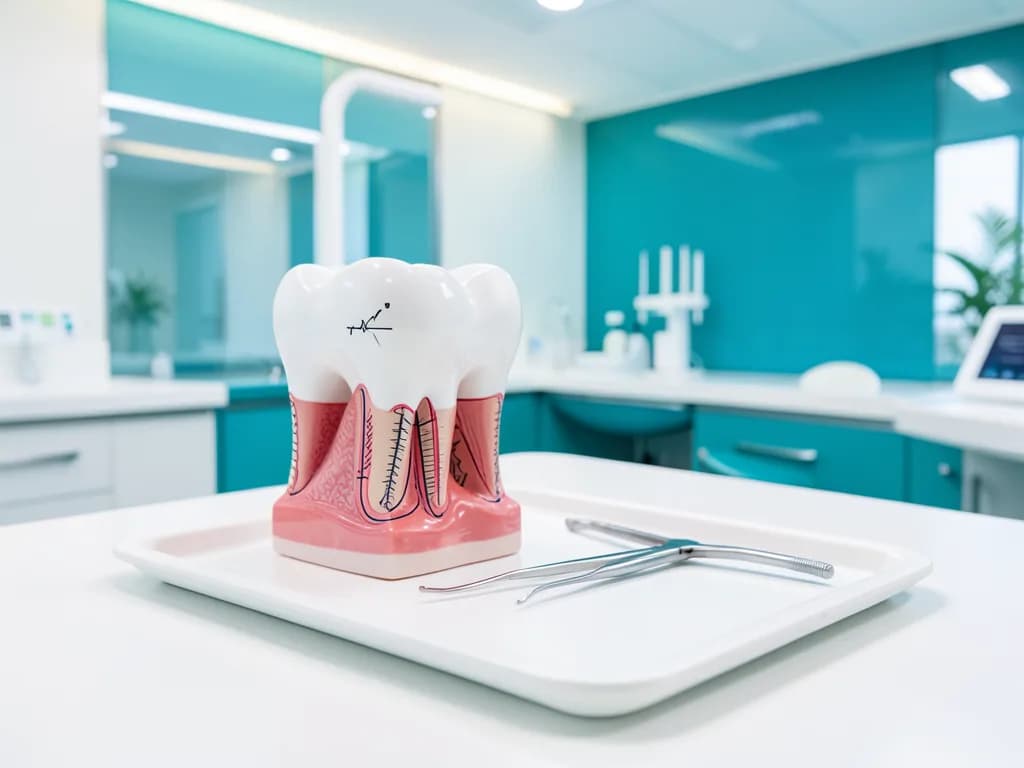
The Myth About Extraction Being Cheaper
Many patients assume extraction is the simple, affordable option. The reality is more complicated.
A root canal followed by a crown typically costs AED 1,800–6,000 depending on the tooth and clinic tier. That same tooth, once extracted, requires a replacement if you want to maintain your bite and facial structure. A dental implant — the gold-standard replacement — costs AED 4,500–8,000 for the implant fixture alone, plus AED 1,200–3,500 for the crown on top, bringing the total extract-and-implant pathway to AED 5,900–12,000.
A three-unit dental bridge costs AED 2,500–5,500 and avoids the implant cost, but requires grinding down the two healthy teeth on either side to serve as anchors — a permanent, irreversible change to teeth that had no problem. A partial denture is the lowest-cost option at AED 1,500–4,000 but is removable and considered the least comfortable long-term solution by most patients.
Dentists across Dubai are consistent in their advice: save the natural tooth wherever possible. The phrase heard most often in dental consultations is "nothing replaces a natural tooth" — and the data on long-term outcomes supports this position firmly.
True Long Term Cost Comparison in Dubai
All prices in AED. Based on Dubai clinic data for 2026. No VAT applies to dental treatments in the UAE.
| Treatment Path | Component Costs (AED) | Total Range (AED) |
|---|---|---|
| Root Canal + Crown (save tooth) | Root canal AED 600–2,500 + Crown AED 1,200–3,500 | 1,800 – 6,000 |
| Extraction + Dental Implant + Crown | Extraction AED 200–500 + Implant AED 4,500–8,000 + Crown AED 1,200–3,500 | 5,900 – 12,000 |
| Extraction + 3-Unit Bridge | Extraction AED 200–500 + Bridge AED 2,500–5,500 | 2,700 – 6,000 |
| Extraction + Partial Denture | Extraction AED 200–500 + Partial denture AED 1,500–4,000 | 1,700 – 4,500 |
| Extraction Only (no replacement) | Simple extraction AED 200–500 / Surgical AED 500–1,200 | 200 – 1,200 |
Root canal cost varies by tooth type — front teeth (AED 600–1,200), premolars (AED 800–1,800), molars (AED 1,200–2,500) at mid-range clinics. See our root canal cost guide and implant cost guide for full breakdowns.
When Root Canal Treatment Is the Right Choice
Choose root canal when
- ✓ The tooth has adequate bone support and is not loose
- ✓ Enough tooth structure remains above the gum for a crown
- ✓ The tooth is a strategic one (molar, canine or front tooth)
- ✓ You want to preserve your natural bite and bone structure
- ✓ The infection has not recurred after previous treatment
- ✓ Your insurance covers restorative root canal treatment
Choose extraction when
- ✗ The tooth structure is too damaged to support a crown
- ✗ Severe bone loss is present and the tooth is mobile
- ✗ Infection has returned after a previous root canal attempt
- ✗ There is a vertical root fracture (non-restorable)
- ✗ Strategic removal before full denture or implant planning
- ✗ Budget constraints require phased treatment over time
Side by Side Comparison
Key factors compared across both treatment paths.
| Factor | Root Canal + Crown | Extraction + Implant |
|---|---|---|
| Short-term cost (AED) | 1,800 – 6,000 | 5,900 – 12,000 |
| Treatment timeline | 2–4 visits over 2–4 weeks | 3–6 months total process |
| Success rate | 90 – 95% | 95 – 98% (implant) |
| Preserves natural tooth | Yes — full preservation | No — tooth removed |
| Bone loss risk | None — root stays in bone | Yes, starts immediately after extraction |
| Insurance (UAE) | 50–80% covered (major restorative) | Implants rarely covered |
| Pain level | Minimal with modern anaesthesia | Extraction minimal; implant surgery moderate |
| Long-term bite stability | Excellent | Excellent (if implant placed promptly) |
Decision Guide — Which Path Is Right for You
This is the textbook indication for root canal treatment. The tooth structure is sound and the nerve infection can be eliminated while preserving everything else.
Without enough crown structure to hold a restoration, saving the tooth is not possible. Extraction followed by implant planning is the standard approach.
Your dentist should assess whether a second root canal (retreatment) or apicoectomy is viable. If the prognosis is poor, extraction may be the more reliable option.
Save the tooth now with root canal and crown; this costs AED 1,800–6,000 versus AED 5,900–12,000 for the extract-and-implant pathway. If extraction is unavoidable, get a temporary denture and plan implant later.
Bone loss compromises the long-term prognosis of root canal treatment significantly. An implant placed after extraction and bone grafting offers a more predictable outcome.
Insurance Coverage for Root Canals and Extractions in Dubai
Root canal coverage
Root canal on front teeth is covered by most UAE health insurance plans at 70–80% after the deductible. Molar root canals are classified as major restorative and typically covered at 50–70% with pre-authorisation required. The subsequent crown is also covered at 50–70% if the tooth has been clinically assessed as non-cosmetic.
Insurers that commonly cover root canals include Daman, AXA, Bupa, MetLife and Nextcare — though annual dental limits (AED 1,000–10,000 depending on plan tier) apply. See our insurance guide for details.
Extraction and implant coverage
Simple extractions are covered at 80–100% by most UAE plans with minimal paperwork. Surgical extractions (impacted or broken roots) are covered at 70–80% and may require pre-authorisation. Dental implants are excluded from almost all standard UAE health insurance plans.
Some premium international plans — Cigna Global, Bupa Global, AXA International — cover implants at 50% up to an annual maximum. Always verify implant coverage with your insurer before committing to treatment.
See our full 2026 dental cost guide or check your insurance coverage.
Related Guides
Frequently Asked Questions
Is a root canal more expensive than extraction in Dubai?
In the short term, a root canal plus crown (AED 1,800–6,000 total) costs more than a simple extraction (AED 200–500). However, when you factor in the cost of replacing the missing tooth — with an implant (AED 4,500–8,000) or bridge (AED 2,500–5,500) — extraction almost always costs more in total. Dentists routinely advise that saving the natural tooth is the more economical long-term choice for most patients.
How long does a root canal take in Dubai?
A root canal in Dubai typically takes one to two appointments of 60–90 minutes each. Single-rooted teeth (front teeth) can often be completed in one session. Multi-rooted teeth such as molars usually require two visits — the first to clean and medicate the canals, the second to fill and seal them. After the root canal, a further appointment is needed to fit the protective crown, adding one to two more visits.
What happens if I extract a tooth and do not replace it?
Leaving a gap after extraction leads to a predictable chain of problems. The teeth either side begin to tilt into the space within months, and the tooth above (or below) starts to over-erupt because it no longer has an opposing tooth to bite against. This misalignment increases the risk of jaw pain, bite problems, and decay in the drifting teeth. Bone loss at the extraction site also begins within weeks and continues for years, which makes later implant placement more complex and costly.
What is the success rate of root canal treatment in Dubai?
Modern root canal treatment has a success rate of 90–95% when performed by a qualified dentist or endodontist. Failure is usually caused by an undetected extra canal, a crack in the root, or inadequate crown sealing after treatment. If a root canal fails, a procedure called an apicoectomy (root-end surgery) can often save the tooth. Dental implants placed after extraction have a slightly higher success rate of 95–98%, but require a significantly longer treatment timeline of 3–6 months.
Does Dubai insurance cover root canals or extractions?
Most UAE health insurance plans cover basic extractions at 80–100% after the deductible, as they are classified as basic restorative procedures. Root canal treatment on front teeth is also typically covered at 70–80%. Root canal on molars and the subsequent crown are classified as major restorative and usually covered at 50–70% with pre-authorisation. Dental implants are excluded from most standard UAE plans, though some premium international plans (Bupa Global, AXA International) cover them at 50%. Always verify with your insurer before committing to treatment.
When is extraction the better choice over a root canal?
Extraction becomes the clinically correct choice when the tooth has too little structure remaining above the gum line to support a crown, when there is severe bone loss causing the tooth to be loose, when infection has recurred after a previous root canal attempt, or when the root is fractured vertically. For patients with very tight budgets and a strategic plan for eventual implant placement, extraction can also be a sensible phased approach — extract now, implant later when finances allow.
Technology and Equipment Used in Root Canal vs Implant Treatment
Root Canal Technology in Dubai
- Periapical and OPG X-rays for initial diagnosis
- CBCT (Cone Beam CT) 3D imaging for complex multi-rooted cases
- Apex locators to precisely measure root canal length
- Nickel-titanium rotary files for faster, more consistent canal shaping
- Dental loupes and microscopes — especially at endodontist clinics
- Ultrasonic irrigation systems to flush bacterial biofilm
- Warm vertical compaction of gutta-percha for superior canal seal
Implant Placement Technology in Dubai
- CBCT 3D scan for bone volume and nerve mapping before implant planning
- Digital implant planning software (Simplant, Straumann CARES, Nobel Clinician)
- Surgical guide stents for guided implant placement accuracy
- Piezoelectric surgery units for atraumatic bone preparation
- Nobel Biocare, Straumann SLActive, or Osstem implant systems
- CAD/CAM crown fabrication — same-day or next-day at select Dubai clinics
- PRF (platelet-rich fibrin) for accelerated osseointegration
For root canal treatment on complex molar cases, an endodontist using a dental operating microscope achieves significantly higher success rates than a general dentist without magnification. Find a specialist endodontist in Dubai for difficult cases, or browse our full dental specialists guide.
Recovery and Aftercare Comparison
After Root Canal Treatment
Day 1–3
Mild tenderness at the treated tooth — manage with ibuprofen 400mg or paracetamol. Avoid chewing on that side until the crown is fitted.
Week 1–2
Temporary filling protects the tooth. Sensitivity reduces. Return to normal eating with care. Avoid hard or crunchy foods on the treated tooth.
Crown fitting (2–4 weeks later)
Crown permanently seals and protects the root-treated tooth. After crown fitting, the tooth functions normally with no restrictions.
Long-term aftercare
Root-treated teeth can become more brittle over time. A crown is essential. Six-monthly check-ups and good oral hygiene preserve the tooth for decades.
After Extraction and Implant Placement
Day 1–3 (extraction)
Significant swelling and discomfort, especially for surgical extractions. Clot must be protected — no rinsing, spitting, or straws. Soft diet.
Week 1–2 (healing)
Socket closes over. Bone resorption begins in the extraction site within weeks. Temporary denture or gap remains visible during this phase.
2–4 months (implant surgery)
Implant placed into jawbone. Sutures for 1–2 weeks. Another period of recovery with soft diet restrictions. Osseointegration period begins.
3–6 months later (crown)
Crown fitted to implant abutment. Total process from extraction to final crown: 5–9 months. Significantly longer recovery pathway than root canal.
Risk Factors for Each Treatment Path
| Risk Factor | Root Canal | Extraction and Implant |
|---|---|---|
| Treatment failure | 5 – 10% — retreatment or apicoectomy may salvage | 2 – 5% implant failure rate; bone graft needed if implant fails |
| Infection risk | Low with antibiotics; higher if access difficult | Dry socket (2 – 5% after extraction); peri-implantitis later |
| Nerve damage | Very rare — mainly lower molar cases | Inferior alveolar nerve injury risk during lower molar extraction/implant |
| Bone loss | None — root maintains bone volume | Begins within weeks of extraction; bone graft may be needed before implant |
| Adjacent tooth damage | Negligible | Tilting of adjacent teeth into gap if replacement delayed |
| Bisphosphonate patients | Safe | Significantly elevated risk of osteonecrosis of jaw (ONJ) — specialist review essential |
Patients on bisphosphonate medications (for osteoporosis) or who have had jaw radiotherapy face specific risks with extractions and implants. Always disclose your full medication history before any dental surgery. See our dental care after cancer guide for specialist considerations.
Long Term Outcomes — What the Evidence Shows
Research consistently shows that natural teeth, even after root canal treatment, outlast implants in the majority of studies that follow patients for more than 10 years. Root-treated teeth with protective crowns and good oral hygiene routinely function for 20 or more years. The natural periodontal ligament — the shock-absorbing connection between tooth and bone — provides proprioception (bite force feedback) that implants cannot replicate.
Dental implants offer excellent outcomes when placed in healthy bone with adequate volume. The five-year success rate for implants placed by experienced operators with proper case selection exceeds 97%. However, implants placed in compromised bone, in patients with uncontrolled diabetes, or in smokers show significantly lower success rates. These same systemic factors are less critical for root canal treatment, making root canal the lower-risk option for medically complex patients.
Bone resorption (bone loss at the extraction site) is the critical long-term consequence of choosing extraction without immediate implant placement. Studies show up to 25% reduction in bone width and 11–22% reduction in bone height within one year of extraction. This affects facial aesthetics and makes later implant placement more complex — often requiring bone grafting (AED 2,000–6,000 per site) to restore adequate volume before an implant can be placed.
What Patients Say About Root Canal vs Extraction
"I nearly had my molar extracted because I thought root canal was too expensive. A second opinion at a different Dubai clinic explained the long-term cost properly. I had the root canal and crown for AED 4,200. Three years later the tooth is fine."
Dubai patient, lower molar root canal, mid-range clinic
"My dentist gave me the full picture including the implant cost if I extracted. Once I understood the real total cost comparison, saving the tooth was clearly the better decision financially and for my bite."
Sharjah patient, upper premolar, root canal plus crown
"The tooth was too far gone — vertical root fracture. Extraction was the only option. I had a temporary partial denture for eight months while saving up, then had the implant done. Looking back I would have maintained better dental hygiene to avoid getting to that point."
Abu Dhabi patient, extraction plus Straumann implant over 10 months
"I chose extraction because I did not have AED 4,500 for root canal and crown at the time. Two years later the adjacent teeth have shifted slightly and my dentist now says I need the implant anyway plus some orthodontic correction. Should have found a way to pay for the root canal."
Expat patient — cautionary experience, no immediate replacement
Illustrative patient experiences. Individual outcomes vary. Always consult a DHA-licensed dentist for your specific clinical situation.
Expert Recommendation — The Dentist Consensus in Dubai
"The single most consistent recommendation across Dubai dental specialists is: save the natural tooth wherever clinically possible."
Endodontists, periodontists, and prosthodontists in Dubai consistently advise that the endodontic retreatment pathway — root canal plus crown — preserves the natural periodontal ligament, maintains bone volume, and avoids the surgical risks and extended timeline of implant placement. The exception is a tooth with a vertical root fracture, severe bone loss causing mobility, or a previously failed root canal where the prognosis of retreatment is poor.
For complex cases where extraction is unavoidable, Dubai oral surgeons recommend immediate or early implant placement (within 4–8 weeks of extraction) to minimise bone loss. This requires careful planning and appropriate bone volume assessment via CBCT scan. Find a dental second opinion before proceeding with extraction of any permanent tooth, or explore our DHA-licensed dentist guide to verify your treating clinician's credentials.
When to see an Endodontist (not just a GP)
- Molar tooth with four or more canals
- Re-treatment of a previously root-filled tooth
- Calcified or curved canals on X-ray
- Tooth with previous failed root canal
- Suspected vertical root fracture
When to see an Oral Surgeon (not just a GP)
- Impacted or partially erupted tooth extraction
- Broken or curved root requiring surgical removal
- Implant placement (especially with bone grafting)
- Extraction near inferior alveolar nerve (lower jaw)
- Sinus lift before upper molar implant
Find a Dentist in Dubai Today
Use our find the right dental clinic to compare clinics, read reviews, and book appointments.
Browse verified clinics offering root canal treatment and implants in Dubai. Compare reviews, check insurance acceptance and book online.