Cracked Tooth Treatment in Dubai — Emergency Guide and Costs
A cracked tooth is one of the most common dental emergencies in Dubai. Whether you have bitten on a hard food, suffered a sports injury or simply noticed an unexplained sharp pain when biting, this guide explains every type of tooth crack, the treatment options available with AED costs, and exactly how quickly you need to see a dentist. For broken tooth emergencies, see our broken tooth Dubai guide.
The 5 Types of Tooth Cracks — From Minor to Severe
Correct identification of the crack type determines urgency and treatment. Not all cracks are emergencies — but some are. Understanding which type you have is the first step.
Craze Lines
Tiny, superficial cracks in the outer enamel layer only. Extremely common — most adults have them. They cause no pain, no sensitivity and require no treatment. They can be mildly unsightly on front teeth, in which case teeth whitening or composite bonding can cosmetically address them. A craze line will never progress to a symptomatic crack without an additional trauma event.
Severity
Cosmetic only — no treatment needed
Urgency
No urgency
Typical Treatment
Monitoring, optional cosmetic bonding
Fractured Cusp
A piece of the tooth's chewing surface (a cusp) breaks off — often around an existing large filling. The fracture is confined to the outer tooth structure and does not involve the pulp (nerve and blood supply). Patients typically notice a loose piece in their mouth. There may be mild sensitivity but not the sharp pain typical of more serious cracks. Treatment is usually a dental crown, which protects the remaining tooth structure.
Severity
Moderate — dental appointment within a week
Urgency
Non-emergency if no severe pain
Typical Treatment
Crown (1,800–4,000 AED)
Cracked Tooth
A crack runs vertically from the chewing surface toward the root. This is the most clinically challenging type — the crack may or may not extend into the pulp. The hallmark symptom is sharp pain on biting or releasing bite pressure ('crack and release' pain), plus sensitivity to cold. If the crack has reached the pulp, root canal treatment is needed before crowning. If it has not yet reached the pulp, a crown alone may save the tooth — but timing is critical, as delays allow the crack to propagate.
Severity
Significant — see a dentist within 48 hours
Urgency
Urgent — delays worsen prognosis
Typical Treatment
Crown (1,800–4,000 AED) or root canal + crown (3,000–6,000 AED)
Split Tooth
An untreated cracked tooth that has propagated until the tooth is split into two distinct segments. Typically caused by biting forces over time on an unprotected crack. The split usually runs through the root, making saving both segments nearly impossible. In some cases one root of a multi-rooted molar can be preserved using a hemisection (surgical separation) — but this is a specialist procedure with a limited prognosis. Most split teeth are extracted.
Severity
Severe — emergency same-day appointment
Urgency
Emergency — extraction likely
Typical Treatment
Extraction (400–800 AED) + implant (7,000–15,000 AED)
Vertical Root Fracture
A crack that begins at the root and extends upward toward the crown — the reverse of a typical crack. Most common in teeth that have had root canal treatment, as devitalised teeth become more brittle. Vertical root fractures often cause few symptoms until the surrounding bone becomes infected. They are frequently only discovered on X-ray. The prognosis is almost always hopeless and extraction is required, followed by replacement options such as an implant or bridge.
Severity
Very severe — extraction required
Urgency
Urgent — see dentist within 48 hours
Typical Treatment
Extraction + replacement (7,000–15,000 AED for implant)
Symptoms of a Cracked Tooth
Cracked tooth symptoms can be intermittent and confusing. Here is what to look for.
Sharp pain when biting or releasing bite pressure
The hallmark of cracked tooth syndrome — classic 'crack and release' pain when the crack flexes open and snaps shut. A diagnostic bite test on a cotton roll isolates the tooth.
Sensitivity to cold (and sometimes heat)
Cold sensitivity is very common. Heat sensitivity, especially when combined with spontaneous aching pain, suggests the pulp is already inflamed or infected.
Intermittent pain — not constant
Early cracked teeth cause pain only during specific activities (biting certain foods, sipping cold drinks). Constant resting pain indicates pulp involvement.
Swelling near the affected tooth
Swelling of the gum, cheek or jaw indicates infection — an abscess has formed from bacteria that have entered through the crack. This requires urgent same-day attention.
Important: Cracked tooth syndrome is notoriously difficult to diagnose — even for experienced dentists. A crack may not be visible on X-ray. Multiple X-ray views, bite tests, cold tests and fibre-optic transillumination are all used. If your dentist cannot immediately identify the cause of your bite pain, ask for a referral to an endodontist or for specialist investigation before accepting the symptoms as unexplained.
When to Call Same Day vs When to Wait
Not every cracked tooth needs an emergency appointment. Use this guide to assess urgency.
| Symptom | Recommended Action | Emergency |
|---|---|---|
| Severe, throbbing pain at rest | Call same day — pulp likely infected | Emergency |
| Visible swelling of the face or jaw | Same-day emergency — possible abscess | Emergency |
| Fever alongside dental pain | Same-day — spreading infection risk | Emergency |
| Tooth has physically split in two | Same-day emergency appointment | Emergency |
| Sharp pain only when biting, no resting pain | Within 24–48 hours — urgent but not critical | Non-urgent |
| Sensitivity to cold that passes quickly | Book appointment within 1 week | Non-urgent |
| Mildly rough or sharp edge, no pain | Routine appointment within 2 weeks | Non-urgent |
| Cosmetically unsightly crack, zero discomfort | Non-urgent — book at convenience | Non-urgent |
Most Dubai dental clinics hold emergency appointment slots each day. Call first thing in the morning and clearly describe your symptoms — most clinics will accommodate urgent cases the same day. For out-of-hours emergencies, see our emergency dentist Dubai guide.
Cracked Tooth Treatment Options with AED Costs
Treatment is matched to crack type and severity. Here is what each option involves.
Dental Bonding
AED 500 – 1,200Hairline cracks and craze lines (cosmetic concern only)
Tooth-coloured composite resin is applied and sculpted to smooth rough edges and improve the cosmetic appearance of surface cracks. A quick, single-appointment procedure. Does not provide structural reinforcement against propagation of deeper cracks.
Dental Crown
AED 1,800 – 4,000Fractured cusp or cracked tooth not yet involving pulp
A crown encircles the entire tooth, preventing the crack from flexing and propagating with each bite. This is the definitive treatment for most cracked teeth. Materials include porcelain-fused-to-metal (PFM), full zirconia and E.max pressed ceramic. Zirconia crowns offer the best combination of strength and aesthetics for posterior teeth.
Root Canal Treatment plus Crown
AED 3,000 – 6,000Crack has reached the pulp causing pulpitis or abscess
The infected or inflamed pulp tissue is removed, the root canal system is shaped, disinfected and sealed with gutta-percha. A crown is then placed to restore and protect the remaining tooth structure. Success rates of 85–95% at 5 years when treatment is completed before the tooth splits. Visit our root canal treatment Dubai page for full details.
Extraction
AED 400 – 800Unsalvageable tooth — split tooth or vertical root fracture
When a crack has split the tooth or extends deep into the root, extraction is the only option. Performed under local anaesthesia as a simple or surgical extraction. After healing (6–8 weeks), the missing tooth is replaced with an implant, bridge or denture.
Dental Implant
AED 7,000 – 15,000Replacement of extracted tooth
A titanium implant is placed in the jaw bone and, after osseointegration (3–6 months), topped with a crown. The gold-standard replacement option — independent of adjacent teeth, bone-preserving, and with a 20+ year success rate with good care. See our dental implants Dubai guide for full details.
Cracked Tooth Treatment Costs in Dubai 2026
All prices in AED. Emergency consultation is always the first step.
| Treatment | AED Range | Notes |
|---|---|---|
| Emergency consultation | AED 150 – 300 | Initial assessment, diagnosis, X-rays |
| Dental bonding (hairline / craze lines) | AED 500 – 1,200 | Cosmetic; per tooth |
| Dental crown (cuspal fracture) | AED 1,800 – 4,000 | Porcelain-fused-to-metal or full zirconia |
| Root canal + crown (pulp involved) | AED 3,000 – 6,000 | Combined cost; varies by tooth type |
| Extraction (unsalvageable tooth) | AED 400 – 800 | Simple or surgical extraction |
| Dental implant (post-extraction) | AED 7,000 – 15,000 | Implant + abutment + crown; single tooth |
| Dental bridge (3-unit) | AED 3,500 – 8,000 | Alternative to implant for missing tooth |
| Temporary crown | AED 300 – 600 | Placed while permanent crown is fabricated |
Prices from Dubai clinic surveys, February 2026. Crown costs vary by material and clinic tier. Specialist clinics may charge 15–30% above general dentist rates.
For a full overview of every dental procedure price, see our 2026 dental cost guide. If your cracked tooth needs a crown, our bridge cost breakdown compares replacement options.
What NOT To Do With a Cracked Tooth
These actions are extremely common — and extremely counterproductive.
Do not chew on the affected side
Every bite applies force that can propagate the crack deeper, turning a salvageable crack into a split tooth requiring extraction.
Do not consume very hot or very cold food and drinks
Thermal changes cause expansion and contraction of the tooth material, worsening crack propagation and triggering severe pain if the pulp is involved.
Do not place aspirin directly on the gum
A common misconception — placing aspirin on the gum does not reach the nerve and causes a chemical burn to the gum tissue. Take pain relief orally as directed.
Do not delay seeing a dentist hoping it will heal
Tooth cracks do not heal on their own. Unlike bone, enamel and dentine cannot regenerate. Delays allow cracks to propagate and convert a treatable crack into an extraction case.
Do not attempt to glue pieces back with household adhesive
Cyanoacrylate (super glue) is toxic to oral tissue, prevents proper dental bonding and can contaminate the fracture site, complicating definitive treatment.
Technology Used to Diagnose and Treat Cracked Teeth in Dubai
Cracked teeth are notoriously difficult to diagnose — the crack may be invisible on standard X-rays. Dubai dental clinics use multiple technologies to identify the type, extent, and depth of a tooth fracture.
CBCT (Cone Beam CT) 3D Imaging
The gold standard for visualising vertical root fractures and deep craze lines. A CBCT scan provides a three-dimensional cross-section of the tooth root at 0.1 mm resolution — revealing fractures that are completely invisible on conventional 2D X-rays. Mandatory before any treatment planning for suspected split tooth or vertical root fracture. Cost: AED 400–800.
Transillumination (Fibre Optic Light)
A high-intensity fibre optic light is shone through the tooth. Light travels normally through intact enamel but is blocked or deflected at fracture lines, making cracks visible. One of the most sensitive and simple first-line diagnostic tools for craze lines and incomplete fractures. Performed in a darkened operatory, takes 1–2 minutes.
Tooth Slooth (Fracture Finder)
A small plastic device with a cusp-shaped tip. The patient bites down on each cusp individually — if biting on a specific cusp produces a sharp pain followed by relief on releasing, this indicates a classic cracked cusp syndrome pattern. Essential for localising exactly which cusp is cracked in an 'incomplete' fracture.
Dye Penetration Testing
Methylene blue dye or other staining agents are applied to the tooth surface and allowed to penetrate for 5 minutes before rinsing. Dye that remains within a fracture line after rinsing confirms the presence and extent of a crack. Particularly useful for fractures within the pulp chamber floor to detect furcation involvement.
Dental Operating Microscope (DOM)
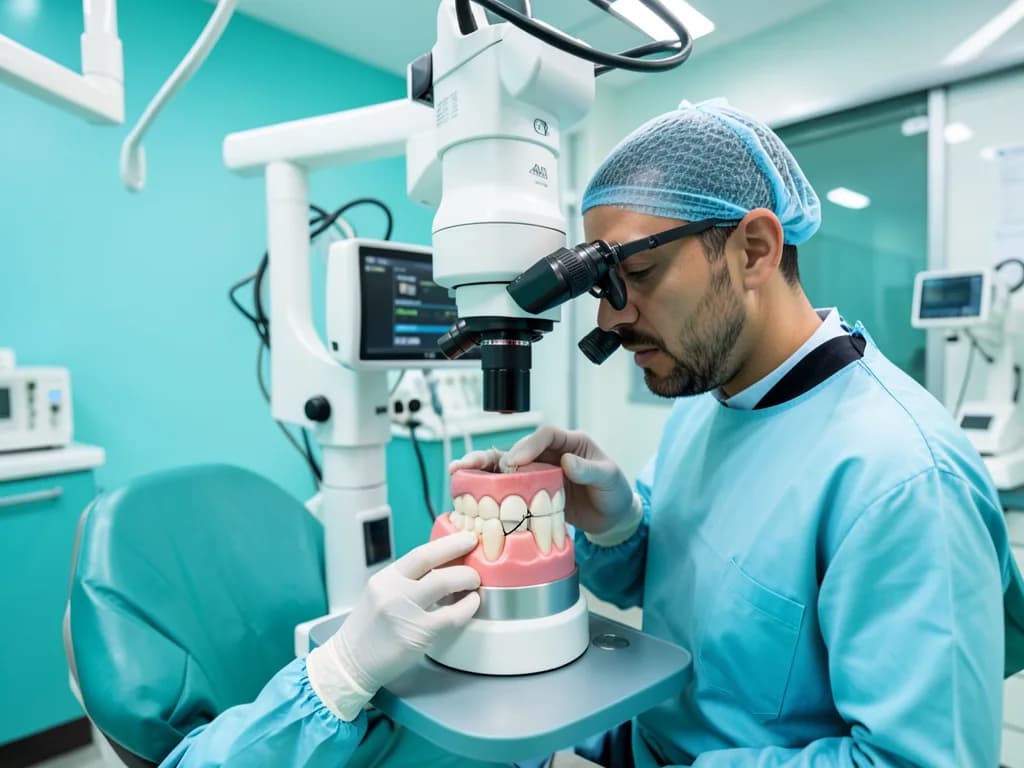
High-magnification (8–20x) illuminated dental microscope used during root canal treatment and crown preparation for cracked teeth. Allows the endodontist to visualise crack lines inside the pulp chamber and root canals, determine if the crack extends into the root, and assess prognosis. Standard equipment at specialist endodontist clinics in Dubai.
Digital Periapical X-Rays
While standard 2D X-rays miss most vertical root fractures, they remain essential for detecting horizontal fractures, bone loss patterns around the root, and periapical pathology (abscess) associated with a cracked tooth. Digital sensors produce instant, low-radiation images. Multiple angulated views increase diagnostic sensitivity.
Before and After Cracked Tooth Treatment — What to Expect
Before Treatment
- ✗ Sharp pain on biting that is difficult to localise
- ✗ Brief, intense pain on releasing bite (classic cracked cusp)
- ✗ Cold and sweet sensitivity lasting more than 20 seconds
- ✗ Ongoing, spontaneous aching without bite trigger (pulpitis)
- ✗ Swelling or abscess near the root tip (advanced crack)
- ✗ Visible crack line or missing cusp in severe cases
- ✗ Avoidance of chewing on the affected side
After Successful Treatment
- ✓ Bite pain eliminated with crown or bonding stabilisation
- ✓ Temperature sensitivity resolved within 2–4 weeks
- ✓ Root canal resolves pulpitis symptoms within 24–72 hours
- ✓ Dental crown restores full chewing function
- ✓ Tooth stabilised — crack prevented from extending
- ✓ Normal bite and occlusion restored
- ✓ Long-term tooth retention with proper crown care
Pain Management During Cracked Tooth Treatment
Emergency appointment and diagnosis
- ✓ Emergency pain relief: ibuprofen 400 mg + paracetamol 500 mg alternating every 4 hours is effective for dental pain
- ✓ Avoid temperature extremes on the affected tooth until seen by dentist
- ✓ Bite splinting or temporary crown at the emergency visit stabilises the crack and provides immediate pain relief
Root canal and crown procedures
- ✓ Root canal treatment performed under local anaesthesia — no pain during the procedure
- ✓ Post-root canal aching for 24–48 hours — managed with ibuprofen and prescribed antibiotics if infection present
- ✓ Crown preparation under local anaesthesia — painless during procedure
- ✓ IV sedation available at specialist centres for patients with dental anxiety — see IV sedation Dubai
Which Dental Specialist Treats a Cracked Tooth in Dubai
General Dentist
First point of contact for most cracked tooth emergencies. Performs diagnostic testing, takes X-rays, places temporary crown, and manages minor cracks with bonding. Refers complex cases to specialists.
Best for: Craze lines, minor chips, initial stabilisation
Endodontist
Root canal specialist. Treats cracked teeth that have progressed to pulpitis or pulp necrosis. Uses dental operating microscopes to assess crack depth inside the root canal system. DHA specialist-licensed in endodontics.
Best for: Cracks requiring root canal, fractured cusps with pulp involvement
Prosthodontist
Crown and bridge specialist. Designs and places the final dental crown after root canal treatment. Manages occlusal rehabilitation where bruxism-related cracking requires multiple crowns or a full-mouth treatment plan.
Best for: Final crown placement, complex cases with multiple cracked teeth
See our dental specialists Dubai directory to find DHA-licensed endodontists and prosthodontists. If you are grinding your teeth and cracking multiple teeth, a custom night guard is essential to prevent further damage.
Cracked Teeth Across Different Age Groups
Children
Children frequently crack or chip teeth from falls, sports injuries, and biting hard objects. Baby teeth (deciduous) with significant fractures may need extraction if the nerve is exposed. Permanent teeth in children should always be assessed urgently — root development may be incomplete (open apex), affecting the choice of root canal technique (apexification vs conventional RCT). Night guards are rarely needed in children as childhood bruxism is usually developmental and self-resolving.
Adults
The most common age group for cracked cusps and cracked tooth syndrome. Risk factors include large old amalgam or composite fillings weakening tooth structure, moderate-to-severe bruxism, and biting hard objects. Adults with cracked teeth from grinding should be assessed for a custom night guard to protect remaining teeth after the cracked tooth is crowned.
Seniors (60+)
Older teeth are more brittle due to decades of use, dehydration of dentine, and large restorations. Vertical root fractures are more common in teeth that have had root canal treatment for many years without a crown. Seniors should have post-and-core restorations with full coverage crowns on all root-canal-treated teeth. Medical history review is important before any surgical treatment — blood thinners, bisphosphonates, and other medications affect treatment planning.
Recovery and Aftercare Following Cracked Tooth Treatment
Avoid chewing on the treated tooth. The temporary crown or bonding is fragile — avoid sticky foods, hard foods, and chewing gum on that side. Some ache and sensitivity as the anaesthetic wears off is expected. Take ibuprofen 400 mg as needed.
After root canal treatment: soreness when biting for 2–5 days is normal and resolves spontaneously. Sensitivity to cold may persist for 1–2 weeks even after a successful root canal as the bone around the root settles. Call the dentist if swelling develops.
Return for permanent crown or final restoration. The temporary crown is replaced with the definitive zirconia or PFM crown. After permanent cementation, bite adjustment may be needed — do not delay this appointment as a high bite causes pain and can damage the tooth.
The crowned tooth no longer feels temperature sensitivity in most cases. Regular 6-monthly checkups with periapical X-rays of the crowned tooth every 1–2 years monitor for any late-developing pathology. If you have been grinding — discuss a night guard to protect the crown and all remaining teeth.
Protect your repaired tooth and remaining teeth with a custom night guard if you grind at night. For related emergency dental issues, see our emergency dentist Dubai guide and dental bridge Dubai guide for replacement options if the tooth cannot be saved.
Insurance Coverage for Cracked Teeth in Dubai
Emergency dental treatment for cracked teeth is typically covered under the UAE DHA Essential Benefits Plan.
Coverage overview
Emergency consultation and X-rays
Covered under emergency dental — all plans
Dental crown (cuspal fracture)
Covered at 50–80% on standard and enhanced plans
Root canal treatment
Enhanced plans; pre-authorisation typically required
Extraction
Covered on all plans as emergency treatment
Temporary crown
Usually included in crown treatment cost
Dental implant (replacement)
Premium plans only; not on basic plans
For full insurer details, see our dental insurance Dubai guide. For implant-specific costs and coverage, see our dental implants Dubai guide.
Frequently Asked Questions
Can a cracked tooth heal on its own?
No. Tooth enamel and dentine cannot regenerate or self-repair. Unlike bone, which has living cells capable of healing, the calcified structure of a tooth is essentially inert once formed. A crack will not close or seal itself — it can only stay the same or worsen over time as biting forces and thermal stresses continue to act on it. The only way to stop a crack from progressing is to place a crown, which binds the tooth structure and prevents the crack from propagating with each bite. This is why dentists advise crowning cracked teeth even before symptoms become severe — waiting until pain is constant typically means the pulp is already infected, requiring root canal treatment before the crown.
How quickly should I see a dentist for a cracked tooth in Dubai?
The urgency depends on your symptoms. If you have severe resting pain, facial swelling, fever, or the tooth has split in two, you need a same-day emergency appointment — call the clinic immediately. Most Dubai dental clinics offer same-day emergency slots. If you have sharp pain only when biting but no resting pain, aim for within 24–48 hours. If you have sensitivity to cold that resolves within a few seconds, book within the week. If you have a small chip with no discomfort, a routine appointment within 2 weeks is appropriate. When in doubt, call the clinic — most will advise you on urgency over the phone based on your symptoms.
Will I need a root canal for a cracked tooth?
Not necessarily — it depends on whether the crack has reached the pulp (the nerve and blood supply inside the tooth). If the crack is confined to the outer tooth structure (enamel and dentine), a crown alone can often save the tooth without root canal treatment. If the crack has extended into the pulp, the pulp tissue becomes inflamed and eventually infected, at which point root canal treatment is required to remove the infected tissue before the crown is placed. The dentist determines this through clinical tests (cold sensitivity, bite tests, electric pulp testing) and X-rays. Catching a crack early — before it reaches the pulp — significantly reduces the complexity and cost of treatment.
What happens if a cracked tooth is left untreated in Dubai?
The crack will progressively worsen under the mechanical forces of biting. A manageable cracked tooth that could be saved with a crown becomes a split tooth requiring extraction. Meanwhile, if the crack reaches the pulp, bacteria enter and cause pulpitis (nerve inflammation) followed by a periapical abscess — infection at the root tip — which causes severe pain, swelling and can spread to adjacent tissues if left untreated. Advanced infections can spread to the jaw, neck and in rare cases become life-threatening. From a financial perspective, a crown at AED 1,800–4,000 compares very favourably to extraction plus implant at AED 7,000–15,000 — acting early always saves money as well as the tooth.
Does UAE dental insurance cover a cracked tooth?
Emergency treatment for cracked teeth is generally covered under the UAE DHA Essential Benefits Plan, which all UAE health insurance plans must include as a minimum. The emergency consultation and X-rays are covered. A crown for a fractured cusp is typically covered on standard and enhanced plans, often at 50–80% after deductible. Root canal treatment is covered on enhanced plans with pre-authorisation from insurers including Daman, AXA, Bupa and MetLife. Extraction is covered. Dental implants as a replacement are covered on some premium plans but not on basic plans. Purely cosmetic bonding for craze lines without symptoms is typically not covered. Always confirm coverage and pre-authorisation requirements with your insurer before treatment.
How do Dubai clinics handle dental emergencies?
Most established dental clinics in Dubai reserve emergency appointment slots each day for urgent cases. Larger group practices and hospital dental departments typically offer same-day emergency appointments during working hours. Some clinics advertise 24-hour emergency hotlines — these connect you to a dentist who can advise you over the phone and, if necessary, arrange an out-of-hours appointment. If you experience a dental emergency outside clinic hours, Dubai public hospitals (Rashid Hospital, Al Maktoum Hospital) have dental emergency departments. When calling a private clinic about a possible emergency, describe your symptoms clearly so the reception team can assess urgency and allocate an appropriate appointment slot.
What is the difference between a cracked tooth and a broken tooth?
A broken tooth (tooth fracture) typically refers to a situation where a visible piece of the tooth has physically separated — you can see and often feel the broken fragment. A cracked tooth has a fracture line running through the tooth structure that has not yet resulted in complete separation of a fragment. Both require prompt dental attention, but a broken tooth where a large cusp has detached is often more immediately obvious. Cracked teeth can be more diagnostically challenging because the crack may not be visible to the naked eye or on routine X-rays — specialised fibre optic transillumination is sometimes needed. If a piece of tooth has broken off, bring the fragment to the clinic in a container of milk or water — it may be re-bonded if the piece is intact and the fracture site is clean.
Find an Emergency Dentist in Dubai
Same-day emergency appointments, verified clinics, insurance accepted. Compare dentists near you and book online. Or find a dentist near you in Dubai to explore all treatment options.