Dental Crowns in Dubai — The Complete Guide
A dental crown covers a damaged or weakened tooth to restore its function and appearance. This guide covers every crown type available in Dubai — zirconia, PFM, CEREC same-day, and full metal — with AED cost comparisons, step-by-step procedure detail, and honest lifespan expectations. For pricing across all treatments, see our 2026 dental cost guide.
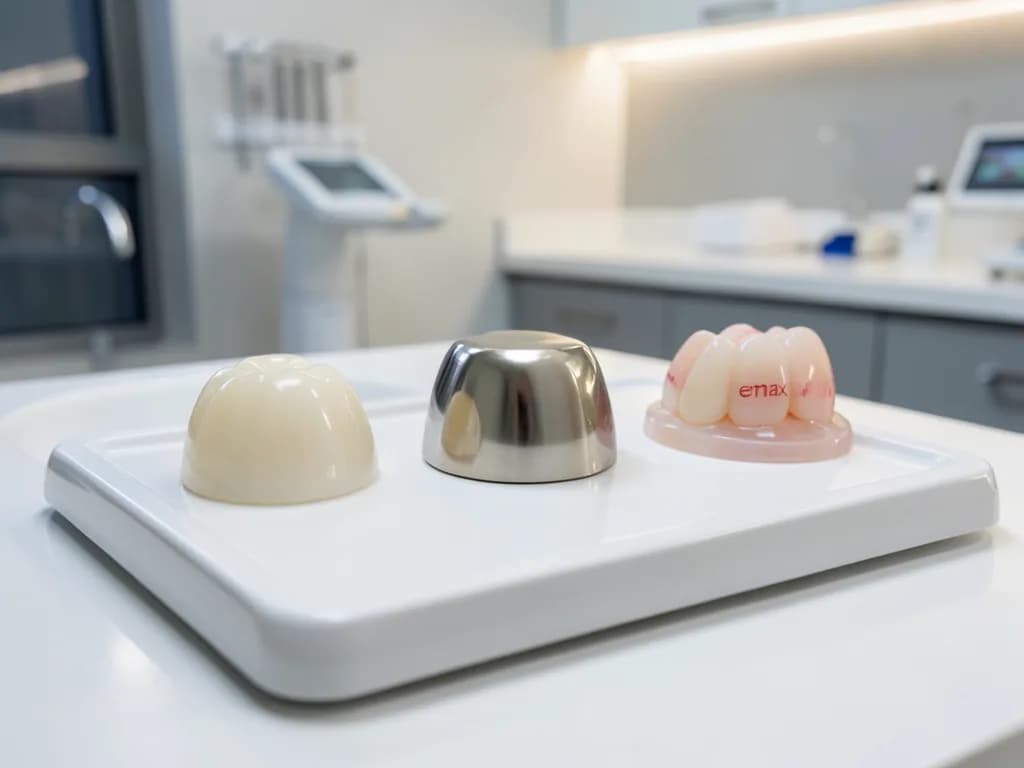
What Is a Dental Crown?
A dental crown is a tooth-shaped cap cemented over a damaged or weakened tooth to restore its shape, strength, and appearance. Crowns are made from zirconia, porcelain, or E-Max ceramic.
When Is a Dental Crown Needed?
A dental crown (also called a cap) is a custom-made restoration that fits over a prepared tooth and covers it entirely from gumline upwards. Unlike a filling — which fills a cavity within the tooth — a crown replaces the entire outer structure of the tooth above the gum, distributing bite forces across its full surface rather than concentrating them at a restoration margin.
Crowns are prescribed when a tooth is too damaged for a filling to provide adequate support or when the risk of tooth fracture is high. They are also used after root canal treatment and as part of cosmetic dentistry for heavily discoloured or malformed teeth.
Large cavity that cannot be restored with a filling
Cracked or fractured tooth with intact root
After root canal treatment to protect the weakened tooth
Broken cusp where insufficient tooth remains for a filling
Severely worn teeth from bruxism or acid erosion
Cosmetic improvement of a severely discoloured or misshapen tooth
As the cap on a dental implant (implant-supported crown)
Types of Dental Crowns Available in Dubai
Dubai clinics offer all major crown materials. The right choice depends on the tooth position, the amount of remaining structure, aesthetics, budget and longevity goals.
A porcelain-fused-to-metal (PFM) crown — also called a metal-ceramic crown — has a metal alloy substructure covered with a layer of tooth-coloured porcelain. PFM crowns were the gold standard for decades and are still widely placed in Dubai. The metal core provides strength while the porcelain layer provides aesthetics. A dark grey line at the gum margin (the metal substructure) can become visible over time as gums recede, which is a cosmetic limitation for front teeth. PFM crowns remain a cost-effective restorative option for posterior teeth where the metal margin is not visible.
Advantages
- ✓ Durable and proven technology
- ✓ Good aesthetics for back teeth
- ✓ Lower cost than full ceramic
Limitations
- ✗ Metal margin can show at gumline
- ✗ Less translucent than all-ceramic
- ✗ Porcelain can chip from metal
Zirconia is the most widely recommended crown material in Dubai today. Milled from a solid block of zirconia ceramic — the hardest dental ceramic available — it is completely metal-free and highly biocompatible. Modern monolithic zirconia (BruxZir and similar high-translucency formulations) has excellent aesthetics and is suitable for both front and back teeth. Layered zirconia offers even more nuanced characterisation for highly visible smile-zone teeth. Preferred by prosthodontists for its strength, aesthetics and absence of allergic risk.
Advantages
- ✓ Strongest dental ceramic
- ✓ Metal-free and biocompatible
- ✓ Excellent aesthetics — no dark margin
- ✓ 15–25 year lifespan
Limitations
- ✗ Higher cost than PFM
- ✗ Cannot be repaired if chipped — must replace
- ✗ Very hard — can wear opposing natural teeth if not polished
CEREC (Chairside Economical Restoration of Esthetic Ceramics) uses in-clinic CAD/CAM (computer-aided design and manufacturing) technology to design and mill a ceramic crown in a single 2-hour appointment. A digital impression via intraoral scanner — iTero, CEREC Omnicam or Trios — replaces the traditional putty impression. The chairside milling unit fabricates the crown from a ceramic block while you wait, eliminating the need for a temporary crown and a second visit. This same-day crown workflow is available at select Dubai clinics equipped with the CEREC or similar CAD/CAM system.
Advantages
- ✓ Completed in one appointment
- ✓ No temporary crown needed
- ✓ Digital precision — no impression material
Limitations
- ✗ Higher per-crown cost
- ✗ Material choice limited to clinic's block inventory
- ✗ Not available at all clinics
Gold alloy crowns are the most durable dental restoration ever made — documented lifespans of 30+ years are not unusual. They require the least tooth reduction of any crown type and are extremely gentle on opposing teeth. The obvious limitation is aesthetics — they are only suitable for posterior teeth that are not visible when smiling. Base metal alloys provide similar durability at lower cost.
Advantages
- ✓ Exceptional longevity (20–40+ years)
- ✓ Least tooth structure removed
- ✓ Gentle on opposing teeth
- ✓ Resistant to fracture
Limitations
- ✗ Highly visible metallic colour
- ✗ Not suitable for visible teeth
- ✗ Gold alloy is expensive material
Crown Types at a Glance
Side-by-side comparison of all crown materials available in Dubai.
| Factor | PFM | Zirconia ★ | CEREC | Full Metal |
|---|---|---|---|---|
| Cost (AED) | 900 – 1,800 | 1,500 – 3,500 | 2,000 – 4,000 | 600 – 1,200 |
| Lifespan | 10–15 years | 15–25 years | 10–15 years | 20–40 years |
| Appointments | 2 visits | 2 visits | 1 visit (same day) | 2 visits |
| Metal-free | No | Yes | Yes | No |
| Aesthetics | Good (dark margin possible) | Excellent | Very good | Poor (metallic colour) |
| Best for | Back teeth, budget | Any tooth, longevity | Convenience | Back teeth, maximum durability |
★ Most recommended material in Dubai for most patients.
The Dental Crown Procedure Step by Step
Traditional lab-fabricated crowns require two appointments. CEREC same-day crowns are completed in one extended visit of 2–3 hours.
Examination and Treatment Planning
Your dentist or prosthodontist examines the tooth with clinical probing and periapical X-ray to assess the remaining tooth structure, root health and bone levels. If significant decay is present, this is removed and a core buildup placed before crown preparation begins. If the tooth has had a root canal, a post and core build-up may be needed first to provide adequate structure for the crown to grip. For implant-supported crown cases, the implant abutment is checked for position. This appointment determines which crown type — onlay, partial crown (3/4 crown), full coverage crown, or implant-supported crown — is appropriate.
Tooth Preparation
Under local anaesthesia, the tooth is reduced on all surfaces by 1.5–2 mm to create space for the crown wall and occlusal surface. A retraction cord is placed around the gum margin to expose the preparation margin cleanly. The amount of reduction depends on the crown material — full metal crowns require the least reduction, while PFM crowns require slightly more. The resulting shape is tapered to allow the crown to seat fully.
Impression or Digital Scan
A precise impression (polyvinyl siloxane or polyether material) or an intraoral digital scan (iTero, CEREC Omnicam, Trios) of the prepared tooth and surrounding teeth is taken. For CEREC same-day crowns, the digital impression feeds directly into the CAD/CAM design software — no laboratory involvement needed. For lab-fabricated crowns, the opposing arch is also recorded to capture the bite relationship, and the data is sent to the dental laboratory with a detailed shade prescription. A skilled prosthodontist or restorative dentist will specify exact material, shade tabs, and surface characterisation. The lab fabricates the crown over the following 7–14 working days.
Temporary Crown Placement
A provisional restoration (temporary crown) is fabricated chairside from PMMA resin or bis-acryl composite and cemented with temporary cement. This temporary crown — also called a provisional — protects the prepared tooth, maintains the space, and allows you to eat normally during the fabrication period. With CEREC same-day crowns, this temporary crown phase is eliminated entirely. Traditional provisional crowns must be treated with care — avoid sticky foods and be gentle when flossing around them.
Crown Try-In and Adjustment
The finished crown is tried on the tooth without cement to verify the fit, marginal seal, contact with neighbouring teeth, and occlusion (bite). Your dentist checks for any high spots using articulating paper. Adjustments are made before cementation. Shade is verified in natural light and with patient approval.
Final Cementation
The tooth surface is cleaned and prepared with an appropriate primer or adhesive (for ceramic crowns) or simply dried (for metal crowns). The crown is filled with cement — resin cement for ceramic crowns, glass ionomer or zinc phosphate for metal crowns — and seated fully with firm pressure and a biting stick. Excess cement is removed with a probe and floss while still pliable. The bite is rechecked after cementation.
Dental Crown Prices in Dubai 2026
All prices in AED per crown. Crown cost does not include root canal treatment, post and core build-up, or post-placement X-rays. See full pricing at our 2026 dental cost guide.
| Crown Type | Price Range (AED) | Lifespan | Notes |
|---|---|---|---|
| Porcelain-fused-to-metal (PFM) crown | AED 900 – 1,800 | 10–15 years | Good strength; dark margin possible |
| All-ceramic zirconia crown | AED 1,500 – 3,500 | 15–25 years | Best overall; most popular in Dubai |
| CEREC same-day ceramic crown | AED 2,000 – 4,000 | 10–15 years | One visit; selected Dubai clinics only |
| Full metal (gold) crown | AED 600 – 1,200 | 20–40 years | For posterior teeth only |
| Temporary crown | AED 100 – 300 | 2–3 weeks | Between preparation and final placement |
Prices from Dubai clinic surveys, February 2026. Premium clinics in DIFC or JBR may charge 20–40% above mid-range figures.
Need an implant-supported crown instead? See our dental implant cost guide or compare with dental bridge pricing for multi-tooth replacements.
Crown Maintenance and Aftercare
Daily care
- ✓ Brush twice daily at the crown margin at the gumline
- ✓ Floss or use an interdental brush daily
- ✓ Use fluoride toothpaste — the underlying tooth root can still decay
- ✓ Attend six-monthly check-ups for crown margin assessment
What to avoid
- ✗ Biting very hard foods (ice, bones, hard nuts) with the crown
- ✗ Using crowned teeth to open packaging
- ✗ Grinding without a night guard — critical for crown longevity
- ✗ Abrasive whitening toothpastes — do not whiten ceramic
Bruxism (teeth grinding): If you grind your teeth at night, a custom-fitted night guard is strongly recommended after any crown placement. Grinding generates 2–3 times normal bite force and is the leading cause of premature crown fracture and debonding. Night guards are available from most Dubai dental clinics (AED 400–1,000).
Does UAE Insurance Cover Dental Crowns?
Restorative crowns are usually covered
UAE health insurance plans generally cover dental crowns when placed for functional restorative reasons. Most plans reimburse or directly bill for a basic PFM or metal crown. If you choose a zirconia or ceramic upgrade, you typically pay the difference between the insurance-approved rate and the actual crown cost. Pre-authorisation is required by most major insurers. Purely cosmetic crowns are excluded.
See our dental insurance Dubai guide for plan-by-plan breakdown, or our dental crown cost guide for a full price breakdown by material.
Dental Crown Cost in UAE
The dental crown cost in UAE depends on the crown material, the clinic location, and whether additional procedures such as root canal treatment or a post and core build-up are needed. Understanding the full dental crown cost in UAE helps patients budget accurately and avoid unexpected expenses. The UAE dental market is competitive, and patients can find quality dental crown treatment at a wide range of price points across Dubai, Abu Dhabi, and Sharjah.
The most affordable dental crown option in the UAE is a full metal crown at AED 600 to 1,200, suitable for back teeth where aesthetics are not a concern. Porcelain-fused-to-metal crowns cost AED 900 to 1,800 and have been the standard choice for decades. The most popular dental crown in the UAE today is the all-ceramic zirconia crown at AED 1,500 to 3,500 — it is metal-free, biocompatible, and offers the best combination of strength and aesthetics. CEREC same-day crowns cost AED 2,000 to 4,000 and are completed in a single appointment.
When calculating the total dental crown cost in UAE, patients should factor in the consultation fee (AED 100 to 500, often credited toward treatment), X-rays (AED 50 to 200), root canal treatment if required (AED 1,200 to 3,500), and the temporary crown (AED 100 to 300). Some clinics offer package pricing that bundles these costs together. The dental crown cost in UAE is generally 40 to 60 percent lower than equivalent treatment in the UK, Europe, or the United States, making the UAE an attractive destination for dental tourism.
| Treatment Component | Cost Range (AED) | |
|---|---|---|
| Consultation and X-ray | 100 – 500 | Often credited toward treatment cost |
| Root canal (if needed) | 1,200 – 3,500 | Depends on tooth and number of canals |
| Post and core build-up | 500 – 1,200 | Required after root canal on back teeth |
| PFM dental crown | 900 – 1,800 | Good strength; dark margin possible |
| Zirconia dental crown | 1,500 – 3,500 | Most popular; best all-round choice |
| CEREC same-day dental crown | 2,000 – 4,000 | Single appointment; no temporary needed |
| Full metal (gold) dental crown | 600 – 1,200 | Maximum durability; back teeth only |
| Temporary crown | 100 – 300 | Worn during lab fabrication period |
Dental crown cost in UAE as of February 2026. Prices may vary by emirate and clinic tier.
For a comprehensive price breakdown, see our dental crown cost guide or compare across all treatments in our 2026 dental cost guide.
Crown Dental Clinics in Dubai
Dubai has hundreds of dental clinics offering crown treatments, but not all crown dental clinics are equal in quality, technology, or pricing. The best crown dental clinics in Dubai combine experienced prosthodontists or restorative dentists with modern CAD/CAM technology and reputable dental laboratories. When choosing a crown dental clinic, the quality of the dentist-laboratory relationship is one of the most important factors — it directly affects how well your dental crown fits, functions, and looks.
Many crown dental clinics in Dubai now offer same-day CEREC crowns using in-clinic milling technology, eliminating the need for a temporary crown and a second appointment. This is particularly convenient for patients visiting Dubai for dental tourism or busy professionals who cannot take multiple days off work. Leading crown dental clinics in areas like Jumeirah, Dubai Marina, Downtown, Al Barsha, and Business Bay offer competitive pricing on zirconia and ceramic crowns with warranties ranging from 3 to 5 years.
To find the best crown dental clinic for your needs, consider these key factors: DHA licensing and clinic accreditation, the availability of in-house CEREC or CAD/CAM technology, the range of crown materials offered, transparent pricing with no hidden fees, positive verified patient reviews specifically mentioning crown treatment, and the warranty or guarantee provided on the crown. Our clinic comparison tool allows you to search for crown dental clinics by location, insurance acceptance, and patient ratings.
What to Look for in a Crown Dental Clinic
- ✓DHA-licensed dentist with restorative or prosthodontic experience
- ✓In-house CAD/CAM or CEREC same-day crown technology
- ✓Partnership with reputable dental laboratory
- ✓Written warranty on crown work (3 to 5 years minimum)
- ✓Transparent pricing with itemised quotes
- ✓Verified patient reviews mentioning crown longevity and fit
Red Flags to Avoid
- ✗Clinic refuses to specify crown material or laboratory used
- ✗Quotes significantly below market rate without explanation
- ✗No X-ray or clinical assessment before crown recommendation
- ✗Pressure to commit to treatment at the first consultation
- ✗No warranty or guarantee on crown work
- ✗Reviews mentioning poor fit, repeated adjustments, or early failure
Browse verified crown dental clinics in our clinic directory or read our guide to finding a top-rated dental clinic in Dubai. For specialist crown treatment, consider a cosmetic dentist or top-rated clinics in the UAE.
Crown Material Comparison in Dubai
Choosing the right crown material is the single most important decision in your treatment plan. Each material has distinct strengths depending on the tooth location, your bite pattern, and your budget. The table below compares the four main crown materials available at Dubai dental clinics in 2026, with current AED pricing, expected lifespan, and the best clinical use case for each.
E-Max crowns have become the preferred option for front teeth among cosmetic dentists in Dubai because of their superior light transmission, which produces the most natural-looking result. Zirconia remains the workhorse material for molars and premolars where strength matters more than translucency. PFM crowns are still widely placed due to their lower cost, though the dark metal margin that can appear over time has reduced their popularity for visible teeth. Gold crowns are rarely requested for cosmetic reasons but remain the longest-lasting crown material ever documented in clinical studies.
| Material | Cost (AED) | Lifespan | Best For | |
|---|---|---|---|---|
| E-Max (lithium disilicate) | 1,200 – 4,000 | 10–15 years | Front teeth, smile zone | Excellent — best translucency |
| Zirconia | 1,300 – 2,000 | 15–25 years | Back teeth, bridges | Very good — strongest ceramic |
| Porcelain-Fused-to-Metal (PFM) | 1,800 – 2,500 | 10–15 years | Budget-friendly option | Good — dark margin risk |
| Gold alloy | 2,000 – 3,500 | 20–40 years | Back teeth, bruxism patients | Poor — metallic colour |
Crown material pricing in Dubai as of March 2026. Prices vary by clinic location and dentist experience.
For a full price breakdown by material, see our dental crown cost guide. Comparing E-Max and zirconia? Our E-Max vs zirconia crowns guide covers every clinical scenario in detail.
Dental Crown vs Veneer
Patients often ask whether they need a crown or a veneer for their front teeth. The answer depends entirely on the structural condition of the tooth, not on personal preference. Understanding the difference between a crown and a veneer helps you have a more informed conversation with your dentist and set realistic expectations for the outcome.
A dental crown wraps around the entire tooth from all sides and is a restorative treatment. It is placed when the tooth has been weakened by decay, a large filling, fracture, or root canal treatment. The dentist removes 1.5 to 2 mm of tooth structure on all surfaces to make room for the crown. A veneer, by contrast, covers only the front-facing surface of the tooth. It is a cosmetic treatment placed on healthy teeth that have minor cosmetic imperfections such as discolouration, slight chips, or gaps. Veneer preparation removes only 0.3 to 0.5 mm from the front surface, preserving significantly more natural tooth structure.
| Factor | Dental Crown | Dental Veneer |
|---|---|---|
| Coverage | Entire tooth (360 degrees) | Front surface only |
| Purpose | Restorative — strengthens weakened tooth | Cosmetic — improves appearance of healthy tooth |
| Tooth reduction | 1.5–2 mm all surfaces | 0.3–0.5 mm front surface |
| Cost (AED) | 900 – 4,000 | 1,800 – 6,000 |
| Lifespan | 10–25 years (material dependent) | 10–20 years |
| Reversible | No | No (prep veneers) / Yes (no-prep) |
| Best for | Damaged, root-canalled, or fractured teeth | Healthy teeth with cosmetic concerns |
In many smile makeover cases, dentists use a combination of crowns and veneers across different teeth. For example, a patient might receive crowns on two root-canalled molars and veneers on four healthy front teeth. The choice is driven by clinical need, not by cost alone. A veneer placed on a tooth that actually needs a crown will fail prematurely because it cannot provide the structural support the weakened tooth requires.
Read our full comparison at veneers vs crowns Dubai or explore our dental veneers guide for porcelain, composite, and no-prep veneer options.
Crown Lifespan and When to Replace
A well-made dental crown placed by a skilled dentist using quality materials can last for many years, but no crown lasts forever. Understanding the typical lifespan of each crown material and recognising the warning signs that indicate replacement is needed helps you plan financially and avoid sudden emergencies.
Expected Crown Lifespans
- •E-Max (lithium disilicate) — 10 to 15 years
- •Monolithic zirconia — 15 to 25 years
- •Porcelain-fused-to-metal — 10 to 15 years
- •Gold alloy — 20 to 40+ years
- •CEREC same-day ceramic — 10 to 15 years
Signs You Need a Crown Replacement
- •Visible gap or dark line between crown and gum
- •Crown feels loose or moves when you bite
- •Pain or sensitivity when chewing on the crowned tooth
- •Visible crack or chip in the crown surface
- •Recurring food impaction around the crowned tooth
- •X-ray shows decay under the crown margin
The three biggest factors that shorten crown lifespan are poor oral hygiene (leading to decay at the crown margin), untreated bruxism (grinding wears and fractures crowns prematurely), and biting hard objects such as ice, bones, and pen caps. Patients who wear a custom night guard, maintain excellent brushing and flossing habits, and attend regular dental check-ups consistently get the maximum lifespan from their crowns.
When a crown does need replacement, the dentist removes the old crown, evaluates the remaining tooth structure, and determines whether a new crown can be placed directly or whether additional treatment such as a post and core build-up is required first. Most teeth can support two to three crown replacement cycles before the remaining tooth structure becomes too small. At that point, a dental implant may be the recommended alternative.
For implant options, see our dental implants cost guide. If your crown is part of a bridge, read our dental bridge guide for bridge-specific replacement considerations.
Crown Preparation, Tooth Reduction and Core Buildup
Crown preparation — also called tooth reduction — is the clinical process of reshaping a tooth to receive a crown. The amount of tooth structure removed depends on the crown material and the clinical situation. Understanding this process helps patients know what to expect and why certain materials cost more than others.
How much tooth is removed?
- Full metal (gold) crown1.0–1.5 mm — least reduction
- PFM crown1.5–2.0 mm — standard reduction
- Zirconia (monolithic)1.5–2.0 mm — same as PFM
- E.max (lithium disilicate)1.5–2.0 mm — slightly more on occlusal
- CEREC same-day crown1.5–2.0 mm — same as conventional
Core buildup — when is it needed?
A core buildup is a foundation restoration placed before crown preparation when significant tooth structure has been lost to decay or fracture. Without adequate tooth structure, the crown has nothing to grip. A core buildup restores the tooth to an acceptable shape for crown preparation and typically adds AED 200–500 to the total cost.
- ✓ Required when more than 50% of tooth structure is missing
- ✓ Post-root-canal teeth almost always need a post and core buildup
- ✓ Composite resin or glass ionomer material commonly used
- ✓ Billed separately from the crown — always ask upfront
Bite adjustment (occlusal equilibration) after crown placement
After a crown is cemented, your dentist checks your bite (occlusion) using coloured articulating paper. Any high spots are ground away in a process called occlusal equilibrationor bite adjustment. A crown that sits too high causes pain, headaches, and can fracture the crown or cause the opposing tooth to be worn prematurely.
If your bite feels slightly off after leaving the clinic, contact your dentist within a few days for a free bite adjustment appointment. Do not leave a high bite unchecked — it places excessive stress on the crown and the periodontal ligament surrounding the tooth.
Crowns on implants (implant-supported crowns) use a different workflow — see our dental implants Dubai cost guide. For bridge-related crown preparation across multiple teeth, see our dental bridge cost Dubai guide.
Implant Crown vs Conventional Crown on a Natural Tooth
An implant-supported crown replaces a completely missing tooth. A titanium implant post is placed into the jawbone and, once integrated (osseointegration takes 3–6 months), a custom crown is attached to the implant abutment. This is different from a conventional crown, which is placed over a damaged but still-present natural tooth.
| Factor | Conventional Crown | Implant Crown |
|---|---|---|
| Requires natural tooth root | Yes — crown placed over existing root | No — implant replaces the root entirely |
| Cost (AED) | 600 – 4,000 for the crown | 5,500 – 12,000 (implant + abutment + crown) |
| Treatment duration | 1–2 weeks (conventional) or same day (CEREC) | 3–8 months (includes osseointegration period) |
| Bone preservation | Preserves existing root — no bone loss | Actively stimulates bone — best for missing tooth sites |
| Adjacent teeth | No effect (crown on natural tooth) | No adjacent teeth involved |
| Longevity | 10–25 years depending on material | 20–25+ years (implant may be permanent) |
| When used | Damaged, cracked or post-RCT tooth with intact root | Missing tooth (extracted, knocked out, or congenitally absent) |
A cantilever bridge and Maryland (resin-bonded) bridge are two alternatives to both conventional crowns and implant-supported crowns for replacing a single missing tooth without implant surgery. A Maryland bridge bonds to the back of adjacent teeth with minimal tooth preparation. A cantilever bridge uses only one abutment tooth instead of two. Both are lower cost alternatives (AED 1,500–4,000) with shorter lifespan and are primarily suitable for front teeth with light bite forces.
See our dental implants Dubai guide for full implant pricing and procedure details, or browse implant-trained dentists in Dubai.
Same-Day CEREC Crowns in Dubai
CEREC (Chairside Economical Restoration of Esthetic Ceramics) technology allows dentists to design, fabricate, and place a permanent ceramic crown in a single appointment lasting 2 to 3 hours. This eliminates the traditional two-visit workflow that requires a temporary crown and a 7 to 14 day waiting period for laboratory fabrication. For busy professionals, frequent travellers, and dental tourists visiting Dubai on a short trip, same-day CEREC crowns offer significant convenience advantages.
The CEREC process works as follows. After the tooth is prepared under local anaesthesia, the dentist takes a digital scan using an intraoral camera. This scan replaces the traditional putty impression, which many patients find uncomfortable. The 3D scan is loaded into the CEREC design software, where the dentist designs the crown shape, adjusts the contact points with neighbouring teeth, and refines the bite surface. Once the design is finalised, the data is sent to the in-clinic milling unit, which carves the crown from a solid block of ceramic (typically lithium disilicate or hybrid ceramic) in about 15 to 20 minutes.
After milling, the dentist applies custom stains and glaze to match the shade of your surrounding teeth, then fires the crown in a small furnace to harden the surface. The finished crown is tried on the tooth, adjustments are made, and it is cemented permanently. The entire process from preparation to cementation takes approximately 2 to 3 hours. You leave the clinic with a permanent crown — no temporary, no second appointment.
CEREC Crown Pricing in Dubai
Single CEREC crown: AED 2,000 – 4,000
Multiple CEREC crowns (same visit, per tooth): AED 1,800 – 3,500 — some clinics offer volume pricing
The CEREC price typically includes the digital scan, design, milling, staining, and cementation. No separate temporary crown charge applies since no temporary is needed.
Not all Dubai clinics offer CEREC crowns because the equipment requires a significant investment (the scanner, design software, and milling unit). Clinics that have made this investment are typically mid-range to premium practices in areas like Jumeirah, Downtown Dubai, Dubai Marina, and Business Bay. Ask your dentist during the consultation whether CEREC is available and whether your specific tooth is suitable for a same-day crown — some clinical situations, such as very deep margins or highly complex multi-unit bridges, may still be better served by traditional laboratory fabrication.
Compare same-day crown clinics in our clinic directory. For a cost comparison of all crown types, see the dental crown cost guide.
Risks and Potential Complications of Dental Crowns
Dental crowns are among the most predictable and reliable restorations in dentistry, with high long-term success rates across all materials. However, being aware of potential complications allows patients to recognise problems early and seek timely treatment.
Possible complications
- Crown loosening or debonding: Rare with permanent cement — re-cemented easily if tooth structure is intact
- Porcelain chipping: Most common in layered ceramic; zirconia monolithic crowns are extremely fracture-resistant
- Allergic reaction to metal (PFM): Very rare; eliminated by choosing zirconia or E.max crowns
- Nerve irritation after preparation: May require root canal treatment on a small percentage of heavily prepared teeth
- Secondary decay at crown margin: Caused by poor oral hygiene — emphasises need for regular check-ups
Expected crown lifespan by material
- Zirconia (monolithic)— Most durable ceramic15–20 years
- E.max (lithium disilicate)— Best aesthetics, front teeth10–15 years
- IPS e.max layered— Superior translucency10–15 years
- PFM— Proven technology10–15 years
- Full gold alloy— Maximum longevity20–40+ years
The best way to maximise crown lifespan is excellent oral hygiene, regular six-monthly check-ups, and wearing a night guard if you grind your teeth. For more details on materials, see our E-Max vs zirconia guide.
Dental Crowns vs Veneers vs Bonding
Patients often struggle to understand when they need a crown versus a veneer versus composite bonding. The answer depends entirely on how much tooth structure is lost and the clinical purpose of the restoration. Understanding the differences helps you have a more informed conversation with your prosthodontist or restorative dentist.
| Factor | Crown | Veneer | Bonding |
|---|---|---|---|
| Coverage | Full tooth (360°) | Front surface only | Spot repair |
| Purpose | Restorative (structural) | Cosmetic (aesthetics) | Minor cosmetic repair |
| Tooth reduction | 1.5–2 mm all sides | 0.3–0.5 mm front | None required |
| Best for | >50% tooth structure lost | Healthy teeth, discolouration | Small chips, gaps |
| Cost (AED) | 600 – 4,000 | 1,800 – 6,000 | 300 – 1,500 |
| Lifespan | 10–25+ years | 10–20 years | 5–10 years |
| Reversible | No | No (prep) / Yes (no-prep) | Yes |
A crown is indicated when more than 50% of the tooth structure is lost — due to decay, fracture, or after root canal treatment. Veneers are for cosmetically unsatisfactory but structurally healthy teeth: discolouration, minor chips, or slight spacing. Composite bonding offers a reversible, no-preparation solution for very minor chips and gaps, though it has shorter longevity.
Read our dedicated comparisons: dental veneers Dubai · veneers vs crowns · dental bonding Dubai
How Painful Is Getting a Dental Crown?
Getting a dental crown is not painful. The tooth preparation is performed under local anaesthesia — you will feel pressure and vibration but no pain. If you feel anything sharp during preparation, tell your dentist immediately so additional anaesthetic can be administered.
Local anaesthesia — pressure felt but no pain. Preparation takes 30–60 min.
1–2 weeks with temporary provisional — sensitivity to temperature is normal and resolves.
Permanent crown should feel natural within days. No ongoing sensitivity expected.
CEREC advantage: Same-day CEREC crowns eliminate the temporary crown phase entirely. You leave with a permanent crown in one 2–3 hour visit, avoiding the sensitivity and inconvenience associated with wearing a temporary provisional for 1–2 weeks.
Does Insurance Cover Dental Crowns?
Most UAE health insurance plans cover dental crowns when they are placed for restorative (functional) reasons — after decay removal, tooth fracture, or root canal treatment. Cosmetic crowns on structurally sound teeth are generally excluded. Typical coverage is 50–80% of the allowable fee after your annual deductible.
Insurance coverage overview
- ✓ Restorative crowns: 50–80% covered after deductible
- ✓ Pre-authorisation required before placement
- ✓ Annual dental maximum applies — check balance first
- ✓ Daman, AXA, Bupa, MetLife, NextCare all cover restorative crowns
- ! Basic standard: PFM or metal crown covered in full
- ! Zirconia/E.max upgrade: patient pays the difference
- ! Cosmetic crowns on healthy teeth: excluded
- ! CEREC same-day: covered if clinical need documented
For a plan-by-plan breakdown, see our dental insurance Dubai guide, or check specific insurer coverage for Daman, AXA and Bupa.
Top Rated Prosthodontists in Dubai
A prosthodontist is a dental specialist who has completed two to three additional years of postgraduate training in prosthodontics — the specialty covering dental crowns, bridges, implants, veneers, and full-mouth rehabilitation. While general dentists place the majority of crowns in Dubai, complex cases involving multiple crowns, severely damaged teeth, or implant-supported restorations benefit from a prosthodontic specialist's expertise.
The best prosthodontists in Dubai work with CEREC or CAD/CAM technology and collaborate with specialist dental ceramic laboratories for layered zirconia and IPS e.max restorations. Look for DHA-licensed prosthodontists with an MDS in Prosthodontics or a Fellowship qualification. Advanced clinics use digital workflows including intraoral scanners (iTero, Trios) and digital crown preparation protocols for superior fit and aesthetics.
Signs of a top crown specialist
- ✓ DHA-licensed prosthodontist or restorative specialist
- ✓ CEREC or CAD/CAM same-day crown capability
- ✓ Partnership with specialist ceramic lab for lab-made crowns
- ✓ Digital impression (intraoral scanner) — no putty needed
- ✓ Crown warranty — minimum 3 years, ideally 5 years
- ✓ Transparent pricing with itemised treatment plan
When to see a prosthodontist
- → Full mouth rehabilitation (6+ crowns)
- → Implant-supported crown or screw-retained restoration
- → Complex case involving both zirconia and E.max crowns
- → Previous crown failures or poor aesthetics
- → TMJ issues affecting bite and crown design
- → Severely worn teeth from bruxism requiring full coverage
Find DHA-licensed prosthodontists and crown specialists in our Dubai dentist directory or read our dental specialists Dubai guide.
Frequently Asked Questions
How long do dental crowns last in Dubai?
Lifespan varies significantly by material and patient habits. All-ceramic zirconia crowns placed in Dubai routinely last 15–25 years with proper care — some studies show retention rates over 97% at 10 years. Porcelain-fused-to-metal crowns typically last 10–15 years. Full gold crowns have documented survival at 30+ years. The biggest threats to crown longevity are secondary decay at the crown margin (poor oral hygiene), bruxism without a night guard, biting hard objects (ice, pens, bones), and gum recession exposing the crown margin to decay. Your dentist will check crown margins at every recall appointment.
Is a crown always needed after a root canal in Dubai?
For molar and premolar teeth — yes, almost always. Root canal treatment removes the dental pulp, which cuts off the blood and nutrient supply to the tooth, making it more brittle. Back teeth absorb tremendous bite forces (up to 800 N), and an uncrowned post-root-canal molar is at very high risk of fracture. Studies show that molars without a crown after root canal have a failure rate many times higher than crowned teeth. For front teeth (incisors and canines), where bite forces are lower, a crown may not always be necessary — but your endodontist or dentist will advise based on how much tooth structure remains. Never delay crown placement after root canal treatment.
Does Dubai health insurance cover dental crowns?
Dental crowns are generally covered by UAE health insurance when they are placed for restorative (functional) reasons — following decay, fracture, or root canal treatment. The standard of care covered is typically a basic metal or PFM crown. Upgrading to a full-ceramic or zirconia crown is usually partially covered, with the patient paying the difference (the 'upgrade cost'). Cosmetic crowns — placed purely to improve appearance on a tooth that is otherwise structurally sound — are excluded. Pre-authorisation is required by most insurers (Daman, AXA, Bupa, MetLife, NextCare) before crown placement.
What is CEREC and is a same-day crown as good as a lab-made crown?
CEREC is a CAD/CAM (computer-aided design and manufacturing) system that allows a dentist to design and mill a ceramic crown in the clinic during a single appointment. A digital scan is taken of the prepared tooth, the crown design is adjusted on-screen, and a milling unit carves the crown from a ceramic block in about 15–20 minutes. The crown is then characterised (painted with stain and glaze) and fired before cementation. Same-day CEREC crowns are clinically equivalent to lab-fabricated crowns in multiple independent studies — fit, strength, and longevity are comparable. The main trade-off is aesthetic characterisation: an experienced dental ceramist in a specialist laboratory can produce a crown with slightly more nuanced layering and translucency, particularly important for highly visible front teeth.
What maintenance does a dental crown need?
A crown-restored tooth still has a natural root and living supporting structures that can develop decay and gum disease. Brush twice daily with fluoride toothpaste, paying particular attention to the crown margin at the gumline. Floss or use an interdental brush daily — debris accumulates between the crown and adjacent teeth just as with natural teeth. Avoid using crowned teeth to open packaging, bite nails or chew ice. If you grind your teeth (bruxism), a custom-fitted night guard is essential — grinding generates forces that significantly exceed normal biting and can fracture even zirconia crowns over time. Attend six-monthly dental check-ups so your dentist can assess the crown margins under magnification and probe for any sign of secondary decay.
Can a dental crown fall off and what should I do if it does?
Crown debonding (coming loose or falling off) does happen, most commonly when temporary cement is used or when the crown preparation lacked sufficient height or taper for retention. If a permanent crown comes off, keep it safely, rinse your mouth gently with warm water, and contact your dental clinic as soon as possible. Do not attempt to re-cement it yourself with over-the-counter glues. If the crown is intact and the underlying tooth is not painful, a dentist can often clean and re-cement it. A painful or sensitive tooth under a dislodged crown may indicate secondary decay, and a new crown may be needed. Most Dubai clinics offer emergency same-day appointments for lost crowns.
What is a dental crown?
A dental crown is a custom-made cap that fits over a damaged, weakened, or decayed tooth to restore its original shape, size, strength, and appearance. The dental crown covers the entire visible portion of the tooth above the gum line, essentially replacing the outer structure of the tooth. Dental crowns are made from various materials including porcelain, zirconia, metal alloys, and porcelain-fused-to-metal (PFM). They are one of the most common restorative dental treatments worldwide, and Dubai clinics place thousands of dental crowns every year. A dental crown is recommended when a tooth has too much damage for a standard filling, after root canal treatment to protect the weakened tooth, when a tooth is cracked or fractured, or as part of a dental implant restoration. The dental crown procedure typically requires two appointments spaced 7 to 14 days apart, although same-day CEREC crowns are available at selected clinics in Dubai.
How much does a dental crown cost in the UAE?
The dental crown cost in UAE varies depending on the material, clinic location, and dentist experience. A basic porcelain-fused-to-metal (PFM) dental crown costs AED 900 to 1,800 in the UAE. An all-ceramic zirconia dental crown — the most popular choice — costs AED 1,500 to 3,500. CEREC same-day ceramic crowns cost AED 2,000 to 4,000. Full metal (gold) crowns cost AED 600 to 1,200. The dental crown cost in UAE also depends on whether additional treatments are needed, such as a root canal (AED 1,200 to 3,500), post and core build-up (AED 500 to 1,200), or temporary crown (AED 100 to 300). Premium clinics in DIFC, Downtown Dubai, and JBR typically charge 20 to 40 percent above mid-range prices. Clinics in Deira, Al Barsha, and Sharjah offer more competitive dental crown pricing. Most UAE health insurance plans cover basic dental crowns for restorative purposes, though upgrading to zirconia usually requires the patient to pay the difference.
How do I choose the right crown dental clinic in Dubai?
Choosing the right crown dental clinic in Dubai starts with verifying the clinic's DHA licence and checking the qualifications of the dentist who will perform the procedure. The best crown dental clinics in Dubai use modern CAD/CAM technology for precise crown fabrication and work with reputable dental laboratories. Look for a crown dental clinic that offers a warranty on crown work — typically 3 to 5 years for ceramic crowns. Read verified patient reviews focusing on crown longevity and fit quality. A good crown dental clinic will take the time to explain which material is best for your specific tooth, show you the shade options, and provide a detailed cost breakdown before treatment. Many crown dental clinics in Dubai offer same-day CEREC crowns, which eliminate the need for a temporary crown and a second appointment. Use our clinic comparison tool to find verified crown dental clinics near you with transparent pricing and real patient reviews.
What is the difference between a dental crown and a dental veneer?
A dental crown covers the entire tooth from all sides, while a dental veneer covers only the front (visible) surface. Dental crowns are restorative — they are placed on teeth that are structurally weakened by decay, fracture, or root canal treatment. Dental veneers are cosmetic — they are placed on healthy teeth to improve colour, shape, or alignment. A dental crown requires more tooth reduction (1.5 to 2 mm on all surfaces) compared to a veneer (0.3 to 0.5 mm on the front surface only). Dental crowns are stronger and more durable than veneers because they encircle the entire tooth, but veneers preserve more natural tooth structure. In terms of cost, dental crowns in Dubai range from AED 900 to 4,000 per tooth while porcelain veneers range from AED 1,800 to 6,000 per tooth. Your dentist will recommend a dental crown when the tooth needs structural reinforcement and a veneer when the tooth is healthy but cosmetically unsatisfactory. In many smile makeover cases, a combination of dental crowns and veneers is used.
How long does a dental crown procedure take in Dubai?
A standard dental crown procedure in Dubai requires two appointments. The first appointment takes 45 to 90 minutes and involves tooth preparation, impression-taking, and temporary crown placement. There is then a waiting period of 7 to 14 working days while the dental crown is fabricated at the laboratory. The second appointment takes 30 to 60 minutes for crown try-in, adjustment, and final cementation. If you choose a CEREC same-day dental crown at a clinic equipped with CAD/CAM technology, the entire dental crown procedure is completed in a single appointment of 2 to 3 hours. The CEREC system takes a digital scan, designs the crown on-screen, and mills it from a ceramic block while you wait. Same-day dental crowns eliminate the need for a temporary crown and a return visit, making them popular with busy professionals and dental tourists visiting Dubai for a limited time.
How much does a dental crown cost in Dubai?
Dental crowns in Dubai cost AED 1,200 to AED 4,000 for E-Max, AED 1,300 to AED 2,000 for zirconia, and AED 1,800 to AED 2,500 for porcelain-fused-to-metal in 2026. Same-day CEREC crowns start at AED 2,000.
What is the difference between E-Max and zirconia crowns?
E-Max (lithium disilicate) crowns are known for outstanding translucency that closely mimics natural enamel, making them the top choice for front teeth. They cost AED 1,200 to AED 4,000 in Dubai. Zirconia crowns are stronger and more fracture-resistant, which makes them better suited for back teeth that absorb heavy biting forces. Zirconia costs AED 1,300 to AED 2,000. Modern high-translucency zirconia bridges the gap in aesthetics, but E-Max still wins on light transmission for incisors and canines. Many Dubai prosthodontists use E-Max on the front six teeth and zirconia on premolars and molars for the best combination of beauty and durability.
Can a dental crown be placed on a tooth without a root canal?
Yes. A dental crown can be placed on any tooth that has enough healthy structure to support it, whether or not a root canal has been performed. Crowns are commonly placed on teeth with large fillings that are weakening, cracked teeth, teeth fractured by trauma, and teeth with significant wear from bruxism. The decision depends on how much tooth structure remains and whether the tooth pulp is healthy. If the pulp is inflamed or infected, root canal treatment must be completed first before the crown is placed.
How many times can a dental crown be replaced?
A dental crown can typically be replaced two to three times over the life of a tooth, though this depends on how much natural tooth structure remains after each replacement cycle. Each time a crown is removed and a new one is prepared, a small amount of additional tooth structure may need to be trimmed. If insufficient tooth structure remains, a post and core build-up can extend the tooth's ability to hold a new crown. In rare cases where the tooth cannot support another crown, extraction followed by a dental implant or bridge becomes the recommended path. Regular six-monthly check-ups help detect early signs of crown failure so replacement can be planned before the underlying tooth deteriorates further.
What is the CEREC same-day crown process in Dubai?
CEREC same-day crowns are completed in a single 2 to 3 hour appointment. Your dentist prepares the tooth, then takes a digital scan using an intraoral camera instead of a traditional impression. The scan is used to design the crown on a computer screen, and the crown is then milled from a ceramic block by an in-clinic milling machine in about 15 to 20 minutes. The dentist stains and glazes the crown for a natural colour match, then cements it permanently. CEREC crowns cost AED 2,000 to AED 4,000 in Dubai and eliminate the need for a temporary crown and a second visit. They are available at selected clinics that have invested in the CAD/CAM equipment.
Should I get a dental crown or a veneer for my front teeth?
If your front tooth is structurally sound with no large fillings, fractures, or root canal treatment, a veneer is usually the better choice because it preserves more natural tooth structure, removing only 0.3 to 0.5 mm from the front surface. Veneers cost AED 1,800 to AED 6,000 per tooth in Dubai. If the tooth is weakened by a large filling, has had root canal treatment, or is fractured, a crown is necessary because it wraps around the entire tooth and provides structural reinforcement. Crowns cost AED 900 to AED 4,000 per tooth. Your cosmetic dentist will examine the tooth and recommend which option gives the best long-term result for your specific case.
How do I care for a temporary dental crown?
A temporary crown protects your prepared tooth while the permanent crown is being fabricated at the laboratory, typically for 7 to 14 days. During this period, avoid chewing on the temporary crown side when possible, especially with sticky or hard foods such as toffee, gum, nuts, and ice. When flossing, pull the floss through sideways rather than snapping it upward, as this can dislodge the temporary crown. If the temporary crown loosens or falls off, contact your clinic immediately. Most Dubai dental clinics offer same-day re-cementation of temporary crowns at no extra charge. Do not leave the prepared tooth exposed for more than a day, as neighbouring teeth can shift and the prepared surface can become contaminated.
Find a Crown Specialist in Dubai
Compare verified clinics offering zirconia and same-day CEREC crowns, check insurance and read real reviews.
Use our Dubai dentist directory to compare clinics, read reviews, and book appointments.