Invisalign vs Braces in Dubai
Both treatments straighten teeth — but they differ significantly in cost, comfort, visibility, and which cases they can treat. This guide gives you an honest side-by-side comparison so you can make the right choice for your smile.
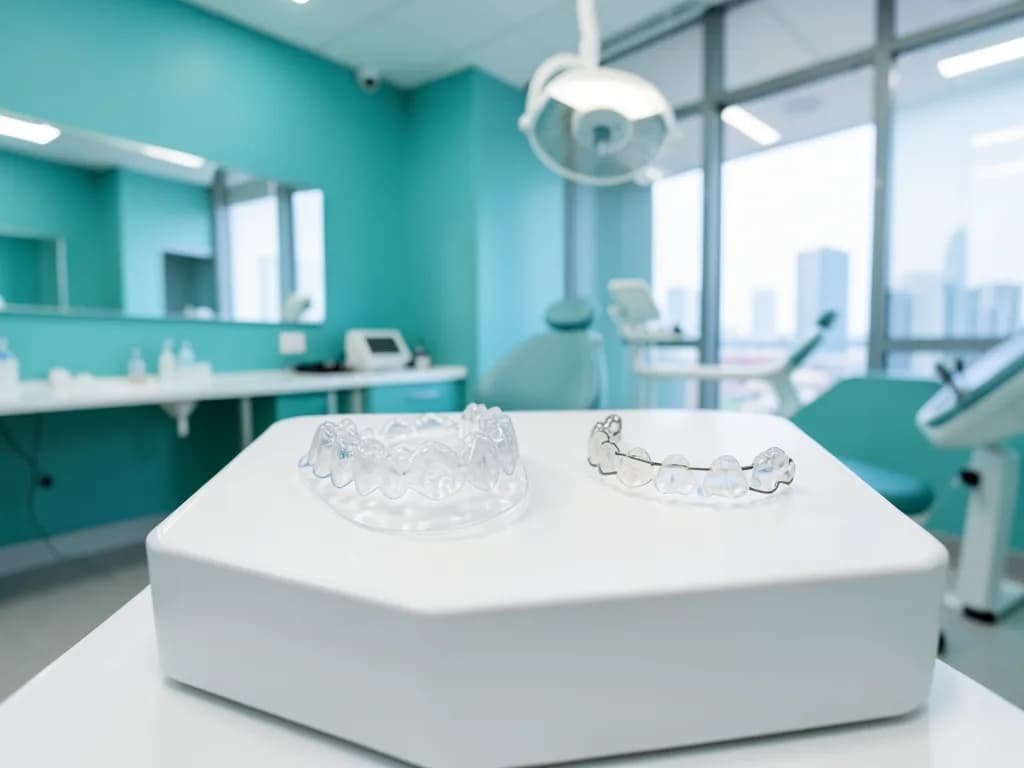
At a Glance Comparison
Key differences between Invisalign and braces across the factors that matter most to patients in Dubai.
| Factor | Invisalign | Braces |
|---|---|---|
| Cost (AED) | 10,000 – 20,000 (full course) | Metal 5,000–12,000 / Ceramic 7,000–15,000 |
| Treatment time | 6 – 18 months | 12 – 24 months |
| Visibility | Nearly invisible | Visible (ceramic less so) |
| Removable | Yes (must wear 20–22 hrs/day) | No — fixed throughout |
| Pain level | Mild pressure when changing trays | Moderate soreness after tightening |
| Best for | Mild to moderate crowding, adults | All complexity levels, children, complex bites |
| Reversibility | Fully reversible (no enamel removal) | Fully reversible (no enamel removal) |
| Insurance coverage | Rarely covered in UAE | Rarely covered (some Bupa plans) |
Everything You Need to Know About Invisalign in Dubai
Invisalign uses a series of custom-made, clear plastic aligner trays that fit snugly over your teeth. Every 1–2 weeks you swap to the next tray in the sequence, which applies gentle pressure to gradually move teeth into the desired position. The system relies on a 3D digital scan called ClinCheck, which shows your orthodontist — and you — the projected outcome before treatment begins.
In Dubai, Invisalign is popular with working professionals and adults who want to straighten their teeth without the look of metal brackets. You can remove the trays to eat, drink anything other than water, and for photos — a significant quality-of-life advantage over fixed braces. However, discipline is required: trays must be worn 20–22 hours per day for the treatment timeline to hold.
Invisalign works best for mild to moderate cases — crowding, spacing, minor overbites or underbites. It is less effective than fixed braces for complex rotations, significant bite correction, or cases that require precise three-dimensional tooth movement. Your orthodontist will tell you at the consultation whether your case is Invisalign-suitable.
Aftercare requires wearing a retainer indefinitely (every night) to prevent teeth drifting back. This applies equally to braces patients. In Dubai, retainers typically cost AED 500–1,200 per arch and are usually included in the overall Invisalign package at quality clinics.
Invisalign pros
- ✓ Nearly invisible — ideal for professionals
- ✓ Removable for eating and social occasions
- ✓ No dietary restrictions
- ✓ Easier to clean teeth
- ✓ Fewer emergency clinic visits (no wires)
- ✓ Digital preview of results before starting
Invisalign cons
- ✗ More expensive than metal braces
- ✗ Requires high patient compliance
- ✗ Not suitable for complex cases
- ✗ Attachments (small tooth-coloured bumps) can be visible
- ✗ Trays must be cleaned regularly to avoid staining
- ✗ Not recommended for young children
Everything You Need to Know About Braces in Dubai
Traditional braces use metal brackets bonded to the surface of each tooth, connected by an archwire that applies controlled force to move teeth over time. Your orthodontist adjusts the wire every 4–8 weeks to continue progress. The system has been refined over decades and remains the most versatile orthodontic tool available — capable of correcting virtually any alignment or bite issue.
In Dubai, metal braces are the most affordable orthodontic option, starting from around AED 5,000. Ceramic braces use tooth-coloured brackets and are significantly less visible than metal — many adults in Dubai choose them as a compromise between discretion and cost.Lingual braces (brackets placed on the inner surface of teeth) are also available at a premium of AED 12,000–25,000, with Incognito being the most popular brand.
Braces are fixed — they cannot be removed — which is actually an advantage for patients who struggle with compliance. Children and teenagers particularly benefit from this: the treatment works regardless of cooperation. For complex cases involving significant bite correction, jaw repositioning, or severe crowding, braces typically deliver more predictable outcomes than aligners. Use our directory to find orthodontists in Dubai who offer both options.
The main lifestyle adjustment is dietary: hard, sticky, or crunchy foods should be avoided to protect the brackets. Oral hygiene requires more effort with interdental brushes to clean around brackets and wires. Most patients adjust within a few weeks. Patients travelling from abroad should also read our dental tourism savings guide before booking.
Braces pros
- ✓ Lower cost than Invisalign
- ✓ Treats complex cases effectively
- ✓ No compliance required — fixed to teeth
- ✓ Suitable for all ages including children
- ✓ Ceramic option is far less visible
- ✓ Highly predictable outcomes
Braces cons
- ✗ Visible — especially metal brackets
- ✗ Cannot be removed
- ✗ Dietary restrictions required
- ✗ More difficult to clean teeth properly
- ✗ Occasional wire breaks need clinic visits
- ✗ Longer treatment time for mild cases
Which Should You Choose
The right choice depends on your case complexity, budget, lifestyle, and age. Here is an honest recommendation by patient profile.
Discretion matters in professional settings. Invisalign is nearly invisible and removable for client meetings, photos, and social occasions.
Fixed braces work regardless of compliance — no risk of forgetting to wear aligners. Orthodontists in Dubai almost universally recommend braces for younger patients.
Metal braces start from AED 5,000 — half the cost of Invisalign for many cases. Ceramic braces give a more aesthetic result for only a moderate premium.
For significant overbites, underbites, or complex rotations, braces provide more precise three-dimensional tooth control than aligners.
For straightforward cases, both deliver equivalent clinical results. The choice comes down to personal preference and budget.
Cost Comparison in Dubai
All prices are in AED and reflect the typical range across Dubai clinics as of 2026. No VAT applies to dental treatments in the UAE.
Invisalign
Braces
For full pricing context across all dental treatments, see our complete Dubai dental cost guide.
Insurance Coverage in Dubai
Invisalign coverage
Orthodontics is excluded from virtually all standard UAE health insurance plans. A small number of premium Bupa plans include an orthodontic benefit with an annual cap. Most patients pay out of pocket or use instalment plans.
Braces coverage
Same position as Invisalign — orthodontics is typically excluded. If your plan includes orthodontic benefits, both metal braces and ceramic braces would qualify. Always check your policy document before booking.
Side by Side Results — What Each Treatment Delivers
In terms of final outcome, both orthodontic treatments straighten teeth — but treatment predictability, aesthetic orthodontics experience, and compliance requirement differ significantly. Here is what patients actually notice.
| Outcome Factor | Invisalign (Clear Aligners) | Fixed Braces |
|---|---|---|
| Final alignment accuracy | Excellent for mild–moderate cases with good compliance | Excellent for all complexity levels |
| Bite correction (overbite, underbite) | Limited — aligners handle mild bite issues only | Full range — complex bite correction possible |
| Rotation of teeth (IPR) | Good for mild rotations; IPR (interproximal reduction) often needed | Better control of severe rotations |
| Treatment predictability | High for indicated cases; refinement trays sometimes needed | Very high across all case types |
| Attachment visibility | Small tooth-coloured attachments can be visible under light | Brackets visible at all times (metal or ceramic) |
| Smile aesthetics during treatment | Near-invisible — comfortable for social and professional settings | Visible hardware throughout treatment duration |
| Post-treatment stability | Equivalent — both require permanent retainer wear | Equivalent — both require permanent retainer wear |
Both removable vs fixed orthodontics deliver excellent results when correctly indicated. The key differentiator is case complexity: for severe malocclusions, significant bite issues, or cases requiring large tooth movements, fixed braces provide greater three-dimensional control. For mild to moderate crowding and spacing in adults who value the aesthetic orthodontics experience, Invisalign clear aligners produce equivalent clinical outcomes. Learn more about all your options on our dental treatments Dubai page.
Treatment Duration Comparison
Invisalign Treatment Timeline
Timeline assumes 20–22 hours per day wear compliance. Poor compliance can add 4–8 months.
Braces Treatment Timeline
Tightening appointments every 4–8 weeks throughout treatment — plan clinic visits into your calendar.
Pain and Comfort Comparison
Both treatments involve some discomfort as teeth move — this is unavoidable. The type and timing of discomfort differs. With Invisalign, patients experience mild pressure and soreness for 1–3 days each time they move to a new aligner tray (typically every 1–2 weeks). With braces, the soreness occurs after each tightening appointment (every 4–8 weeks) and tends to be more intense, lasting 3–5 days.
Braces also carry the risk of soft tissue irritation — brackets and wires can cut the inside of the lips and cheeks, particularly in the first month. Orthodontic wax can help, but many patients in Dubai find this a significant quality-of-life consideration. Invisalign smooth plastic trays do not cause this type of irritation.
Emergency visits are more common with braces — a broken bracket or protruding wire requires an unscheduled clinic visit. Invisalign patients rarely need emergency appointments. If a tray breaks or is lost, a replacement is ordered and a spare from the next set can usually bridge the gap.
| Comfort Factor | Invisalign | Braces |
|---|---|---|
| Soreness frequency | Every 1–2 weeks (new tray) | Every 4–8 weeks (tightening) |
| Soreness intensity | Mild — typically 1–3 days | Moderate — typically 3–5 days |
| Soft tissue irritation | Minimal — smooth plastic trays | Common — brackets can cut lips/cheeks |
| Emergency appointments | Rare — no wires to break | Occasional — broken brackets or wires |
| Speech impact | Slight lisp for 1–2 weeks initially | Minimal after initial adjustment |
| Eating comfort | Trays removed for all meals | Restricted — no hard/sticky foods |
Age Suitability — Who Is Each Treatment Best For
Invisalign — Best Age Groups
- ✓ Adults 18+ — ideal candidates, high compliance typically
- ✓ Young adults (18–30) — most satisfied patients in Dubai
- ✓ Professionals who need discretion in work settings
- ✓ Patients with mild to moderate cases and healthy teeth
- ✓ Invisalign Teen — available from age 14–15 with compliance indicators built into trays
- ✓ Not recommended under 14 — active tooth development complicates planning
Braces — Best Age Groups
- ✓ Children 10–14 — ideal age to begin treatment as teeth are still developing
- ✓ Teenagers 14–18 — fixed compliance means results do not depend on cooperation
- ✓ Adults — all braces types available, ceramic is popular for aesthetic adults
- ✓ Complex bite cases (all ages) — braces provide greater biomechanical control
- ✓ Patients who know they will struggle with 20–22 hr daily wear
- ✓ Budget-conscious patients — metal braces from AED 5,000 are the most affordable
Technology Used in Each Treatment
Invisalign Technology
ClinCheck 3D planning: Invisalign uses an intraoral scanner and proprietary software to create a precise digital model of your teeth. Your orthodontist plans every tooth movement digitally before a single tray is produced. You can see your projected final result before treatment begins.
SmartTrack material: Each aligner is manufactured from Align Technology's proprietary multilayer polyurethane — designed for consistent force delivery and enhanced tray retention.
Attachments: Small tooth-coloured composite bumps bonded to teeth provide additional grip for the aligners to execute complex movements. These improve treatment effectiveness but are slightly visible.
IPR (interproximal reduction): In some cases your orthodontist removes a fraction of a millimetre of enamel between teeth to create space for movement — a standard, safe procedure used in both aligner and braces treatments.
Braces Technology
Bracket systems: Modern brackets are far smaller and lower-profile than the brackets of 20 years ago. Options include standard metal, ceramic (tooth-coloured), self-ligating (Damon system), and lingual (inner surface). Each has different aesthetic profiles and force characteristics.
Archwire sequencing: Treatment progresses through a sequence of archwires — from flexible nickel-titanium wires that apply gentle initial forces to stiffer stainless steel wires for final detailing. Dubai orthodontists use heat-activated wires that apply continuous light forces between appointments.
Digital records: Modern orthodontic practices in Dubai use digital X-rays, intraoral scanners and orthodontic planning software (e.g., OrthoAnalyzer) to plan and monitor treatment with precision comparable to digital orthodontic comparison systems.
Want to explore all available orthodontic options? Visit our orthodontic treatment directory or see all dental treatment costs in Dubai 2026.
Related Guides
See all orthodontic options compared in our orthodontics Dubai overview.
Frequently Asked Questions
Is Invisalign more expensive than braces in Dubai?
Yes, generally. Invisalign costs AED 10,000–20,000 for a full treatment course, while metal braces start from AED 5,000–12,000 and ceramic braces AED 7,000–15,000. The price gap reflects the technology and lab work involved in manufacturing custom aligner trays versus standard bracket hardware.
How long does Invisalign take compared to braces in Dubai?
Invisalign typically takes 6–18 months for mild to moderate cases. Traditional braces are used for 12–24 months, particularly for more complex alignment or bite issues. Your orthodontist will give you a more accurate estimate after a clinical assessment and X-rays.
Can I get Invisalign covered by insurance in Dubai?
Orthodontic treatment is excluded from most UAE health insurance plans. Some premium Bupa plans include a partial orthodontic benefit — but this is rare. Most patients pay out of pocket, and many Dubai clinics offer 0% instalment plans through Tabby or Tamara.
Which is better for kids in Dubai — Invisalign or braces?
Traditional braces are generally recommended for children because compliance is built in — they cannot be removed. Invisalign requires wearing the trays 20–22 hours per day, which is harder to enforce with younger patients. Invisalign Teen exists but orthodontists in Dubai typically recommend braces for children under 14.
Do Dubai orthodontists offer free consultations for braces or Invisalign?
Many do, especially for Invisalign, as clinics are certified Invisalign providers and use the consultation to generate a ClinCheck digital treatment preview. Some charge a nominal AED 100–200 consultation fee that is credited toward treatment if you proceed. Always ask when booking.
Find an Orthodontist in Dubai
Use our dental provider directory to compare clinics, read reviews, and book appointments.
Browse verified clinics offering Invisalign and braces in Dubai. Compare patient reviews, check insurance acceptance, and book a free consultation.
Ready to take the next step? dental practice search tool and book your appointment today.
Related guides: