Ceramic Braces in Dubai — Complete Treatment and Cost Guide
Ceramic braces offer a discreet, fixed orthodontic solution for patients who want straighter teeth without the metallic appearance of traditional braces. Made from tooth-coloured or transparent ceramic materials, these brackets blend with your natural smile while delivering the same proven tooth-moving mechanics that orthodontists have relied on for decades.
Compare ceramic braces with Invisalign clear aligners, or read the full Invisalign vs ceramic braces comparison to decide which system suits your lifestyle.
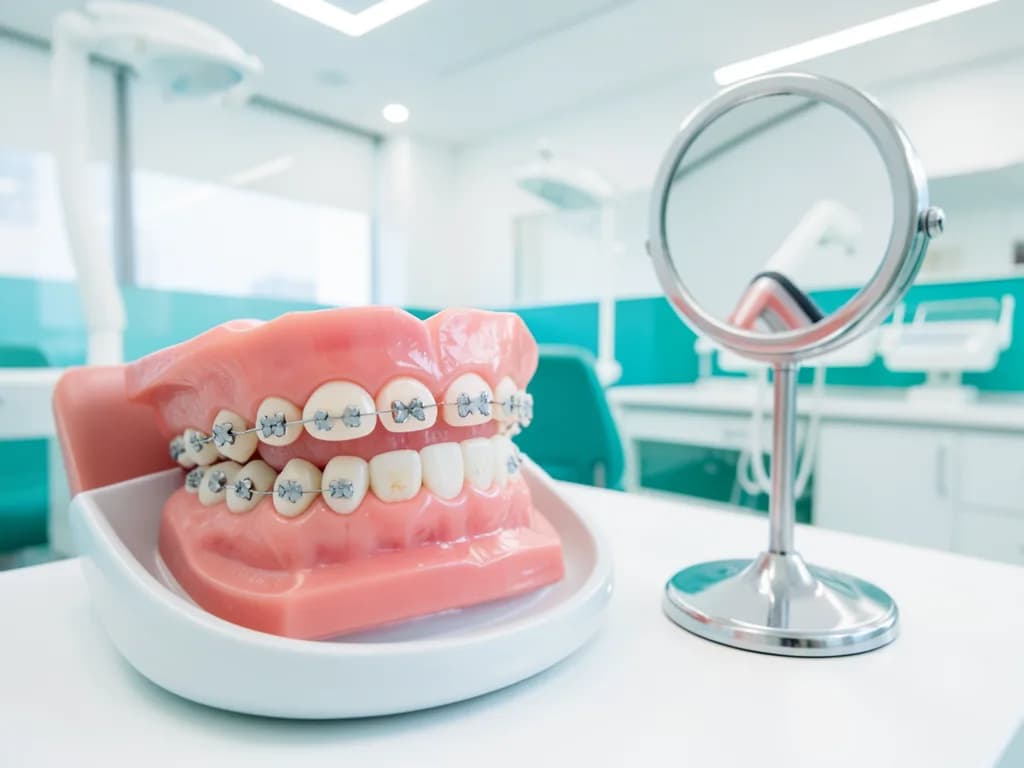
What Are Ceramic Braces and How Do They Work
Ceramic braces work using the same fundamental mechanics as traditional metal braces. Brackets are bonded to the front surface of each tooth using a dental adhesive, and an archwire threaded through all brackets applies controlled force to move teeth gradually into their correct positions. The key difference is the bracket material — instead of stainless steel, ceramic brackets are manufactured from polycrystalline or monocrystalline aluminium oxide, a material that can be made tooth-coloured or completely transparent.
The archwire provides the primary force that moves teeth, while the brackets serve as handles that transfer that force to each individual tooth. At each adjustment appointment, your orthodontist in Dubai replaces the wire with a progressively thicker or differently shaped wire, continuing the planned tooth movement sequence. Most ceramic braces cases are completed within 12 to 24 months, which is comparable to metal braces for the same level of case complexity.
Ceramic braces are particularly popular among working professionals in Dubai who need orthodontic treatment but prefer not to wear visible metal brackets in client-facing roles. They are also an excellent option for patients who are not good candidates for invisible braces such as clear aligners due to the complexity of their case or concerns about compliance with removable appliances.
Tooth Coloured Material
Brackets made from polycrystalline or monocrystalline ceramic match your natural tooth shade and are far less noticeable than metal brackets at conversational distance.
Proven Fixed Mechanics
The same wire and bracket system used in traditional orthodontics for decades. Works 24 hours per day without relying on patient compliance — no need to remember to wear anything.
Suitable for Complex Cases
Ceramic braces handle moderate to complex tooth movements including bite correction, rotation, and torque that some clear aligner systems struggle with.
Understanding Ceramic vs Clear Braces
The terms “ceramic braces” and “clear braces” are often used interchangeably, but there is a distinction. Ceramic braces specifically refer to brackets made from ceramic material that is either tooth-coloured (polycrystalline) or transparent (monocrystalline). “Clear braces” is a broader term that can include ceramic brackets, clear aligners like Invisalign, and even lingual braces. When searching for a provider, be specific about wanting ceramic bracket braces to ensure you receive accurate pricing and treatment planning information. If you are considering treatment for crooked teeth, ceramic braces remain one of the most reliable options available.
Types of Ceramic Braces Available in Dubai
Dubai orthodontic clinics offer several ceramic bracket systems. The right choice depends on your aesthetic priorities, budget, and the specific tooth movements your case requires.
Almost completely transparent — blends with any tooth shade
Patients who want maximum aesthetics and have lighter tooth shades
Slightly more brittle than polycrystalline — requires careful handling
Tooth-coloured but slightly opaque — excellent match for most patients
Most adult and teenage patients seeking a discreet fixed orthodontic option
More resistant to fracture than monocrystalline — the most popular choice
Tooth-coloured bracket with no visible elastic ties — cleaner look
Patients who want fewer adjustment appointments and reduced friction on teeth
Strong and resistant to staining — no elastics means less discolouration
The most discreet fixed braces option — both brackets and wires blend in
Professionals and adults who want maximum discretion from a fixed appliance
Wire coating may wear slightly over time but is replaced at each adjustment
Ceramic Braces Cost in Dubai 2026
Prices vary by clinic location, bracket type, and case complexity. The table below shows typical 2026 pricing across budget, mid-range, and premium clinics in Dubai. For a broader overview of all braces pricing, see our braces cost Dubai guide.
| Clinic Tier | Typical Areas | Single Arch | Both Arches | Includes |
|---|---|---|---|---|
| Budget Clinics | Deira, Bur Dubai, Al Qusais | AED 4,000 – 5,500 | AED 8,000 – 10,000 | Brackets, wires, basic retainer |
| Mid Range Clinics | JLT, Al Barsha, Jumeirah | AED 5,500 – 7,000 | AED 10,000 – 13,000 | Brackets, coated wires, bonded or Essix retainer |
| Premium Clinics | Downtown, DIFC, JBR, Dubai Hills | AED 7,000 – 8,500 | AED 12,000 – 15,000 | Self-ligating or monocrystalline brackets, coated wires, Vivera retainer set |
Ceramic Braces vs Metal Braces vs Invisalign vs Lingual Braces
All four systems straighten teeth effectively. The right choice depends on your case complexity, aesthetic preferences, budget, and lifestyle. For a focused two-way comparison, read our Invisalign vs braces Dubai guide or Invisalign vs ceramic braces comparison.
| Factor | Ceramic Braces | Metal Braces | Invisalign | Lingual Braces |
|---|---|---|---|---|
| Visibility | Low — tooth-coloured or clear brackets | High — silver metallic brackets and wires | Very low — nearly invisible clear plastic trays | Zero — brackets bonded behind teeth |
| Removability | Fixed — worn 24 hours per day | Fixed — worn 24 hours per day | Removable — patient takes out to eat and brush | Fixed — worn 24 hours per day |
| Cost in Dubai (AED) | 8,000 – 15,000 | 5,000 – 12,000 | 7,000 – 20,000 | 15,000 – 30,000 |
| Treatment Duration | 12 – 24 months | 12 – 24 months | 6 – 24 months | 18 – 30 months |
| Dietary Restrictions | Moderate — avoid hard and staining foods | Moderate — avoid hard and sticky foods | None — remove aligners to eat anything | Moderate — similar to traditional braces |
| Oral Hygiene Difficulty | Moderate — brackets trap food, need careful brushing | Moderate — similar bracket cleaning required | Easy — brush and floss normally with trays removed | Difficult — hard to access behind teeth |
| Staining Risk | Brackets resist staining but elastic ties can discolour | No staining concern — metal does not absorb colour | Trays can yellow if not cleaned properly | No visible staining — hidden behind teeth |
| Best Suited For | Adults and professionals wanting discreet fixed braces | Complex cases, children, and budget-conscious patients | Adults and teens who can comply with 22 hour daily wear | Patients who want zero visible orthodontic appliance |
Prices from Dubai clinic surveys, 2026. For lingual braces details or Damon self-ligating braces, see our dedicated guides.
Who Is a Good Candidate for Ceramic Braces
Ceramic braces are suitable for a wide range of orthodontic cases. Your orthodontist in Dubai will assess your specific situation and recommend the most appropriate system during your consultation.
Ideal Candidates
- ✓ Adults in professional or client-facing roles who want discreet orthodontics
- ✓ Patients with moderate to complex crowding, spacing, or bite issues
- ✓ Teenagers aged 12 and older with all permanent teeth erupted
- ✓ Patients who struggle with compliance wearing removable aligners
- ✓ Those who want a fixed appliance that works 24 hours per day automatically
- ✓ Patients with overbite, underbite, crossbite, or open bite needing correction
- ✓ Brides, public speakers, and media professionals wanting discreet treatment
Less Suitable Cases
- ✗ Contact sport athletes who risk frequent bracket breakage from impacts
- ✗ Patients who frequently consume staining foods and refuse to modify their diet
- ✗ Severe skeletal jaw discrepancies requiring surgical orthodontics
- ✗ Very young children under 12 with primary or mixed dentition
- ✗ Budget-constrained patients — metal braces cost AED 2,000 to 5,000 less
- ✗ Patients who grind or clench heavily — ceramic brackets may fracture
The Ceramic Braces Treatment Process Step by Step
From your initial consultation to long-term retention — here is the full ceramic braces journey at a Dubai orthodontic clinic. Understanding each phase helps you prepare and ensures realistic expectations.
Initial Orthodontic Consultation and Records
Your DHA-licensed orthodontist performs a comprehensive clinical examination of your teeth, bite, and jaw relationship. Digital X-rays including a panoramic radiograph and lateral cephalogram are taken, along with intraoral photographs and dental impressions or a 3D digital scan. These records allow your orthodontist to diagnose the specific nature of your malocclusion and determine whether ceramic braces are the right option for your case. Consultation fees range from AED 0 to AED 300 at most Dubai clinics and are often credited toward treatment if you proceed.
Customised Treatment Plan Design
Using the diagnostic records, your orthodontist creates a personalised treatment plan that maps out exactly how your teeth need to move, in what sequence, and over what timeframe. Modern clinics use digital treatment planning software that allows you to see a simulation of your projected outcome. The plan specifies bracket placement positions for each tooth, wire sequences, and any additional appliances such as elastics or expanders. You discuss the plan, timeline, cost, and payment options before giving consent to begin treatment.
Ceramic Bracket Bonding Appointment
Your teeth are professionally cleaned and each ceramic bracket is bonded to the front surface of the selected teeth using a dental adhesive. The initial lightweight archwire is then threaded through all brackets and secured with either elastic ties or the self-ligating mechanism. The entire bonding appointment takes 60 to 90 minutes. You will feel mild pressure but no pain. Your orthodontist provides detailed instructions on oral hygiene with braces, dietary restrictions, and what to expect during the first week as your mouth adjusts to the brackets.
Regular Adjustment Appointments
Every 4 to 6 weeks, you visit the clinic for an adjustment. The orthodontist replaces the archwire with a progressively thicker or differently shaped wire that applies new force vectors to continue moving your teeth according to the treatment plan. Elastic ties are replaced with fresh ones if applicable. Each adjustment visit takes 20 to 30 minutes. You may feel tightness and mild soreness for 2 to 3 days after each adjustment — this is normal and indicates the treatment is progressing. Over-the-counter pain relief such as ibuprofen manages any discomfort effectively.
Mid Treatment Review and Progress Assessment
At approximately the halfway point of treatment, your orthodontist takes updated X-rays and photographs to assess progress against the original treatment plan. If tooth movement is on track, treatment continues as planned. If any teeth are not responding as expected, the plan may be modified — additional attachments such as power chains, springs, or interarch elastics may be introduced to address specific movements. This review is a standard part of orthodontic care and is included in the treatment fee at reputable clinics.
Debonding and Final Records
Once your orthodontist confirms that all teeth have reached their planned positions and your bite is correct, the ceramic brackets are carefully removed using specialised pliers. Any remaining adhesive is polished off the tooth surfaces. Final X-rays and photographs are taken to document the completed result. The debonding process takes 30 to 45 minutes and is painless, though you may feel a slight popping sensation as each bracket is released from the tooth surface.
Retainer Fitting and Long Term Retention
Immediately after debonding, your orthodontist fits retainers to prevent your teeth from shifting back toward their original positions. Options include a fixed bonded wire retainer behind the front teeth, a clear removable Essix retainer, or a Hawley retainer with a metal wire and acrylic plate. Most patients receive a combination — a fixed wire on the lower teeth plus a removable retainer for the upper teeth. Retainers must be worn consistently, initially full time and then nightly, for the rest of your life. Without retention, orthodontic relapse is almost certain.
Annual Orthodontic Follow Up
After the active retention phase, annual check-ups ensure your teeth remain in their corrected positions and your retainers are functioning properly. Your orthodontist checks for any signs of relapse, examines retainer wear, and makes any necessary adjustments. These follow-up visits are brief, usually 15 to 20 minutes, and are essential for protecting your investment in orthodontic treatment. Many clinics include the first year of follow-up visits in the original treatment fee.
Honest Pros and Cons of Ceramic Braces
Advantages
- ✓ Far less visible than metal braces — tooth-coloured brackets blend with your smile
- ✓ Fixed appliance — works 24 hours per day without relying on patient compliance
- ✓ Effective for moderate to complex cases that clear aligners cannot handle well
- ✓ Widely available at most orthodontic clinics across Dubai
- ✓ Proven orthodontic mechanics — decades of clinical evidence behind bracket systems
- ✓ Coated archwire option further reduces visibility for maximum discretion
- ✓ More affordable than lingual braces and comparable to Invisalign pricing
- ✓ No risk of losing or forgetting to wear aligners since brackets are bonded to teeth
Disadvantages
- ! Elastic ties can stain from coffee, tea, curry and turmeric between adjustments
- ! Slightly larger bracket size compared to metal braces which may affect comfort
- ! Ceramic brackets are more brittle and can chip if you bite hard foods directly
- ! More expensive than traditional metal braces by AED 2,000 to AED 5,000
- ! Cannot be removed for photos, events, or important occasions unlike clear aligners
- ! Dietary restrictions — must avoid hard, sticky, and heavily pigmented foods
- ! Oral hygiene requires more effort with specialised brushes and floss threaders
Weighing your options? Compare Invisalign versus braces or explore all orthodontic treatments available in Dubai to find the best fit for your lifestyle and budget.
Ceramic Braces Care and Maintenance Guide
Proper care of your ceramic braces prevents staining, reduces the risk of bracket breakage, maintains healthy gums, and helps keep your treatment on schedule. Follow these six essential maintenance practices throughout your treatment period.
Brush After Every Meal
Use an orthodontic toothbrush or an electric toothbrush with a small head. Brush at a 45 degree angle above and below each bracket. Spend at least 3 minutes brushing — food debris around ceramic brackets leads to staining and decalcification marks on enamel.
Use an Interdental Brush Daily
Small interdental brushes (such as TePe or GUM sizes 0.4mm to 0.7mm) clean between the wire and your gums where a regular toothbrush cannot reach. This is critical for preventing white spot lesions and gum inflammation during treatment.
Floss with a Floss Threader or Superfloss
Regular floss cannot pass through braces wires. Use a floss threader to guide floss under the archwire between each pair of teeth, or use Oral-B Superfloss which has a stiff end for threading. Floss at least once daily, ideally before bedtime.
Avoid Staining Foods and Drinks
Coffee, tea, red wine, turmeric, soy sauce, and curry powder stain the elastic ties on ceramic braces within days. If you cannot avoid these entirely, drink through a straw and rinse your mouth with water immediately after consumption. Opt for self-ligating ceramic brackets to eliminate elastic tie staining entirely.
Wear a Mouthguard During Sports
Ceramic brackets can fracture on impact. If you play contact sports or martial arts, wear a custom orthodontic mouthguard fabricated by your dentist. Over-the-counter boil-and-bite mouthguards work as a temporary solution but custom guards offer better protection and fit.
Attend Every Adjustment Appointment
Skipping or delaying adjustment appointments extends your treatment time and may cause unwanted tooth movement. Set calendar reminders for each appointment and notify your clinic at least 48 hours in advance if you need to reschedule.
Does UAE Insurance Cover Ceramic Braces
Most Plans Exclude Orthodontics
The majority of standard UAE health insurance plans classify all orthodontic treatment — including ceramic braces — as elective and exclude it entirely. This includes Daman Enhanced, AXA Smart, MetLife basic plans, and most standard employer-provided policies. Even plans that include a dental rider typically exclude adult orthodontics from the covered services list.
Plans with Partial Orthodontic Coverage
- ✓ Daman Thiqa — lifetime orthodontic benefit AED 5,000 to 7,000
- ✓ Bupa Platinum — orthodontic cover AED 3,000 to 5,000 lifetime
- ✓ Some government and semi-government employer premium plans
- ✓ Children under 18 often have better orthodontic benefit limits
- ✓ Coverage applies equally to ceramic, metal, or Invisalign
Ceramic Braces or Invisalign — Which Should You Choose
This is the most common question patients in Dubai ask when choosing between discreet orthodontic options. Both ceramic braces and Invisalign clear aligners deliver excellent results, but they suit different patients and lifestyles. Ceramic braces are a fixed appliance that works continuously without requiring any compliance effort — you cannot forget to wear them or lose them. Invisalign aligners must be worn 20 to 22 hours per day and require the discipline to remove and replace them at every meal.
For complex cases involving significant bite correction, rotations of cylindrical teeth, or vertical tooth movements, ceramic braces generally offer more predictable outcomes because the orthodontist has direct mechanical control through the bracket and wire system. Invisalign excels for mild to moderate crowding and spacing cases where aesthetics during treatment are the top priority.
Cost-wise, ceramic braces (AED 8,000 to AED 15,000) and Invisalign (AED 7,000 to AED 20,000) overlap significantly in the mid-range. The best approach is to consult an orthodontist who offers both systems and can recommend the most clinically appropriate option for your specific case without a financial bias toward either system.
For a detailed comparison of these two systems, read our complete Invisalign vs ceramic braces Dubai guide.
Risks and Potential Complications
Ceramic braces are a well-established orthodontic treatment with a strong safety record, but patients should understand several risks before committing to treatment. Being informed helps you take preventive steps and recognise early warning signs throughout your orthodontic journey.
Bracket Fracture
Ceramic brackets made from polycrystalline alumina or monocrystalline sapphire are more brittle than metal brackets. Biting directly into hard foods — raw carrots, crusty bread, nuts, or ice — can crack or dislodge a bracket. A broken bracket does not move teeth correctly and requires an urgent appointment to rebond. Fractures can add 2 to 4 weeks to your overall treatment timeline. Avoiding hard foods and cutting firm fruits into small pieces significantly reduces this risk.
Enamel Demineralisation
Poor oral hygiene with braces allows plaque acids to demineralise the enamel around bracket bonding sites, creating white spot lesions (WSLs). These chalky white marks can become permanent if not addressed. They are the single most preventable complication of orthodontic treatment. Using fluoride toothpaste, an interdental brush at every meal, and a fluoride mouthwash nightly greatly reduces WSL risk. Your orthodontist may apply fluoride varnish at each adjustment visit as an additional protective measure.
Elastic Tie Staining
The clear elastic ligature ties that secure the NiTi archwire to each tooth-colored bracket absorb pigment from coffee, tea, turmeric, red wine, and other coloured foods. Stained ties turn yellow or brown within days, making ceramic braces look less discreet. Ties are replaced at each 4 to 6 week adjustment appointment, so staining is temporary but noticeable. Choosing self-ligating ceramic brackets eliminates elastic ties entirely, removing this staining risk and maintaining a cleaner tooth-colored appearance throughout treatment.
Treatment Time vs Metal Braces
Ceramic brackets produce slightly more friction on the orthodontic wire than metal brackets, which can slow tooth movement very modestly for complex rotations. In straightforward crowding or spacing cases the difference is negligible. Self-ligating passive ceramic bracket systems — which use a clip instead of an elastic tie — significantly reduce friction and can close the speed gap with metal braces. For Class II or Class II malocclusion cases requiring significant bite correction, your orthodontist will factor bracket friction into the wire sequencing plan.
Gum Sensitivity and Soft Tissue Irritation
New ceramic brackets and archwire ends can cause irritation to the inner cheeks and lips during the first 1 to 2 weeks. Orthodontic wax applied to any sharp or protruding area provides immediate relief. Gum inflammation (gingivitis) can develop around brackets if oral hygiene is inadequate — regular professional cleaning every 3 to 4 months during treatment helps maintain gum health. Patients with pre-existing gum disease should address this before starting orthodontic treatment.
Prolonged Retention Requirements
After ceramic braces are removed, the retention phase is lifelong — not optional. Without a fixed lingual retainer and a removable clear retainer worn nightly, teeth will drift back toward their original positions over months to years. This is called orthodontic relapse and is one of the most common disappointments in orthodontics. The retention phase is as important as the active treatment phase and should be planned and budgeted for before you begin.
Ceramic Braces vs Other Orthodontic Options
Choosing the right orthodontic appliance depends on your case complexity, aesthetic preferences, lifestyle, and budget. Below is a detailed side-by-side comparison of ceramic braces against the main alternatives available in Dubai. Each system has genuine strengths — the right choice is the one best matched to your specific needs.
| Factor | Ceramic Braces | Metal Braces | Lingual Braces | Invisalign |
|---|---|---|---|---|
| Visibility | Low — tooth-colored bracket blends with enamel | High — silver brackets and wire clearly visible | Zero — hidden behind teeth, undetectable | Very low — clear plastic, barely noticeable |
| Comfort | Moderate — ceramic bracket slightly larger than metal | Moderate — standard bracket size, wires may poke | Lower initially — tongue irritation for 2 to 4 weeks | High — smooth plastic trays, minimal irritation |
| Cost in Dubai (AED) | 8,000 – 15,000 | 5,000 – 12,000 | 15,000 – 30,000 | 7,000 – 20,000 |
| Treatment Time | 12 – 24 months | 12 – 24 months | 18 – 30 months | 6 – 24 months |
| Compliance Needed | None — fixed appliance works 24/7 | None — fixed appliance works 24/7 | None — fixed appliance works 24/7 | High — must wear 20 to 22 hrs daily |
| Best For | Adults wanting discreet fixed braces at mid-range cost | Complex cases, teens, cost-sensitive patients | Professionals needing 100% invisible treatment | Mild to moderate cases, removable preference |
Read detailed guides on each alternative: Invisalign Dubai, lingual braces Dubai, Damon braces, and clear aligners in Dubai. Or explore the full orthodontics Dubai hub for a complete overview of every treatment option available.
Pain and Comfort During Ceramic Braces Treatment
One of the most common questions from prospective patients is how much ceramic braces hurt. The honest answer is that discomfort is real but manageable — and it decreases significantly after the first few weeks as your mouth adapts to the appliance.
First Week After Bonding
The initial placement of ceramic brackets and the first archwire causes the most noticeable discomfort in the entire treatment. Your teeth feel sore, tender to biting pressure, and your cheeks may be irritated by the new brackets. This peaks around day 2 to 3 and gradually subsides by day 5 to 7. Eat soft foods — yoghurt, scrambled eggs, pasta, soup, mashed potato — during this period. Ibuprofen (400mg every 6 to 8 hours) or paracetamol manages the soreness effectively for most patients.
After Each Adjustment Appointment
Every 4 to 6 weeks when your orthodontist changes the archwire or tightens elastic ties, expect 24 to 72 hours of renewed tenderness. This soreness is a sign the treatment is working — new forces are being applied to move your teeth further. The discomfort after adjustments is typically milder than the initial bonding soreness and reduces over time as treatment progresses. Many patients report that the discomfort becomes predictable and manageable after the first 2 to 3 adjustment cycles.
Cheek and Lip Irritation
Ceramic brackets have slightly larger profiles than metal brackets, and protruding wire ends can catch on the inner cheeks or lips. Apply orthodontic wax to any bracket or wire end causing irritation — pinch a small ball of wax and press it firmly over the offending bracket or wire. Silicone orthodontic wax is available at most pharmacies across Dubai for under AED 20. Your oral tissues toughen over 2 to 4 weeks and the irritation largely resolves on its own.
Managing Soreness Throughout Treatment
Over-the-counter anti-inflammatory pain relief such as ibuprofen is the most effective option for post-adjustment soreness. For patients who cannot take ibuprofen, paracetamol provides adequate relief. Rinsing with warm salt water (one teaspoon of salt dissolved in a glass of warm water) can soothe irritated gum tissue. Cold foods and drinks — ice cream, cold yoghurt, chilled water — can temporarily numb the area. Avoid very hot foods immediately after adjustments as heat can worsen sensitivity.
How to Find Top Rated Orthodontists in Dubai for Ceramic Braces
Ceramic braces produce better outcomes when placed and managed by a qualified orthodontic specialist rather than a general dentist who occasionally performs orthodontics. Here is what to look for when choosing a ceramic braces provider in Dubai.
DHA Licence in Orthodontics
All orthodontists practising in Dubai must hold a Dubai Health Authority (DHA) licence specifically in orthodontics — not just a general dentistry licence. You can verify a practitioner's credentials on the DHA online licence verification portal. A general dentist performing orthodontics without a specialist licence may produce inferior results and carry higher risk of complications.
MSc or MOrth Postgraduate Qualification
Look for orthodontists holding a Masters of Science in Orthodontics (MSc Orthodontics) or a Membership in Orthodontics (MOrth) from a recognised postgraduate training programme. These degrees typically require 3 years of full-time specialist training after dental school and indicate a high level of clinical competence in bracket mechanics, treatment planning, and malocclusion management.
World Federation of Orthodontists Membership
The World Federation of Orthodontists (WFO) represents orthodontic societies from over 100 countries. Membership indicates a commitment to global standards of orthodontic practice. Many leading Dubai orthodontists are also members of the Emirates Orthodontic Society (EOS) and the European Orthodontic Society (EOS) — affiliation with professional bodies reflects ongoing participation in continuing education.
Experience with Ceramic Bracket Systems
Ask prospective orthodontists how many ceramic braces cases they treat per year and which ceramic bracket brands they use. Experienced providers will discuss the differences between polycrystalline alumina and monocrystalline sapphire brackets, self-ligating versus conventional systems, and coated versus standard archwires. This knowledge demonstrates genuine expertise with the material rather than occasional use.
Patient Before-and-After Records
Reputable orthodontists maintain documented before-and-after records of completed ceramic braces cases. Reviewing these photos gives you a realistic expectation of treatment outcomes. Be cautious of clinics that cannot show clinical examples of completed orthodontic cases — patient records are standard practice in orthodontics.
Transparent All-Inclusive Pricing
Ask whether the quoted price includes brackets, wires, all adjustment visits, X-rays, retainers, and any emergency appointments for broken brackets. Some clinics quote a low initial price and charge separately for each adjustment. An all-inclusive treatment fee from AED 8,000 to AED 15,000 is standard for full ceramic braces treatment in Dubai.
Ready to find a verified orthodontist near you? Search our directory of dental clinics in Dubai to compare orthodontic specialists, read patient reviews, and book a ceramic braces consultation. You can also browse our curated list of top rated dental clinics in the UAE.
Frequently Asked Questions
How much do ceramic braces cost in Dubai in 2026?
Ceramic braces in Dubai cost between AED 8,000 and AED 15,000 for both arches in 2026. The price depends on the type of ceramic bracket used, the complexity of your orthodontic case, and the clinic location. Budget clinics in areas like Deira and Bur Dubai charge AED 8,000 to AED 10,000, mid-range clinics in JLT and Al Barsha charge AED 10,000 to AED 13,000, and premium clinics in Downtown Dubai, DIFC, and JBR charge AED 12,000 to AED 15,000. Single-arch treatment costs roughly half the full treatment price. Self-ligating ceramic brackets and monocrystalline sapphire brackets sit at the higher end of the range. Most clinics include all adjustment visits, the brackets and wires, and a basic retainer in the quoted price, but confirm exactly what is included before committing. Many clinics offer zero percent instalment plans through Tabby or Tamara, spreading the cost over 6 to 12 monthly payments with no interest charges. For a comprehensive comparison of all orthodontic pricing, visit our braces cost guide.
Are ceramic braces as effective as metal braces for straightening teeth?
Yes, ceramic braces are equally effective as metal braces for straightening teeth. They use identical orthodontic mechanics — the same archwire sequences, the same force systems, and the same adjustment protocols. The bracket material is the only significant difference. Ceramic brackets are made from aluminium oxide or sapphire rather than stainless steel, which makes them tooth-coloured or transparent but does not change how they move teeth. Studies published in the American Journal of Orthodontics confirm that treatment outcomes with ceramic brackets are clinically equivalent to metal brackets when placed by a qualified orthodontist. The only practical difference is that ceramic brackets are slightly larger and slightly more brittle, meaning your orthodontist may recommend avoiding extremely hard foods to prevent bracket fractures. Treatment duration is virtually identical — 12 to 24 months for most cases — and ceramic braces handle complex movements including rotation, torque, and bite correction just as effectively as their metal counterparts.
Do ceramic braces stain and how can I prevent discolouration?
The ceramic brackets themselves are highly stain-resistant because they are made from a non-porous material. However, the small elastic ligature ties that hold the archwire to each bracket are made from latex or silicone and do absorb colour from foods and beverages. Coffee, tea, red wine, turmeric, curry, soy sauce, and tomato-based sauces are the most common culprits. Stained elastic ties make ceramic braces appear yellow or brown between adjustment visits, which defeats the aesthetic purpose. To prevent this, avoid heavily pigmented foods and drinks as much as possible, drink staining liquids through a straw, rinse your mouth with water immediately after consuming anything coloured, and maintain excellent oral hygiene with brushing after every meal. Alternatively, choose self-ligating ceramic brackets, which eliminate elastic ties entirely by using a built-in clip mechanism to hold the wire. Self-ligating brackets cost AED 1,000 to AED 3,000 more but stay clean and tooth-coloured throughout treatment. Your orthodontist replaces elastic ties at each adjustment visit, so staining is temporary — typically 4 to 6 weeks between appointments.
How long does ceramic braces treatment take in Dubai?
Ceramic braces treatment in Dubai typically takes 12 to 24 months, which is the same as metal braces for equivalent case complexity. Mild cases involving minor crowding or small gaps may be completed in 10 to 14 months. Moderate cases with significant crowding, spacing, or mild bite issues take 14 to 20 months. Complex cases involving significant bite correction, multiple extractions, or severe crowding can take 20 to 30 months. Your orthodontist provides a personalised time estimate at your initial consultation based on your specific diagnosis and treatment plan. Several factors can extend treatment time beyond the initial estimate, including missed or delayed adjustment appointments, bracket breakages from eating hard foods, poor oral hygiene requiring emergency visits, and the biological response rate of your teeth and bone. Attending every scheduled adjustment on time and following your orthodontist's dietary and hygiene instructions carefully are the most effective ways to keep treatment on schedule and avoid unnecessary extensions.
What is the difference between ceramic braces and Invisalign?
Ceramic braces and Invisalign are fundamentally different orthodontic systems. Ceramic braces are a fixed appliance — tooth-coloured brackets bonded to your teeth 24 hours per day that work continuously without relying on patient compliance. Invisalign uses removable clear plastic aligners that must be worn 20 to 22 hours per day and taken out for eating, drinking, and brushing. Ceramic braces are better for complex cases involving significant bite correction, rotation of rounded teeth, and cases requiring precise torque control. Invisalign is better for patients who prioritise removability and want no visible appliance at all. Cost-wise, ceramic braces range from AED 8,000 to AED 15,000 while Invisalign costs AED 7,000 to AED 20,000 in Dubai. Both achieve excellent results for mild to moderate cases when managed by a qualified orthodontist. The right choice depends on your case complexity, lifestyle preferences, and ability to comply with aligner wear requirements. Read our detailed comparison guide for a thorough side-by-side analysis of both systems.
Can children and teenagers get ceramic braces in Dubai?
Yes, teenagers can get ceramic braces once all permanent teeth have erupted, which typically occurs between ages 12 and 14. Ceramic braces are a popular choice for teenagers who feel self-conscious about the appearance of metal braces, particularly in school and social settings. However, ceramic brackets are slightly more fragile than metal brackets and require more careful eating habits — biting into hard foods like apples, carrots, nuts, and ice can crack or fracture a ceramic bracket. For younger children under 12 who still have primary teeth or mixed dentition, metal braces are generally recommended because they are more durable and better suited to the developing mouth. Children under 10 typically require interceptive orthodontic appliances rather than full braces. Your DHA-licensed orthodontist will assess your child's dental development, maturity level, and ability to follow dietary restrictions before recommending ceramic versus metal brackets. Insurance coverage for orthodontics is generally better for children under 18, with some UAE plans covering AED 3,000 to AED 7,000 of orthodontic treatment for dependents.
Does dental insurance in the UAE cover ceramic braces?
Most standard UAE health insurance plans classify orthodontic treatment including ceramic braces as elective and do not cover it. Basic plans such as Daman Enhanced, AXA Smart, and standard employer-provided policies typically exclude all orthodontic care for adults. However, several premium plans do provide partial orthodontic coverage. Daman Thiqa offers a lifetime orthodontic benefit of AED 5,000 to AED 7,000 for Abu Dhabi residents. Bupa Platinum plans include orthodontic coverage of AED 3,000 to AED 5,000. Some government and semi-government employer plans include adult orthodontic benefits with higher limits. Children under 18 generally have better orthodontic coverage than adults — many family plans include dependent orthodontic benefits of AED 3,000 to AED 7,000. Important: insurance that covers orthodontics typically covers the orthodontic appliance regardless of type, meaning the benefit applies equally to ceramic braces, metal braces, or Invisalign. Always call your insurance provider before your consultation to verify your specific orthodontic benefit, coverage limits, and any waiting periods or pre-authorization requirements. For a full guide to dental insurance options, visit our dental insurance Dubai resource.
Are ceramic braces more painful than metal braces?
Ceramic braces produce the same level of discomfort as metal braces because the forces applied to teeth are identical regardless of bracket material. The mild soreness you feel after each adjustment comes from the archwire pressure moving your teeth through bone — not from the bracket material itself. Most patients experience tightness and tenderness for 2 to 4 days after each adjustment, with the first adjustment after initial bonding typically being the most uncomfortable. Over-the-counter pain relievers such as ibuprofen or paracetamol effectively manage any post-adjustment soreness. One difference is that ceramic brackets are slightly larger than metal brackets, which means they may initially feel bulkier against your lips and cheeks. This sensation typically resolves within the first week as your soft tissues adapt. Orthodontic wax applied to any bracket that causes irritation provides immediate relief. Some patients report that self-ligating ceramic brackets feel more comfortable than conventional ceramic brackets with elastic ties because the self-ligating mechanism applies lighter, more consistent forces throughout the adjustment interval. Overall, pain levels are manageable for the vast majority of patients and should not be a deciding factor when choosing between ceramic and metal brackets.
What foods should I avoid with ceramic braces?
With ceramic braces you should avoid three categories of food. Hard foods that can fracture ceramic brackets include raw carrots, whole apples, corn on the cob, hard nuts, popcorn kernels, ice cubes, hard candy, and crusty bread rolls. Always cut hard fruits and vegetables into small pieces and chew with your back teeth rather than biting with your front teeth. Sticky foods that can pull brackets off your teeth include toffee, caramel, chewing gum, gummy bears, and fruit roll-ups. Staining foods and drinks that discolour the elastic ties on ceramic brackets include coffee, tea, red wine, cola, turmeric, curry, soy sauce, balsamic vinegar, tomato sauce, and beetroot. If you consume staining beverages, use a straw and rinse with water immediately afterward. Your elastic ties are replaced at each adjustment appointment, so staining is temporary but can look unsightly. Choosing self-ligating ceramic brackets eliminates the staining concern entirely since there are no elastic ties. Foods that are safe and recommended include soft fruits, cooked vegetables, pasta, rice, yoghurt, cheese, eggs, fish, and tender meats cut into small pieces.
Find an Orthodontist for Ceramic Braces in Dubai
Use our dentist search tool to compare clinics, read patient reviews, and book consultations.
Browse verified orthodontic clinics across Dubai offering ceramic braces. Compare prices, read real patient reviews, and find a clinic that fits your budget and location — no registration required.