Lingual Braces in Dubai — The Complete Guide to Hidden Braces
Lingual braces are fixed orthodontic brackets bonded to the back (tongue side) of your teeth — making them completely invisible to everyone around you. This guide covers how lingual braces work, the main systems available in Dubai including Incognito and WIN, what treatment costs, how long it takes, and who is a good candidate for this truly hidden orthodontic option.
Looking for removable clear aligners instead? See our Invisalign Dubai guide. To compare all orthodontic options side by side, read our Invisalign vs braces comparison.
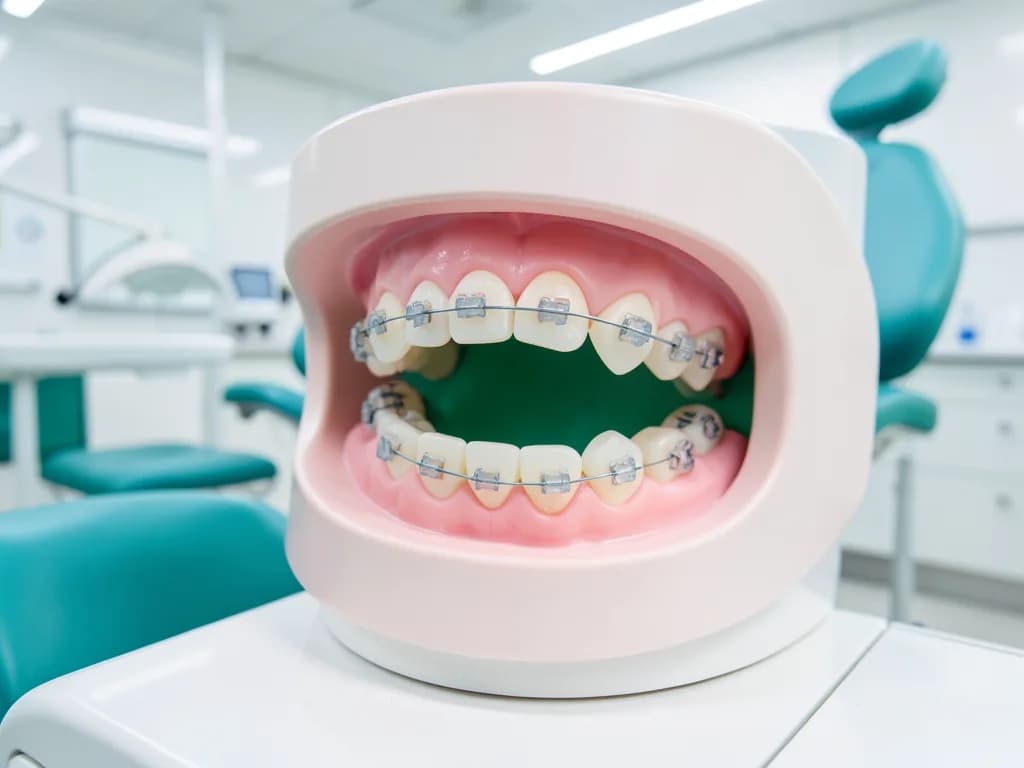
How Lingual Braces Work
Lingual braces work on the same mechanical principle as traditional braces — brackets are bonded to the teeth and connected by archwires that apply controlled forces to move teeth into their planned positions. The critical difference is placement. While conventional braces sit on the labial (front) surface of the teeth where they are visible, lingual braces are bonded to the lingual (tongue-side) surface — making them completely hidden from view. Nobody can see your braces unless they look directly into your open mouth from below.
Because the lingual surface of each tooth has a unique, irregular anatomy — far more varied than the relatively flat labial surface — every lingual bracket must be custom-manufactured to fit precisely. This is why lingual braces cost significantly more than standard braces and why only orthodontists with specialised training in lingual technique offer them. The customisation process uses CAD/CAM technology and robotic wire bending to achieve a level of precision that generic, off-the-shelf brackets cannot match.
If you are exploring all orthodontic options in Dubai, lingual braces sit at the premium end of the spectrum — offering true invisibility at a higher price point than invisible braces alternatives like clear aligners or ceramic brackets.
Custom Bracket Fabrication
Every bracket is individually designed using CAD/CAM to match the unique lingual surface anatomy of each tooth. Robotic wire bending creates archwires with sub-millimetre precision for each patient.
Indirect Bonding Placement
Brackets arrive on a custom transfer tray that positions each bracket in the exact planned location. The orthodontist bonds all brackets in one appointment lasting 90 minutes to 2 hours.
Progressive Wire Changes
Treatment progresses through a series of increasingly stiff archwires at 4 to 6 week intervals. Each wire change applies new forces that continue moving teeth according to the planned sequence.
The Speech Adjustment — What to Expect
Because lingual brackets change where the tongue rests and how it contacts the teeth during speech, most patients experience a temporary lisp — particularly on S, T, D, and L sounds. This typically lasts 2 to 4 weeks and resolves as the tongue adapts to the bracket surfaces. Modern ultra-thin systems like WIN and current-generation Incognito cause significantly less speech disruption than older, bulkier lingual brackets. Reading aloud for 20 to 30 minutes daily during the first two weeks accelerates adaptation.
Lingual Braces Systems Available in Dubai
Several lingual bracket systems are offered by DHA-licensed orthodontists in Dubai. Each system has different bracket profiles, materials, and price points. Your orthodontist will recommend the system they have the most experience with and that best suits your clinical needs. For a comparison with the popular Incognito braces system specifically, see our dedicated page.
Gold alloy brackets, custom-milled
Ultra-thin — individually designed to each tooth surface
Adults requiring the highest level of discretion with complex bite correction
Cobalt-chromium alloy, flat design
Very flat — thinnest lingual bracket system available
Patients prioritising comfort and minimal speech disruption during treatment
Self-ligating nickel-free brackets
Rounded and smooth — self-ligating for fewer adjustments
Moderate crowding and spacing cases where fewer clinic visits are preferred
Small, light brackets — semi-custom
Compact size — smaller than older lingual bracket generations
Mild to moderate cases, generally more affordable than fully custom systems
Lingual Braces vs Invisalign vs Ceramic vs Metal — Full Comparison
All four options straighten teeth effectively — the right choice depends on your priorities around visibility, comfort, compliance, and budget. For a deeper dive into two of these options, see our Invisalign vs braces Dubai guide or compare ceramic braces in Dubai.
| Factor | Lingual Braces | Invisalign | Ceramic Braces | Metal Braces |
|---|---|---|---|---|
| Visibility | Completely invisible — bonded behind teeth | Nearly invisible — clear removable trays | Semi-visible — tooth-coloured front brackets | Fully visible — silver brackets and wires |
| Removability | Fixed 24/7 — cannot be removed by patient | Removable — must self-discipline 20–22 hrs daily | Fixed — cannot be removed by patient | Fixed — cannot be removed by patient |
| Speech impact | Temporary lisp for 2–4 weeks while tongue adapts | Minimal — slight lisp for a few days | None — same as metal braces | None — positioned on front of teeth |
| Comfort | Tongue irritation initially, improves after 2–3 weeks | Smooth plastic — minimal soft tissue irritation | Brackets may irritate cheeks and lips | Brackets and wires can irritate cheeks |
| Dietary restrictions | Yes — avoid hard and sticky foods | None — remove aligners before eating | Yes — same restrictions as metal braces | Yes — no hard, sticky or crunchy foods |
| Treatment duration | 18–30 months | 6–24 months depending on complexity | 12–24 months | 12–24 months (often fastest for severe cases) |
| Cost in Dubai (AED) | 15,000–30,000 | 7,000–20,000 | 7,000–15,000 | 5,000–12,000 |
| Best for | Professionals who need 100% hidden treatment | Adults and teens wanting removable discretion | Adults wanting less visible fixed braces | Severe cases and cost-conscious patients |
Prices based on Dubai clinic surveys, 2026. For a full cost breakdown of all options, see our braces cost Dubai guide.
Who Is a Good Candidate for Lingual Braces?
Lingual braces are the ideal choice for patients who need completely invisible orthodontic treatment and prefer a fixed appliance that works continuously without relying on patient compliance to wear removable trays. However, not every patient or case is suited to lingual treatment.
Ideal candidates
- ✓ Professionals in client-facing roles (lawyers, executives, TV presenters)
- ✓ Adults who want 100% invisible fixed orthodontic treatment
- ✓ Patients who know they will not comply with removable aligner wear
- ✓ Moderate to complex crowding, spacing, or bite correction
- ✓ Musicians who play wind instruments (front teeth remain unobstructed)
- ✓ Patients with adequate tooth surface area on the lingual side
- ✓ Older teenagers with fully erupted permanent teeth
Less suitable cases
- ✗ Very small or short teeth (insufficient surface for bracket bonding)
- ✗ Severe deep overbite where upper teeth bite onto lower brackets
- ✗ Children under 14 with mixed dentition still erupting
- ✗ Patients with active periodontal disease or severe decay
- ✗ Severe skeletal jaw discrepancies requiring surgical intervention
- ✗ Patients unable to commit to thorough oral hygiene with brackets
Lingual Braces Cost in Dubai — Budget, Midrange and Premium
Lingual braces are the most expensive orthodontic option due to the custom manufacturing process, specialised placement technique, and longer chair time at each adjustment. Prices vary based on the bracket system, case complexity, and clinic location in Dubai. For a full breakdown of all braces types, visit our braces cost Dubai guide.
| Tier | Price Range | What Is Included | Typical Clinic Type |
|---|---|---|---|
| Budget Lingual (STb Brackets) | AED 15,000–18,000 | Semi-custom lingual brackets, basic wire adjustments, single arch or both arches | Community clinics and general orthodontic practices |
| Mid-Range Lingual (Harmony or WIN) | AED 18,000–25,000 | Fully custom brackets, advanced wire system, both arches, refinement adjustments | Established multi-specialty clinics in Jumeirah, Al Barsha, Bur Dubai |
| Premium Lingual (Incognito 3M) | AED 22,000–30,000 | Gold alloy custom brackets, robotic wire bending, both arches, comprehensive refinements | Specialist orthodontic centres in DIFC, Downtown Dubai, JBR |
What is typically included
- ✓ Initial consultation and diagnostic records
- ✓ Custom bracket fabrication and shipping
- ✓ Bracket bonding appointment
- ✓ All adjustment appointments (every 4–6 weeks)
- ✓ Debonding and polishing
- ✓ One set of retainers (fixed or removable)
Often charged separately
- ! Replacement retainers — AED 500–1,500 each
- ! Emergency bracket rebonding — AED 200–400 per visit
- ! Additional refinement phases beyond initial plan
- ! Tooth whitening after debonding — AED 800–2,000
- ! Pre-orthodontic treatments (fillings, extractions)
Compare these prices with Invisalign costs in Dubai (AED 7,000–20,000) to understand the premium you pay for truly invisible fixed treatment. You can also browse top-rated dental clinics in the UAE to compare orthodontic pricing across different providers.
Lingual Braces Treatment Step by Step
From your first consultation to debonding day — here is the full lingual braces journey at a Dubai orthodontic clinic. Treatment is longer and more involved than standard braces due to the custom fabrication process and specialised adjustment technique.
Initial Orthodontic Consultation
Your DHA-licensed orthodontist performs a thorough clinical examination including digital X-rays, photographs, and an assessment of your bite. The orthodontist evaluates whether lingual braces are clinically appropriate for your specific case — not all malocclusions are suited to lingual treatment. A preliminary cost estimate and timeline are discussed. Most Dubai clinics charge AED 0–300 for this initial visit, with many waiving the fee if you proceed with treatment.
3D Digital Impressions and Records
If lingual braces are suitable, precise 3D digital impressions of your teeth are taken using an intraoral scanner. Some cases still require traditional polyvinyl siloxane (PVS) impressions for certain lingual systems. Full records including cephalometric X-rays and dental photographs are sent to the lingual bracket manufacturer. These records are essential because every lingual bracket is custom-fabricated to fit the unique anatomy of the tongue-side surface of each individual tooth.
Custom Bracket Manufacturing
The manufacturer — 3M for Incognito, DW Lingual Systems for WIN, or the relevant lab for other systems — uses CAD/CAM technology to design and fabricate brackets that conform precisely to the lingual surface of each tooth. Robotic wire-bending technology creates customised archwires. This manufacturing process takes 4–6 weeks and is one reason lingual braces cost more than labial (front-side) braces — the level of individualisation is significantly higher.
Bracket Bonding Appointment
The custom brackets arrive at the clinic on a transfer tray — a precise jig that positions each bracket in the exact planned location on the tongue side of each tooth. The orthodontist bonds all brackets in a single appointment lasting approximately 90 minutes to 2 hours. An indirect bonding technique ensures each bracket is placed with sub-millimetre accuracy. Some mild tongue discomfort begins immediately as the tongue encounters the new bracket surfaces.
Speech Adaptation Period (2 to 4 Weeks)
The most distinctive aspect of lingual braces is the speech adjustment period. Because the brackets sit on the tongue side of the teeth, they temporarily affect tongue placement for certain sounds — particularly S, T, D, and L sounds. Most patients report that the lisp is noticeable for the first 1–2 weeks and resolves substantially by week 3–4. Reading aloud for 30 minutes daily can accelerate the adaptation process. Orthodontic wax can be applied to any brackets causing tongue irritation during this period.
Regular Adjustment Appointments
You return to the clinic every 4–6 weeks for wire adjustments and progress evaluation. The orthodontist changes archwires to progressively stronger gauges, activates specific bracket mechanics, and checks that teeth are moving according to the treatment plan. Lingual adjustments take slightly longer than labial adjustments due to limited visibility and access. Each appointment typically lasts 30–45 minutes. This is a normal part of fixed orthodontic treatment and should be factored into your schedule.
Mid-Treatment Assessment and Refinement
At approximately the halfway point, the orthodontist takes new records to assess progress against the original plan. If certain teeth are not responding as expected, treatment modifications are made — this may involve repositioning specific brackets, changing wire sequences, or adding auxiliary mechanics such as elastics. Lingual cases sometimes require more mid-course corrections than labial cases because the biomechanics of tongue-side force application are more complex.
Debonding and Retainer Fitting
When treatment goals are achieved, all lingual brackets and adhesive are carefully removed from the tooth surfaces. The teeth are polished to remove any residual bonding material. Immediately after debonding, a fixed lingual retainer wire is bonded behind the front teeth — typically canine to canine — to prevent relapse. A removable clear retainer (Essix or Vivera style) is also fabricated for nighttime wear. Retainers must be worn indefinitely to maintain the treatment result, as teeth have a lifelong tendency to shift back toward their original positions.
Honest Advantages and Disadvantages of Lingual Braces
Lingual braces offer unmatched invisibility but come with trade-offs that every patient should understand before committing. This honest assessment will help you decide whether the benefits justify the higher cost and initial adjustment period.
Advantages
- ✓ Completely invisible — nobody sees your braces
- ✓ Fixed appliance — works 24/7 without relying on patient compliance
- ✓ Effective for complex cases including bite correction
- ✓ No risk of forgetting to wear them (unlike aligners)
- ✓ Custom brackets provide precise, individualised tooth movement
- ✓ Front tooth surfaces remain completely untouched
- ✓ Suitable for athletes in contact sports (no lip laceration risk)
Disadvantages
- ! Most expensive orthodontic option (AED 15,000–30,000)
- ! Temporary speech change for 2–4 weeks after bonding
- ! Tongue irritation and discomfort during adaptation period
- ! Harder to clean — brackets trap food on tongue side of teeth
- ! Longer adjustment appointments than standard braces
- ! Fewer orthodontists trained in lingual technique in Dubai
- ! Dietary restrictions — no hard or sticky foods throughout treatment
Unsure whether lingual braces or aligners are right for you? Our Invisalign vs braces comparison breaks down every difference. You can also explore all invisible braces options in Dubai to see the full range of discreet orthodontic treatments available.
Does UAE Insurance Cover Lingual Braces?
Insurance coverage for lingual braces in Dubai follows the same pattern as other orthodontic treatments — most plans exclude adult orthodontics as elective. However, some premium plans offer partial benefits that can offset a portion of the cost. For a comprehensive overview, read our dental insurance Dubai guide.
Most plans do not cover lingual braces
Lingual braces are classified as elective orthodontics by major UAE insurers. Standard plans from Daman Enhanced, Bupa Essential, AXA Smart, MetLife Basic, and most employer-provided insurance explicitly exclude adult orthodontic treatment. Even plans with dental riders and preventive coverage typically exclude orthodontics for patients over 18 years old.
Partial coverage exceptions
- ✓ Daman Thiqa — orthodontic benefit AED 5,000–7,000 lifetime cap
- ✓ Bupa Platinum — orthodontic cover AED 3,000–5,000 lifetime
- ✓ Some government employer plans include adult orthodontics
- ✓ Children under 18 often have better orthodontic benefits
- ✓ Corporate platinum plans may partially reimburse orthodontics
Incognito vs WIN — Choosing Between the Two Leading Systems
Incognito and WIN are the two most widely used fully-customised lingual bracket systems in Dubai. Both produce excellent clinical results, but they have meaningful differences in design, material, comfort, and cost that may influence your decision.
Incognito by 3M
- Material: Gold alloy — biocompatible, smooth surface, minimal allergic reactions
- Design: Each bracket individually milled to the exact lingual anatomy using CAD/CAM
- Wires: Robotically bent copper-nickel-titanium archwires customised to each patient
- Speech impact: Moderate — gold alloy profile is slightly thicker than WIN
- Best for: Complex full-arch cases, patients who want maximum precision and biocompatibility
- Cost in Dubai: AED 22,000–30,000
WIN Lingual System
- Material: Cobalt-chromium alloy — extremely flat bracket profile, strong and durable
- Design: Flat-design brackets with the thinnest profile of any commercial lingual system
- Wires: Individually designed archwires, similar precision to Incognito
- Speech impact: Lower — thinnest profile means less tongue interference
- Best for: Patients prioritising comfort and minimal speech disruption
- Cost in Dubai: AED 18,000–28,000
Dental Conditions Lingual Braces Can Treat
Lingual braces can treat the same range of orthodontic conditions as traditional labial braces. The main difference is the approach from behind the teeth rather than in front. Here are the most common conditions treated with lingual braces in Dubai orthodontic practices.
Crowding
Overlapping and rotated teeth are gradually aligned using sequential archwire progression. Mild to severe crowding can be addressed, though severe cases may require extractions to create space.
Spacing (Gaps)
Gaps between teeth are closed by applying controlled forces to bring teeth together. Lingual braces are highly effective for closing anterior gaps including diastema between front teeth.
Overbite (Deep Bite)
Upper teeth overlapping lower teeth excessively can be corrected with lingual braces using bite turbos and intrusion mechanics. Deep overbite is one of the more challenging conditions to treat lingually.
Underbite
Dental underbites caused by tooth positioning can be corrected by moving upper teeth forward and lower teeth backward. Severe skeletal underbites may require combined surgical and orthodontic treatment.
Crossbite
Teeth that bite on the wrong side of each other can be corrected with lingual mechanics including elastics and specific bracket positioning to guide teeth into correct occlusion.
Open Bite
Front teeth that do not meet when back teeth are together can be treated by intruding posterior teeth and extruding anterior teeth using customised lingual archwire mechanics.
If you are dealing with crooked teeth and want to understand all your treatment options, our guide compares every approach available in Dubai. For a comprehensive overview of all orthodontic treatments in Dubai, visit our hub page.
Risks and Potential Complications of Lingual Braces
Lingual orthodontics is a highly effective treatment, but the behind-the-teeth placement creates some unique challenges that differ from conventional labial braces. Understanding these risks before you begin helps you prepare practically and set realistic expectations for your treatment journey.
Speech Difficulties and Adaptation Period
Because lingual brackets sit on the tongue-side of your teeth, they temporarily alter tongue placement and articulation. Most patients experience a noticeable lisp — particularly on S, T, D, and L sounds — for the first 2 to 4 weeks after bonding. This is the most commonly reported side effect of lingual orthodontics and affects virtually all patients to some degree. The speed of speech adaptation varies by individual. The Incognito system uses a slightly thicker gold alloy bracket profile that some patients find takes a little longer to adapt to compared to the flatter WIN system lingual brackets. Patients who read aloud for 20 to 30 minutes daily during the first two weeks adapt significantly faster.
Tongue Irritation
The lingual surface of the teeth is anatomically very close to the tongue. Custom lingual bracket systems — particularly the Incognito system — are precision manufactured using CAD/CAM and digital treatment planning to minimise profile height, but some tongue contact is unavoidable in early treatment. The tongue develops keratinisation (toughening) in response to bracket contact, and most patients report that irritation reduces substantially by weeks 3 to 4. Orthodontic wax and silicone lingual shields provide immediate relief during the adaptation window. If irritation persists beyond 6 weeks, consult your orthodontist for possible bracket profile reduction.
More Challenging Oral Hygiene
Maintaining oral hygiene with lingual brackets requires more effort than with labial (front-surface) braces because the brackets are positioned where visibility and access are limited. Food debris accumulates on the tongue side of the teeth and around bracket bonding sites in areas the tongue naturally rests. A water flosser — used at least once daily — is strongly recommended for all lingual braces patients in Dubai. Traditional string floss can be used with a floss threader, but most patients find the water irrigator far more effective. Inadequate oral hygiene with lingual brackets risks decalcification on the lingual enamel — while these surfaces are hidden, they still contribute to long-term tooth and gum health.
Longer Appointment Times
Adjustment appointments for lingual braces typically take 30 to 45 minutes — longer than the 20 to 30 minutes required for labial braces — because the orthodontist must work in a confined space with limited direct visibility. Indirect bonding at the start of treatment takes 90 minutes to 2 hours. Clinics that offer lingual orthodontics typically schedule longer appointment slots to accommodate this. Factor longer appointment times into your schedule when planning your treatment, particularly if you have work or family commitments that constrain your availability.
Higher Cost of Treatment
The custom manufacturing process required for lingual braces — CAD/CAM bracket design, robotic wire bending, indirect bonding transfer trays, and the extended chair time at every appointment — makes lingual orthodontics significantly more expensive than labial braces. In Dubai, lingual braces from established systems like Incognito, WIN, and Harmony cost between AED 15,000 and AED 30,000 for full treatment. The precision manufacturing process adds 4 to 6 weeks to the pre-treatment lead time compared to conventional braces which can be bonded in one visit.
Occlusal Bite Adjustment Requirements
Patients with deep overbites — where upper front teeth bite heavily over the lower front teeth — face a specific challenge with lingual braces. The upper teeth may initially contact and dislodge the lower lingual brackets in a deep overbite situation. Orthodontists address this with bite turbos — small composite resin pads bonded to the back of upper incisors or the chewing surfaces of upper molars that temporarily open the bite just enough to clear the lower lingual brackets. Occlusal adjustment is a standard part of lingual treatment for deep overbite cases and is factored into the treatment planning stage.
Pain, Comfort and Tongue Adaptation with Lingual Braces
The comfort experience with lingual braces is different from conventional labial braces. The primary challenge is not tooth soreness — it is the tongue interacting with the new bracket surfaces on the lingual side of the teeth. Understanding this allows you to prepare effectively and move through the adaptation window with minimal disruption to your daily life.
Days 1 to 7 — Initial Bracket Contact
Immediately after bonding, the tongue makes constant, unavoidable contact with the new lingual bracket surfaces. This feels unusual and may cause soreness on the underside of the tongue, particularly around the tip and lateral edges which most frequently contact the lower lingual brackets. Apply orthodontic wax generously to any bracket causing irritation — this creates a smooth, rounded surface that greatly reduces tongue discomfort. Eat soft foods: yoghurt, soup, cooked pasta, mashed potato, eggs, and tender fish. Avoid chewy or hard foods entirely during the first week.
Weeks 2 to 4 — Speech and Tongue Adaptation
The tongue gradually learns to navigate around the brackets during articulation. Most patients report their speech is noticeably improved by week 2 and largely normalised by week 4. The adaptation process can be accelerated significantly by practising reading aloud for 20 to 30 minutes daily — this forces the tongue to work through all phonemes and builds the necessary muscle memory faster. Silicone lingual shields — soft silicone strips placed over the brackets — can help during sleep and during periods when speech quality matters most, such as presentations or social occasions. Speech exercises such as repeating S-sound and T-sound words can also speed adaptation.
After Each Adjustment Appointment
As with all fixed orthodontic treatment, you will experience renewed tooth soreness for 24 to 72 hours after each wire change. This comes from the new archwire applying fresh forces to move teeth further. The discomfort after lingual adjustments is similar to labial braces — manageable with over-the-counter anti-inflammatory medication such as ibuprofen (400mg every 6 to 8 hours). Cold foods and ice water can provide temporary relief. Soreness after adjustments typically diminishes as treatment progresses and the major tooth movements are completed.
Managing Tongue Sores
Small ulcers or sores may develop on the underside of the tongue in the first 2 to 4 weeks as tissues adjust to bracket contact. These are a normal short-term response and resolve on their own. Orthodontic wax provides the most immediate relief. Warm salt water rinses (one teaspoon of salt in a glass of warm water, swirled for 30 seconds and spat out) soothe ulcers and reduce inflammation. Topical anaesthetic gels available over the counter at UAE pharmacies (such as Bonjela or Orajel) can be applied to painful sore spots for temporary numbing. Persistent or worsening ulcers beyond 4 to 6 weeks should be reviewed by your orthodontist.
How to Find Top Rated Lingual Orthodontists in Dubai
Lingual orthodontics is a highly specialised field that requires additional training and certification beyond standard orthodontic qualifications. Not every orthodontist in Dubai offers lingual braces — and among those who do, experience levels vary considerably. Here is what to look for when choosing a lingual braces specialist.
Specialist DHA Licence in Orthodontics
The first step is confirming that your provider holds a DHA Specialist Licence in Orthodontics — not merely a general dentistry licence. Many general dentists in Dubai advertise orthodontic services including braces, but a DHA specialist licence in orthodontics confirms that the practitioner has completed an accredited postgraduate specialist training programme of at least 3 years. Verify credentials directly on the DHA website before booking a consultation.
Fellowship or Advanced Training in Lingual Orthodontics
Lingual orthodontics requires additional hands-on training beyond general orthodontic qualifications. Both the Incognito system (3M) and the WIN system (DW Lingual Systems) require practitioners to complete a manufacturer-certified training programme before they can offer the system to patients. Ask your prospective orthodontist specifically whether they are a certified Incognito or WIN provider — this certification is a meaningful indicator of genuine training rather than occasional case experience.
Volume of Lingual Cases Per Year
Ask prospective orthodontists approximately how many lingual braces cases they treat per year and what proportion of their overall orthodontic caseload is lingual. An orthodontist treating 20 or more lingual cases per year has significantly more hands-on experience with the specific biomechanics and clinical challenges of lingual treatment than one treating only 2 to 3 cases annually. High volume translates to more refined technique and better clinical outcomes.
Digital Treatment Planning and 3D Technology
Modern lingual orthodontics relies on digital treatment planning tools including 3D scanning, CAD/CAM bracket design, and digital treatment simulation. Clinics that have invested in full digital workflow technology produce more accurate bracket positioning and more predictable treatment outcomes than practices relying on traditional analogue impressions. Ask whether your clinic uses an intraoral scanner (iTero, 3Shape Trios) and digital treatment planning software for lingual case design.
Membership in Lingual Orthodontic Societies
The International Lingual Orthodontic Association (ILDA) and the European Society of Lingual Orthodontics (ESLO) are the two main professional bodies representing lingual specialists globally. Membership in these organisations indicates ongoing engagement with lingual-specific research, techniques, and continuing education. Some leading Dubai orthodontists attend the annual ILDA congress and present cases at international meetings — a further indicator of specialist-level expertise.
Transparent Pricing and All-Inclusive Quotes
Lingual braces pricing in Dubai ranges from AED 15,000 to AED 30,000 depending on the system and case complexity. Request an itemised quote that specifies what is included: initial consultation, 3D records, bracket manufacturing, bonding appointment, all adjustment visits, any required refinements, debonding, and retainers. Some clinics quote lower initial prices and charge separately for each adjustment visit or for retainers — an all-inclusive quote provides clarity and prevents unexpected costs.
Use our directory to find verified orthodontic clinics: search dental clinics in Dubai. You can also explore our top rated dental clinics UAE list or read our guide to Incognito braces in Dubai to learn more about the most popular lingual system available.
Frequently Asked Questions
How much do lingual braces cost in Dubai in 2026?
Lingual braces in Dubai cost between AED 15,000 and AED 30,000 depending on the system used and the complexity of your case. Semi-custom systems like STb brackets start from approximately AED 15,000 for both arches. Fully custom systems such as WIN cost AED 18,000 to AED 28,000, while Incognito by 3M — the gold-alloy premium system — ranges from AED 22,000 to AED 30,000. These prices typically include the consultation, bracket fabrication, bonding, all adjustment appointments, and debonding. Retainers are usually charged separately at AED 500 to AED 1,500. Premium orthodontic centres in areas like DIFC and Downtown Dubai tend to be at the higher end of these ranges, while clinics in Jumeirah, Al Barsha, and Deira often offer more competitive pricing for the same clinical outcome. Many clinics offer interest-free instalment plans via Tabby or Tamara, spreading the total cost over 6 to 12 months.
Do lingual braces affect speech and for how long?
Yes, lingual braces cause a temporary speech change — typically a lisp on S, T, D, and L sounds — because the brackets sit on the tongue side of the teeth and alter where the tongue normally rests and articulates. Most patients notice the greatest speech disruption during the first 7 to 14 days after bonding. By week 3, the majority of patients report that their speech is 80 to 90 percent normal, and by week 4 to 6, most people cannot detect any remaining difference. The adaptation speed depends on the bracket profile — thinner systems like WIN and modern Incognito cause less disruption than older, bulkier lingual brackets. Speech professionals, public speakers, and musicians who play wind instruments should discuss timing carefully with their orthodontist. Practising reading aloud for 20 to 30 minutes daily during the first two weeks significantly accelerates tongue adaptation. Some orthodontists recommend starting treatment just before a holiday or quiet period at work to allow the worst of the speech adjustment to pass before returning to client-facing situations.
What is the difference between Incognito and WIN lingual braces?
Incognito and WIN are both fully customised lingual bracket systems, but they differ in design philosophy and material. Incognito, manufactured by 3M, uses gold alloy brackets that are individually milled to fit the lingual surface of each tooth, combined with robotically bent archwires. The gold alloy is biocompatible and smooth, which many patients find comfortable after the initial adaptation period. WIN, developed by Dr Dirk Wiechmann in Germany, uses cobalt-chromium alloy brackets with an extremely flat profile — the thinnest lingual brackets commercially available. The flatter profile of WIN brackets often results in less tongue irritation and faster speech adaptation compared to other lingual systems. Both systems produce excellent clinical outcomes for complex cases. In Dubai, Incognito tends to cost AED 2,000 to AED 5,000 more than WIN due to the gold alloy material and brand premium. Your orthodontist's familiarity with a particular system is often more important than the system itself — ask which system they have the most experience with and the best clinical results from.
Are lingual braces better than Invisalign for adults?
Neither is universally better — it depends on your priorities and case complexity. Lingual braces are truly invisible because they are bonded behind the teeth and work 24 hours a day without requiring patient compliance to wear them. They are excellent for adults in client-facing roles who cannot risk anyone seeing their orthodontic treatment. Invisalign aligners are nearly invisible but still noticeable at close range, and they require disciplined wear of 20 to 22 hours daily — patients who forget or skip wear hours get poor results. However, Invisalign is more comfortable, has no speech impact after the first few days, allows normal eating without restrictions, and costs AED 7,000 to AED 20,000 compared to AED 15,000 to AED 30,000 for lingual braces. For complex bite correction where the patient is unreliable with aligner compliance, lingual braces often produce better results because they work continuously. For mild to moderate cases in compliant patients, Invisalign is usually the more practical and affordable choice. Discuss both options with a DHA-licensed orthodontist who offers both treatments to get an unbiased recommendation based on your specific case.
Who is a good candidate for lingual braces in Dubai?
Good candidates for lingual braces include adults and older teenagers who want completely invisible orthodontic treatment and are willing to accept the higher cost and initial speech adjustment period. Professionals in client-facing roles — lawyers, TV presenters, executives, cabin crew — are among the most common lingual braces patients in Dubai because the treatment is truly undetectable by others. Lingual braces work for a wide range of orthodontic issues including crowding, spacing, overbite, underbite, crossbite, and open bite. They are particularly valuable for patients who know they will not be compliant with removable aligner wear — lingual braces work 24 hours a day without relying on patient discipline. Less suitable candidates include patients with very small teeth where bracket placement space is limited, patients with deep overbites where upper teeth would bite directly onto lower lingual brackets (though some systems can accommodate this), and patients with severe tongue-thrusting habits. Children under 14 are generally not candidates because permanent teeth may still be erupting and oral hygiene compliance is more challenging with lingual appliances.
Does dental insurance in Dubai cover lingual braces?
Most standard UAE health insurance plans do not cover lingual braces because they are classified as elective orthodontics — a cosmetic or lifestyle choice rather than a medical necessity. Even plans that include dental coverage typically exclude adult orthodontic treatment entirely. However, there are some exceptions. Daman Thiqa — the government insurance for UAE nationals — includes an orthodontic benefit of AED 5,000 to AED 7,000 as a lifetime cap, which can partially offset the cost of lingual treatment. Bupa Platinum plans sometimes include orthodontic benefits of AED 3,000 to AED 5,000. Children under 18 generally have better orthodontic coverage than adults, as insurers recognise orthodontic treatment during adolescence as medically beneficial for jaw development. If your insurance does not cover orthodontics, many Dubai clinics offer 0 percent instalment plans through Tabby, Tamara, or in-house financing — allowing you to spread AED 20,000 or more over 6 to 12 months with no interest. Always request a detailed cost breakdown from your orthodontist before committing, and ask the clinic to submit a pre-authorisation to your insurer on your behalf to confirm whether any portion is covered.
How long does lingual braces treatment take in Dubai?
Lingual braces treatment in Dubai typically takes 18 to 30 months for most cases, though the exact duration depends on the complexity of the malocclusion being corrected. Mild crowding or spacing cases may be completed in 16 to 20 months, while complex cases involving significant bite correction — deep overbite, crossbite, or substantial tooth rotation — can take 24 to 30 months. Treatment time with lingual braces is generally comparable to or slightly longer than traditional labial (front-side) braces for the same case, primarily because the biomechanics of force application from the tongue side are more complex and require more precise control. Factors that can extend treatment time include missed adjustment appointments, poor oral hygiene requiring bracket rebonding, and unexpected tooth movement patterns. Your orthodontist will provide a treatment timeline estimate at the consultation stage, but it is important to understand that this is an estimate — biological response to orthodontic forces varies between individuals. Patients who attend all scheduled appointments and follow care instructions consistently tend to finish closer to the estimated timeline.
How do you clean teeth with lingual braces?
Cleaning teeth with lingual braces requires more effort than with labial braces because the brackets are on the tongue side where visibility is limited and food accumulates more easily. You should brush after every meal using a soft-bristled toothbrush, angling the bristles toward the gum line and around each bracket. An interdental brush — a small bottle-shaped brush that fits between brackets and under wires — is essential for removing food debris that regular brushing misses. Water flossers such as Waterpik devices are highly recommended for lingual braces patients in Dubai — the pressurised water stream reaches areas that manual brushing and flossing simply cannot access with brackets in the way. Traditional string floss can be used with a floss threader, though most patients find a water flosser faster and more effective. Your orthodontist may recommend a fluoride mouthwash to reduce the risk of decalcification (white spot lesions) around bracket sites. Professional dental cleaning every 3 to 4 months rather than the standard 6 months is advisable during lingual treatment to maintain gum health. Poor oral hygiene during lingual braces can lead to cavities, gum inflammation, and white spots on the inner surfaces of teeth — areas that are hidden but still important for long-term dental health.
Can lingual braces fix complex bite problems?
Yes, modern lingual braces systems — particularly Incognito and WIN — are capable of treating complex orthodontic cases including deep overbites, underbites, crossbites, open bites, and significant crowding or spacing. The fully customised bracket design and robotically bent archwires allow for precise three-dimensional tooth movement comparable to what labial braces achieve. For deep overbite cases specifically, lingual braces require careful management because the upper teeth may initially bite onto the lower lingual brackets — orthodontists address this with bite turbos (small composite pads) that temporarily open the bite until sufficient correction has occurred. Some extremely complex cases involving severe skeletal discrepancies — where the jaw bones themselves are significantly misaligned — may still require traditional labial braces combined with orthognathic surgery, as the surgical planning and post-surgical orthodontic mechanics are more straightforward with labial appliances. If you have a complex bite problem and want invisible treatment, consult a DHA-licensed orthodontist who has specific experience with lingual mechanics for complex cases — not all orthodontists who offer lingual braces are equally experienced with difficult malocclusions treated from the lingual side.
Find a Lingual Braces Specialist in Dubai
Use our dental clinic search to compare orthodontists, read verified reviews, and book a consultation.
Browse DHA-licensed orthodontic clinics offering lingual braces in Dubai. Compare systems, read real patient reviews, and find a specialist who accepts your insurance — no registration needed.