Laser Dentistry Dubai — Treatments, Types and 2026 Costs
Dental lasers are now widely used across Dubai clinics for gum contouring, periodontal treatment, tongue-tie release, ulcer therapy, and more. Laser procedures typically mean less bleeding, faster healing, and often no need for stitches or drills.
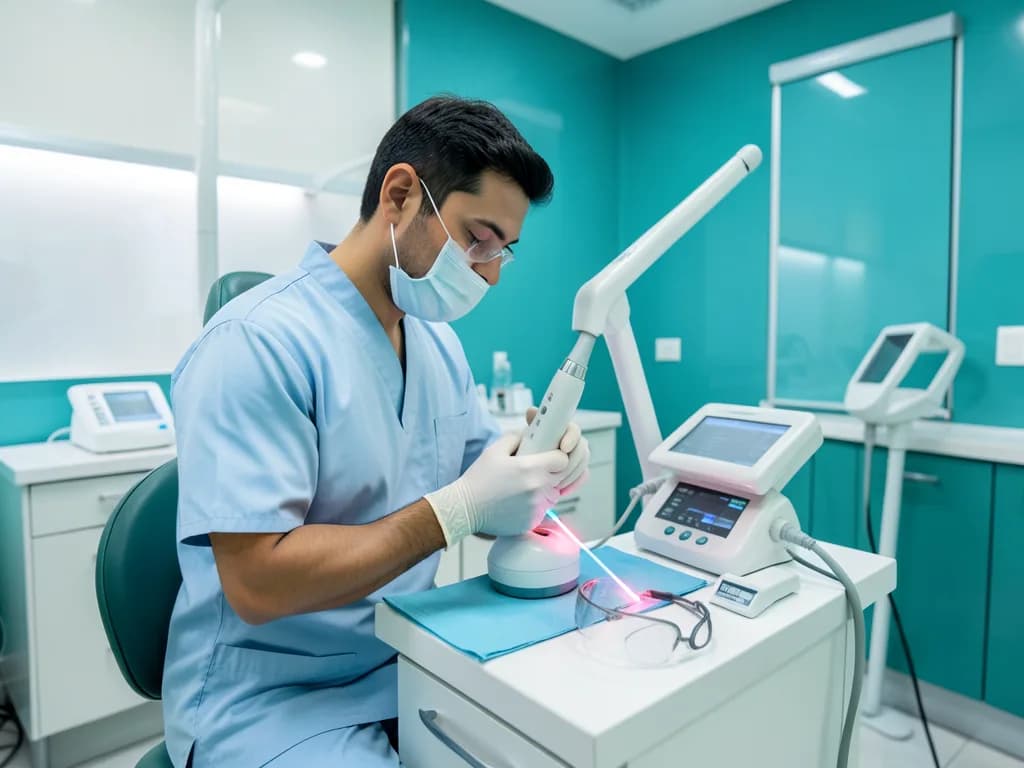
What Is Laser Dentistry
Dental lasers use concentrated beams of light energy at specific wavelengths to cut, reshape, or sterilise tissue with far more precision than conventional drills and scalpels. Different laser wavelengths interact differently with tissue — some are absorbed primarily by water (targeting hard tissue such as bone and enamel), others by pigment (targeting soft tissue such as gums and blood vessels), and others by bacteria-produced compounds (making them highly effective for periodontal sterilisation).
The result is a category of dental procedures that typically produce less bleeding (lasers cauterise as they cut), less postoperative swelling, faster healing, reduced risk of bacterial infection, and often a more comfortable experience for the patient. Many laser procedures eliminate the need for stitches entirely, and some soft-tissue treatments can be performed with only a topical anaesthetic — no injections needed.
It is important to note that laser dentistry is not a replacement for all conventional dental care — complex extractions, multi-surface restorations, and orthodontics still require conventional techniques. Lasers are powerful adjuncts and alternatives for specific procedures, not a universal solution. When considering laser treatment, always ask your dentist whether laser is clinically indicated for your specific situation or whether it is simply being offered as a premium add-on.
Advantages of Laser Dentistry
Less Bleeding
Lasers cauterise blood vessels as they work, dramatically reducing bleeding during and after soft-tissue procedures. This is particularly valuable for patients on blood thinners or those with bleeding disorders.
Faster Healing
Laser-treated tissue heals significantly faster than tissue cut with a scalpel. Low-level laser light also has a biostimulatory effect on cells, accelerating tissue regeneration in the treatment zone.
Often No Stitches
The precision of laser cutting and the cauterising effect frequently eliminates the need for sutures. This reduces postoperative visits and the discomfort of suture removal.
Greater Precision
Laser energy can be targeted to the exact tissue that needs treatment, preserving surrounding healthy tissue. This is particularly important in gum contouring, where precise shaping determines the cosmetic result.
Reduced Anaesthetic Need
Many laser soft-tissue procedures require only topical anaesthetic gel rather than injected local anaesthetic. This is a major benefit for needle-anxious patients, particularly children and those with dental phobia.
Lower Infection Risk
Laser energy sterilises the tissue as it cuts, significantly reducing the risk of post-procedure infection. This is especially important for immunocompromised patients and those with conditions such as diabetes.
Why Choose Laser Dentistry in Dubai
Dubai has become a regional hub for advanced laser dentistry, with clinics across the city investing heavily in the latest dental laser technology. Laser dentistry appeals to patients who want a more comfortable dental experience — reduced bleeding, less pain, faster recovery, and fewer follow-up visits are the core benefits driving demand. For patients who experience dental anxiety, laser dentistry removes many of the triggers that make traditional dental visits stressful: there is no drill noise, no vibration, and in many cases no need for injections.
The applications of laser dentistry continue to expand. Beyond the well-known soft-tissue procedures such as gum contouring and frenectomy, dental lasers are now routinely used for cavity detection (DIAGNOdent), teeth whitening activation, periodontal pocket sterilisation, root canal disinfection, and biopsy of oral lesions. Clinics such as American Hospital Dubai, Dr Joy Dental Clinic, Dr Michael's Dental Clinic, DRHC Dental Clinic, DentalZorg near JLT, and Novomed all offer specialised laser dentistry services with trained practitioners and multiple laser systems.
Cost is one of the main considerations when choosing laser dentistry. Dental laser equipment is a significant investment for clinics — individual units cost between USD 6,000 and USD 100,000 — which explains why laser procedures carry a premium over conventional treatment. However, the total cost of care is often comparable when you account for fewer follow-ups, faster healing, reduced medication needs, and less time off work. When evaluating whether laser dentistry is right for your treatment, ask your dentist whether the laser provides a genuine clinical advantage for your specific procedure or whether it is being offered as an optional premium upgrade.
Types of Dental Laser Used in Dubai
Diode Laser
810–980 nmClinical uses: Soft tissue only: gum contouring, frenectomy, sulcular debridement, ulcer and cold sore treatment, soft-tissue crown lengthening
Dubai availability: Most common in Dubai — found at the majority of laser-equipped clinics
Er:YAG Laser
2,940 nmClinical uses: Hard and soft tissue: cavity preparation (alternative to drill), calculus removal, root surface debridement, root canal sterilisation adjunct
Dubai availability: Available at specialist clinics and larger dental centres
Nd:YAG Laser
1,064 nmClinical uses: Periodontal pockets: kills bacteria deep in gum pockets, used in LANAP protocol for advanced periodontitis treatment without scalpel surgery
Dubai availability: Available at periodontal specialist and implant-focused clinics in Dubai
CO2 Laser
10,600 nmClinical uses: Oral surgery: biopsy, excision of benign lesions, fibroma removal, aphthous ulcer treatment, soft-tissue surgeries requiring high precision
Dubai availability: Found at oral surgery and hospital-based dental departments
Laser Dental Treatments — Dubai Costs 2026
Indicative AED price ranges. Costs vary by clinic tier, number of teeth treated, and procedure complexity. For the full Dubai dental cost overview, see our 2026 dental cost guide.
| Treatment | Laser Type | Cost (AED) |
|---|---|---|
| Gum Contouring (Gum Lift) | Diode | 500–2,500 |
| LANAP (Periodontal Treatment) | Nd:YAG | 800–2,000 per quadrant |
| Frenectomy (Tongue-tie / Lip-tie) | Diode / CO2 | 800–2,000 |
| Mouth Ulcer / Cold Sore Treatment | Diode | 200–500 |
| Laser Teeth Whitening (Activation) | Diode / LED | 800–2,500 |
| Root Canal Sterilisation (Adjunct) | Er:YAG / Nd:YAG | Included in RCT cost |
| Biopsy / Lesion Removal | CO2 / Diode | 500–2,000 |
| DIAGNOdent Cavity Detection | Diode (diagnostic) | 50–200 (additional) |
All amounts in AED. Confirm fees before treatment. No VAT applies to dental treatment in the UAE.
See our full 2026 dental cost guide or check your insurance coverage.
Laser Gum Contouring in Dubai — What to Expect
Laser gum contouring — also called a gum lift, gingivectomy, or crown lengthening — is one of the most commonly requested cosmetic laser procedures in Dubai. It reshapes the gumline to expose more of the tooth crown, correcting a "gummy smile" where the upper lip reveals too much gum tissue, or evening out an irregular gumline where different teeth show different amounts of gum.
The procedure takes 30 to 90 minutes depending on how many teeth are treated. A topical anaesthetic is applied and, if needed, a small amount of local anaesthetic is injected. The diode laser is then used to remove and reshape the excess gum tissue with high precision, sealing the tissue as it cuts. Patients leave with an immediately visible result — the gumline does not move during healing. Minor tenderness and sensitivity last 1 to 3 days and are managed with over-the-counter paracetamol.
For the cosmetic context — how gum contouring fits into a full smile makeover — see our cosmetic dentistry Dubai guide.
Who is suitable
Patients with excess gum tissue covering the crown; uneven gumline; adequate bone support confirmed on X-ray
Who is not suitable
Gummy smile caused by upper lip hypermobility (needs Botox not laser); insufficient bone support; active gum disease must be treated first
Permanence
Results are permanent in most adults. In younger patients whose jaw is still growing, minor gum regrowth is possible
Combining with veneers
Gum contouring is often done 4–6 weeks before veneer placement to allow the gumline to stabilise before impression taking
When Laser Is Not the Right Choice
Laser dentistry is a powerful set of tools, but it is not universally superior to conventional techniques. Knowing when a laser adds genuine value versus when it is unnecessary is important for making informed treatment decisions.
Complex multi-rooted extractions
Surgical extraction still requires sectioning the tooth and elevating flaps — lasers have a limited role here
Large multi-surface fillings
Er:YAG lasers can prepare small cavities but for extensive restorations conventional high-speed drilling remains faster and more efficient
Orthodontic treatment
Braces and aligner-based straightening are unaffected by laser technology; it is not a shortcut to straighter teeth
Advanced bone loss requiring grafting
Severe periodontitis with significant bone destruction requires bone grafting procedures that lasers alone cannot address
Purely cosmetic add-on to routine procedures
Some clinics charge a laser surcharge for procedures that do not clinically benefit from laser use — ask your dentist to explain why laser is indicated for your specific case
Who Is a Good Candidate for Laser Dentistry
Most patients qualify for at least some form of laser dentistry. The technology is particularly well-suited to specific profiles — understanding whether you are a good candidate helps you have a more productive conversation with your dentist about whether laser treatment is genuinely the right choice for your situation. For cosmetic procedures such as gum contouring, also explore our gummy smile correction Dubai guide.
Patients with dental anxiety
Laser procedures eliminate the drill noise, vibration, and pressure that trigger most dental anxiety. Many soft-tissue procedures require no injections at all — just a topical anaesthetic gel. This makes laser dentistry particularly well-suited for needle-phobic patients and those with a strong gag reflex.
Patients needing soft-tissue procedures
Gum contouring (gingivectomy), frenectomy (tongue-tie or lip-tie release), gingival fibroma removal, and sulcular debridement are all ideal applications. Diode lasers perform these with minimal bleeding, no sutures, and healing that is typically 3–5x faster than scalpel surgery.
Patients with advanced periodontitis
LANAP (Laser-Assisted New Attachment Procedure) using an Nd:YAG laser is a clinically validated alternative to traditional flap surgery for treating advanced gum disease. It targets and destroys bacteria in periodontal pockets without incisions or sutures.
Patients with recurrent mouth ulcers or cold sores
Low-level diode laser therapy (photobiomodulation) reduces pain within minutes and shortens healing time from the typical 7–14 days to 3–5 days. No anaesthetic is required and treatment takes just 1–3 minutes per lesion.
Pregnant women (limited procedures)
Soft-tissue laser procedures can be performed during pregnancy, particularly for urgent gum treatments. Laser sterilisation reduces the need for post-procedural antibiotics — an advantage when minimising medications during pregnancy. Complex procedures are typically deferred to after delivery.
Patients needing large multi-surface restorations
For large fillings and complex posterior restorations, conventional high-speed drilling remains faster and more efficient than Er:YAG laser cavity preparation. The laser advantage is primarily for small cavity preparations and areas requiring minimal tissue removal.
Patients with pacemakers (some laser types)
Some older pacemaker models may be susceptible to electromagnetic interference from Nd:YAG lasers. Patients with pacemakers should inform their dentist and cardiologist before any laser procedure. Diode lasers at low settings are generally considered safe but always requires medical clearance.
Laser Dentistry vs Traditional Methods — Direct Comparison
The table below compares laser versus conventional treatment for three common procedures. These comparisons are based on typical Dubai clinic scenarios. For full procedure costs, see our 2026 dental cost guide and gum recession treatment Dubai.
Cavity preparation
Laser — Er:YAG laser
Pain level: Minimal — often no injection
Healing time: N/A (hard tissue)
AED cost: AED 600–1,200
Conventional — High-speed drill
Pain level: Moderate — local anaesthetic needed
Healing time: N/A (hard tissue)
AED cost: AED 300–800
Laser best for: Small cavities, anxious patients, children
Gum surgery (soft tissue)
Laser — Diode laser gingivectomy
Pain level: Minimal — topical only
Healing time: 1–3 days
AED cost: AED 500–2,500
Conventional — Scalpel and sutures
Pain level: Moderate — injection required
Healing time: 7–14 days
AED cost: AED 800–3,000
Laser best for: Gum contouring, cosmetic procedures, anxious patients
Periodontal treatment
Laser — LANAP (Nd:YAG)
Pain level: Low — injection needed, no stitches
Healing time: 2–5 days
AED cost: AED 800–2,000 per quadrant
Conventional — Flap surgery (scalpel)
Pain level: Moderate — injection and sutures
Healing time: 10–21 days
AED cost: AED 600–1,800 per quadrant
Laser best for: Advanced periodontitis, patients avoiding surgery
Risks and Potential Complications of Laser Dentistry
Laser dentistry has an excellent safety record when performed by trained, certified practitioners using properly calibrated equipment. The risks are far lower than many patients assume — however, understanding them allows you to ask the right questions when choosing a laser dentist in Dubai.
Thermal damage to surrounding tissue
Low (trained operator)If used incorrectly or at the wrong power setting, laser energy can burn or char surrounding healthy tissue. This risk is minimised by clinicians with proper laser training and WCLI (World Clinical Laser Institute) certification. Always ask about the treating dentist's laser training credentials.
Eye injury from laser beam
Negligible (with safety protocol)Direct or reflected laser beam exposure can cause permanent retinal damage. All patients and clinical staff must wear wavelength-specific protective eyewear during every laser procedure. This is standard protocol at all properly equipped clinics. The risk is negligible when protective glasses are used.
Post-operative sensitivity
Low to ModerateEr:YAG laser use on hard tissue (cavity preparation) can cause temporary sensitivity similar to conventional drilling. Soft-tissue laser procedures may cause mild soreness lasting 1–3 days. Both are typically managed with over-the-counter paracetamol or ibuprofen.
Incomplete treatment for complex cases
Moderate (if wrong application)Lasers cannot replace conventional treatment for complex cases such as severe bone loss, multi-rooted extractions, or large restorations. If a laser is used as the sole treatment modality in a case that genuinely requires conventional surgery, the clinical outcome can be compromised.
Higher cost with no additional benefit
Moderate (at some clinics)Some clinics add a laser surcharge to procedures that do not clinically benefit from laser use. Bacterial decontamination with laser during routine scaling, for example, has limited evidence for patients without periodontitis. Always ask your dentist to explain the specific clinical benefit of laser for your procedure.
Overall safety perspective: The most important safety factor in laser dentistry is the operator — not the equipment. A dentist with WCLI (World Clinical Laser Institute) or equivalent training, adequate supervised clinical hours, and understanding of laser physics will produce safe, predictable results. When enquiring at a Dubai clinic, ask whether the treating dentist holds a laser safety certification and how many procedures of your specific type they have performed with laser. See our dental treatments Dubai guide for general treatment safety guidance.
Technology and Equipment Used in Dubai Laser Clinics
Not all dental lasers are equal. The specific system in use at a clinic determines which procedures can be performed and to what standard. Here are the key laser systems you may encounter at advanced dental clinics in Dubai, from the Biolase Waterlase to the LANAP PerioLase and the DIAGNOdent diagnostic device.
Biolase Waterlase iPlus (Er,Cr:YSGG)
Hard and soft tissueThe flagship all-tissue dental laser system from Biolase. Uses a combination of laser energy and water spray (hydrokinetic technology) to cut both hard tissue (enamel, dentine, bone) and soft tissue (gums) with remarkable precision and minimal thermal damage. Widely considered the gold standard for clinics offering no-drill dentistry. The Waterlase can prepare cavities, perform frenectomies, do bone surgery, and sterilise root canals — a truly versatile system.
Diode Laser (810–980 nm, various brands)
Soft tissue onlyThe most common type in Dubai clinics. Compact, affordable, and highly effective for all soft-tissue procedures including gum contouring, frenectomy, ulcer treatment, teeth whitening activation, and sulcular debridement. Brands include Biolase EZlase, Sirona SIROLaser, Dentsply Sirona, and AMD Lasers. For laser sterilisation and bacterial decontamination of periodontal pockets, the diode is routinely used as an adjunct to scaling and root planing.
LANAP Protocol (PerioLase MVP-7 Nd:YAG)
Periodontal treatmentThe LANAP (Laser-Assisted New Attachment Procedure) protocol uses the PerioLase MVP-7 Nd:YAG laser specifically designed for periodontal therapy. The laser selectively destroys bacteria and diseased tissue in periodontal pockets while leaving healthy connective tissue intact — allowing genuine regeneration of the periodontium. LANAP is the only laser periodontal therapy with published peer-reviewed evidence of true periodontal regeneration (new cementum, new bone, new periodontal ligament). Clinics offering LANAP in Dubai typically charge per quadrant.
DIAGNOdent (KaVo) — Laser Cavity Detection
Diagnostic (hard tissue)Uses a low-power diode laser at 655 nm to detect early interproximal and occlusal caries that are not visible on conventional X-rays or clinical examination. The device measures the fluorescence of reflected laser light — healthy enamel fluoresces at low levels, decayed tissue at higher levels. DIAGNOdent pen readings above 20 indicate early enamel caries; above 30 indicate dentinal involvement. Used as a preventive screening tool at check-up appointments (AED 50–200 as add-on). Early detection means smaller, less expensive restorations.
Questions to ask your clinic: Which specific laser system do you use? Is the treating dentist WCLI certified? Can you show me cases of this procedure performed with laser? These questions quickly distinguish clinics that have invested in both the equipment and the training from those that own a single diode laser used primarily as a marketing differentiator. Browse DHA-licensed clinics offering laser dentistry and compare their treatment menus.
Recovery and Aftercare After Laser Dental Treatment
One of the primary advantages of laser dentistry over conventional surgical approaches is faster healing with less post-operative discomfort. Recovery varies by procedure type.
Gum contouring
1–3 days- •Mild tenderness managed with paracetamol
- •Eat soft foods for 24–48 hours
- •Avoid spicy, acidic, or very hot foods for 3 days
- •Gentle brushing around treated area — use a soft brush
- •Results are immediately visible — gumline is set
LANAP periodontal treatment
2–5 days- •Soft diet for 3–7 days — no hard, crunchy, or sticky foods
- •Avoid smoking — significantly impairs healing
- •Antibiotic rinse (chlorhexidine) as prescribed
- •Return visit at 3 weeks to check pocket depths
- •Full bone regeneration assessment at 3–6 months
Frenectomy (tongue or lip tie)
3–7 days- •Stretching exercises as instructed — critical to prevent reattachment
- •Ice chips or cold water to reduce swelling in first 24 hours
- •Paracetamol for soreness as needed
- •Return for wound check at 1 week
- •Infants: breastfeed immediately — feeding often improves within hours
Compared to conventional surgical approaches, laser procedures require less pain medication, fewer post-operative visits, and significantly shorter social downtime. Most patients having laser gum contouring return to work the same day or the following morning. LANAP patients typically resume normal activities within 2–3 days — compared to 1–2 weeks for conventional periodontal surgery. See our dental insurance Dubai guide to check whether post-operative follow-up visits are included in your plan.
Insurance Coverage for Laser Dentistry in Dubai
UAE health insurance plans classify procedures by clinical indication, not by technology used. This means that a laser gingivectomy for a clinical gum condition is treated the same as a conventional gingivectomy for insurance purposes — the laser is simply the delivery method. Here is a practical breakdown.
LANAP periodontal treatment
Covered on plans with periodontal benefits — same rate as conventional flap surgery. Requires periodontitis diagnosis code and pre-authorisation.
Laser frenectomy (tongue-tie / lip-tie)
Typically covered on basic and enhanced plans when there is a functional indication (feeding, speech). Purely aesthetic lip-tie release may not be covered.
Laser biopsy of oral lesion
Usually covered as a diagnostic/surgical procedure. Histopathology lab fee is separate and also typically covered.
Laser gum contouring — cosmetic
Not covered — classified as cosmetic. The gummy smile is an aesthetic concern not a medical condition. Purely cosmetic gum reshaping is universally excluded.
Laser-activated teeth whitening
Teeth whitening is always cosmetic — never covered by UAE dental insurance regardless of method.
DIAGNOdent cavity detection
May be covered as part of a dental check-up on enhanced plans. Confirm as it is often listed as an optional add-on charge.
Always get prior authorisation — before proceeding with any laser treatment you believe may be covered, contact your insurer and request written pre-authorisation. Provide the procedure code and diagnosis. For a full guide to dental insurance in the UAE including Daman, AXA, Bupa, MetLife, and Cigna coverage, see our dental insurance Dubai guide and dental insurance for expats.
Choosing a Top Rated Laser Dentistry Specialist in Dubai
Laser dentistry outcomes depend more on the operator's training and clinical experience than on the brand of equipment. Here is what to look for when evaluating a laser dentist or laser-equipped clinic in Dubai.
WCLI Certification
The World Clinical Laser Institute (WCLI) offers internationally recognised laser certification for dental professionals. Dentists with WCLI training have completed both theoretical and hands-on clinical modules with specific laser systems. Ask to see the certificate — many laser-competent Dubai dentists display them.
Multiple laser systems
Clinics with both a diode laser and an Er:YAG or Nd:YAG system offer a wider range of laser procedures and are more likely to have genuine laser expertise versus clinics that bought a single diode for soft-tissue add-ons. The Biolase Waterlase indicates a serious investment in laser technology.
Volume of laser procedures
Ask how many laser frenectomies, LANAP sessions, or gum contouring procedures the treating dentist has performed. A dentist performing laser procedures weekly will have far better technique refinement than one who uses the laser occasionally. High procedure volume is the single best predictor of consistent outcomes.
Before-and-after documentation
Skilled laser dentists maintain photographic records of their cases. For cosmetic gum contouring in particular, before-and-after images reveal the evenness of the gumline, proportionality, and healing quality. A dentist who cannot show real patient cases for the specific procedure you need is a concern.
Related Treatments and Guides
Gum Disease Treatment Dubai
Comprehensive guide to periodontal care
Gum Treatment Cost Dubai
Pricing for all gum disease treatments
Cosmetic Dentistry Dubai
Full guide to smile makeovers in Dubai
Dental Treatments Dubai
Overview of all procedures available
Teeth Whitening Dubai
Laser and non-laser whitening options
Gummy Smile Correction Dubai
Gum contouring and lip treatment options
Gum Recession Treatment Dubai
Grafting and laser treatment for receding gums
Dental Veneers Dubai
Porcelain and composite veneer guide
Smile Makeover Dubai
Combined treatment planning for a full smile
Find a Dentist
Search laser-equipped Dubai clinics
Frequently Asked Questions
Is laser dentistry painful?
Most laser dental procedures involve little to no pain, and many patients require less local anaesthetic than they would for conventional treatment with drills or scalpels. The laser energy precisely targets tissue without the vibration and pressure that patients associate with dental drills. For soft-tissue procedures such as gum contouring, frenectomy, and ulcer treatment, some clinics perform the procedure with only a topical anaesthetic gel, without any injections. That said, some laser procedures — particularly LANAP periodontal treatment across multiple quadrants — do require conventional local anaesthetic injections for patient comfort.
What types of laser are used in dentistry?
The main types used in Dubai clinics are: Diode lasers (soft tissue only — gum contouring, frenectomy, ulcer treatment, sulcular debridement); Er:YAG lasers (hard and soft tissue — cavity preparation, root canal sterilisation, calculus removal); Nd:YAG lasers (periodontal pockets — kills bacteria deep in pockets, used in LANAP protocols); and CO2 lasers (oral surgery, biopsy, lesion removal). Not every clinic has all types — when researching clinics, ask which laser systems they use and whether those systems are appropriate for the specific procedure you need.
How much does laser gum contouring cost in Dubai?
Laser gum contouring (also called a gum lift or gingivectomy) typically costs AED 500 to AED 2,500 in Dubai, depending on how many teeth are being treated and the clinic's tier. A minor correction to one or two teeth is at the lower end of the range. A full smile correction across six to ten upper teeth is at the higher end. The procedure usually takes one appointment of 30 to 90 minutes and results are immediate — there is no healing period during which the gumline changes. Results are permanent in most cases.
What is LANAP and how does it compare to traditional gum surgery?
LANAP (Laser-Assisted New Attachment Procedure) is a minimally invasive treatment for advanced periodontitis that uses an Nd:YAG laser to selectively destroy bacteria in periodontal pockets while leaving healthy tissue intact. Unlike traditional flap surgery — which cuts and folds back the gum tissue with a scalpel — LANAP does not require incisions or sutures. Postoperative discomfort is typically lower, healing is faster, and most patients can return to normal activity the same day. In Dubai, LANAP is performed at specialist periodontal clinics. It is priced per quadrant (quarter of the mouth), with costs typically ranging from AED 800 to AED 2,000 per quadrant.
Can laser treatment remove mouth ulcers?
Yes — low-level diode laser therapy is one of the most effective treatments for mouth ulcers (aphthous ulcers) and cold sores. A brief application of laser energy (typically 1 to 3 minutes per lesion) significantly reduces pain within minutes and accelerates healing from the typical 7 to 14 days down to 3 to 5 days. The laser does not cure the underlying cause of recurrent aphthous stomatitis, but it dramatically reduces the discomfort and duration of each episode. Treatment costs AED 200 to AED 500 per session. No anaesthetic is needed — patients feel only mild warmth during the procedure.
Is laser dentistry covered by UAE health insurance?
Coverage depends on the procedure and your specific plan. Laser treatment for a clinical indication — such as LANAP for periodontal disease, frenectomy for a tongue-tie affecting speech or feeding, or biopsy of a suspicious lesion — is more likely to be covered than cosmetic gum contouring. Insurers classify procedures by their clinical necessity rather than the technology used, so the same procedure with a laser may be covered if it would have been covered conventionally. Cosmetic gum contouring (purely to improve the appearance of a gummy smile) is typically excluded. Always obtain prior authorisation and confirm coverage in writing before proceeding.
What is a frenectomy and does it need a laser?
A frenectomy is the removal or release of a frenum — the small band of tissue connecting the lips to the gums (labial frenum) or the tongue to the floor of the mouth (lingual frenum). A tight lingual frenum causes tongue-tie (ankyloglossia), which can affect breastfeeding in infants, speech development in children, and oral hygiene in adults. A tight labial frenum can create a gap between the front teeth (diastema). Laser frenectomy is preferred over traditional scalpel frenectomy because it produces less bleeding, does not require sutures, has lower infection risk, and heals faster. In Dubai it costs AED 800 to AED 2,000. Infants can feed within an hour of a laser tongue-tie release.
Why is laser dentistry more expensive than conventional treatment?
Laser dentistry costs more primarily because dental laser equipment is expensive — a single clinical-grade laser unit costs USD 6,000 to USD 100,000 depending on the type and manufacturer. Clinics need to recoup this investment through treatment fees. However, the higher upfront cost is often offset by reduced recovery times, fewer follow-up appointments, lower risk of complications, and less need for anaesthesia. When comparing prices, factor in the total cost of care including follow-ups, pain medication, and time off work — not just the procedure fee.
Which Dubai clinics are known for laser dentistry?
Several well-known dental centres in Dubai offer advanced laser dentistry services. American Hospital Dubai provides precision oral care with laser technology as part of their comprehensive dental department. Dr Joy Dental Clinic is recognised for laser dental treatment across multiple branches. Dr Michael's Dental Clinic, DRHC Dental Clinic, DentalZorg near JLT, and Novomed all offer specialised laser dentistry procedures. When choosing a clinic, ask which specific laser systems they use, how many laser procedures the treating dentist has performed, and whether the laser is appropriate for your particular treatment.
Can laser dentistry be used for cavity detection?
Yes — laser cavity detection using devices such as DIAGNOdent is one of the most practical applications of laser dentistry. The device shines a low-power laser beam onto the tooth surface and measures the fluorescence of the reflected light. Decayed tooth structure fluoresces differently from healthy enamel, allowing the dentist to detect cavities at a much earlier stage than visual examination or even X-rays. The procedure is painless, takes seconds per tooth, involves no radiation, and costs AED 50 to AED 200 as an add-on to a standard check-up. Early detection means smaller, less expensive fillings.
How does laser dentistry compare to traditional dental drills?
Laser dentistry differs from traditional drills in several important ways. Dental lasers produce no vibration, no pressure, and no high-pitched noise — eliminating the three sensations patients fear most about dental visits. Lasers cauterise tissue as they work, producing significantly less bleeding than scalpels. Many laser procedures require less or no local anaesthetic compared to drill-based treatment. Recovery is faster because lasers cause less trauma to surrounding tissue. The main limitations of laser dentistry are that lasers cannot yet handle all types of dental work — large fillings, complex extractions, and orthodontic adjustments still require conventional instruments.
Find a Laser Dentist in Dubai
Use our find the right dental clinic to compare clinics, read reviews, and book appointments.
Browse DHA-licensed clinics offering laser dentistry. Many include gum contouring, LANAP, and laser-assisted whitening on their treatment menus.