Sedation Dentist Dubai — Guide for Anxious Patients 2026
Dental sedation allows anxious patients, those with a severe gag reflex, and patients needing complex treatment to receive dental care comfortably and without fear. Dubai offers four levels of sedation — nitrous oxide, oral tablets, IV conscious sedation, and general anaesthesia — at DHA-licensed clinics and hospitals. This guide covers all types, 2026 AED costs, who qualifies, and what to expect. For dental anxiety support, see our dentist for dental anxiety Dubai page.
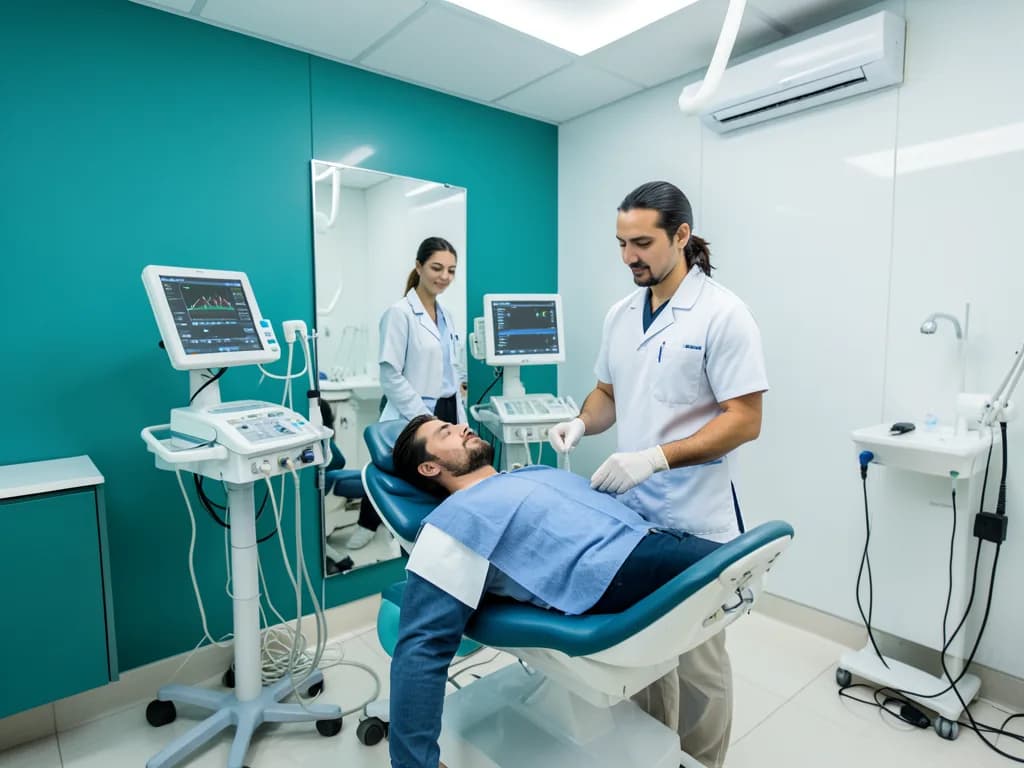
Types of Dental Sedation Available in Dubai
Each sedation level suits different anxiety levels, procedure lengths, and patient circumstances. The safest and least invasive method that achieves adequate comfort is always preferred.
Nitrous oxide is delivered through a small nasal mask throughout the procedure, producing a pleasant relaxed, floaty feeling. You remain fully conscious and responsive. The effect wears off within minutes of removing the mask — most patients can drive themselves home after a short rest. This is the mildest form of sedation and is suitable for mild dental anxiety, gag reflex issues, and nervous children at paediatric-friendly clinics.
Advantages
- ✓ Wears off quickly — can drive home after recovery
- ✓ Safe for most patients including many children
- ✓ Easily titrated — dose adjusted in real time
- ✓ No injections required for the sedation itself
Considerations
- ! Less effective for severe phobia
- ! Not suitable for patients with claustrophobia (nasal mask)
- ! May not be sufficient for long complex procedures
A sedative tablet (typically diazepam or temazepam — benzodiazepine class) is prescribed and taken 1 hour before the appointment. This produces moderate drowsiness and anxiety reduction. You remain conscious and can cooperate with the dentist, but feel very relaxed and may have limited memory of the procedure. The effects last 4–6 hours after ingestion — a responsible adult must escort you home and stay with you.
Advantages
- ✓ No injections required
- ✓ Good anxiety reduction for moderate phobia
- ✓ Often combined with other techniques (nitrous, local)
- ✓ Widely available at Dubai clinics that offer sedation
Considerations
- ! Cannot drive for 24 hours after taking tablet
- ! Requires an escort — cannot attend alone
- ! Variable individual response — some patients remain too anxious
- ! Not suitable for patients with liver disease or certain medications
A sedative medication (typically midazolam, often combined with an analgesic) is administered intravenously by a trained sedationist during the procedure. This produces deep relaxation and amnesia — most patients have no memory of the treatment. You remain breathing independently and responsive to verbal commands, but in a very relaxed state. This is the most effective option for significant dental phobia and for completing multiple treatments in a single long appointment. DHA requires specific facility licensing.
Advantages
- ✓ Deep relaxation with amnesia — no memory of treatment
- ✓ Multiple procedures possible in one visit
- ✓ Allows complex, time-consuming work under sedation
- ✓ Rapidly reversible using reversal drugs if needed
Considerations
- ! Requires IV cannula insertion
- ! Cannot drive for 24 hours — escort required
- ! Requires specifically DHA-licensed facility
- ! Higher cost than oral sedation
The patient is rendered fully unconscious by an anaesthetist in a hospital or fully equipped surgical facility. Used for extreme dental phobia, very young children who cannot cooperate with any other approach, patients with severe special needs, and certain complex oral surgery cases. The dentist performs all planned treatment while the patient is under. General anaesthesia carries higher risks than conscious sedation methods — appropriate patient selection is essential.
Advantages
- ✓ Patient is completely unaware and pain-free
- ✓ Extensive treatment completed in one session
- ✓ Essential for patients who cannot be treated any other way
- ✓ Anaesthetist manages all airway and vital signs
Considerations
- ! Highest cost and risk of all sedation options
- ! Requires hospital or surgical centre with anaesthetist
- ! Recovery takes several hours — overnight stay sometimes needed
- ! Pre-operative fasting and medical assessment mandatory
Sedation Types Side by Side
A quick reference comparison of all four sedation options across five key factors.
| Factor | Nitrous Oxide | Oral Sedation | IV Sedation | General Anaesthesia |
|---|---|---|---|---|
| Sedation depth | Minimal — fully conscious | Mild to moderate — drowsy | Moderate to deep — deeply relaxed | Unconscious |
| Memory of procedure | Full | Partial or none | Usually none | None |
| Additional cost (AED) | 200 – 500 | 300 – 600 | 800 – 2,000 | 3,000 – 8,000+ |
| Can drive after | Yes (after recovery) | No — 24 hours | No — 24 hours | No — 24–48 hours |
| Who administers | Dentist or nurse | Dentist (prescription) | Trained sedationist required | Anaesthetist required |
Who Qualifies for Dental Sedation
Sedation is not just for severe phobia — several clinical and situational factors make it a medically appropriate choice. For an in-depth look at intravenous options specifically, see our IV sedation dentistry Dubai guide.
Dental phobia (odontophobia)
Severe fear of dental treatment preventing regular care, often rooted in past negative experiences.
Severe gag reflex
Uncontrollable gagging that prevents impressions, X-rays, or treatment — sedation significantly reduces gag reflex.
Special needs patients
Patients with autism, intellectual disabilities, or conditions that prevent tolerating dental treatment without sedation.
Multiple treatments in one visit
Combining extractions, fillings, root canals or implant surgery into one long sedated session — cost-efficient despite sedation fee.
Children with severe anxiety
Young children who cannot tolerate dental treatment through behaviour management alone — nitrous oxide first approach, then GA if needed.
Complex oral surgery
Wisdom tooth removal, multiple extractions, sinus lifts, or implant surgeries that are lengthy and uncomfortable under local alone.
Combining multiple treatments: One of the most cost-effective uses of IV sedation is combining multiple treatments in one session. Instead of paying the sedation fee three or four times for separate appointments, a single sedated session covering fillings, extractions, and even an implant placement means you only pay the sedation cost once — making the total cost competitive despite the sedation fee. See our full 2026 dental cost guide or check your insurance coverage.
What to Expect at Your Sedation Dental Appointment
Understanding the process in advance significantly reduces pre-appointment anxiety. If you have not visited a dentist recently, scheduling a routine dental check-up first allows the clinician to assess your needs and recommend the appropriate sedation level. Your general dentist can also provide a referral to a sedation-certified clinic if needed.
- 1
Sedation Consultation and Medical Assessment
Before sedation, a thorough medical history review is essential. The dentist or sedationist checks for contraindications: liver or kidney disease (affects drug metabolism), obstructive sleep apnoea (higher risk under sedation), pregnancy, allergy to benzodiazepines, and medications that interact with sedatives (particularly other CNS depressants). For IV sedation and GA, a pre-operative assessment appointment is standard. Blood pressure and baseline observations are recorded.
- 2
Pre-appointment Instructions
For nitrous oxide: no special fasting required, though a light meal 2 hours before is advisable to reduce nausea. For oral sedation: take the tablet 1 hour before as directed — do not eat after the tablet. For IV sedation and GA: fasting for 6 hours (food) and 2 hours (clear fluids) before the procedure is mandatory for safety. Arrange your escort in advance — IV and GA patients must have a responsible adult with them. No alcohol for 24 hours before IV or GA sedation.
- 3
Sedation Administration
Nitrous oxide is started via nasal mask before local anaesthetic injection — this reduces anxiety during the injection. Oral sedation is already active when you arrive. For IV sedation, a small cannula is inserted (usually in the back of the hand or inner elbow) and the sedative administered slowly while the sedationist monitors oxygen saturation and heart rate throughout. All sedated patients receive local anaesthetic in addition — sedation does not replace pain control.
- 4
Treatment and Recovery
Dental treatment is performed while you are in the sedated state. For nitrous oxide, the gas is turned off at the end of treatment and oxygen administered for 5 minutes — you will be ready to leave within 15–30 minutes. For IV sedation, recovery takes 30–60 minutes in the clinic recovery area before you are discharged with your escort. GA patients may require several hours in recovery. All patients receive written post-operative instructions and an emergency contact number.
DHA Licensing Requirements for Sedation in Dubai
Nitrous Oxide
Available at standard DHA-licensed dental clinics. No special facility licence required beyond standard dental clinic registration. The delivering practitioner should have training in nitrous oxide administration.
Oral Sedation
Requires a valid DHA prescription — the dentist must hold a DHA prescribing licence. The benzodiazepines used (diazepam, temazepam) are controlled medicines in the UAE and require proper prescription documentation.
IV Conscious Sedation
Requires DHA facility licensing for sedation services and a trained sedationist (dentist or anaesthetist with sedation qualification). The clinic must maintain resuscitation equipment and trained recovery staff. Not all Dubai dental clinics hold this licence.
General Anaesthesia
Must be performed in a DHA-licensed hospital, day surgery centre, or surgical facility. Requires a medical anaesthetist. Cannot be performed in a standard dental clinic. Hospital dental departments and specialist surgical centres offer this service.
Risks and Potential Complications of Dental Sedation
Dental sedation in Dubai is very safe when performed at a properly equipped, DHA-licensed facility by qualified practitioners. Understanding the potential risks helps you make an informed decision. For advanced intravenous techniques, see our dedicated IV sedation dentistry Dubai guide.
Respiratory Depression
IV and oral sedation — managed by monitoringThe most serious risk with IV sedation and oral sedation is slowing of breathing. Continuous pulse oximetry and capnography monitoring detects any drop in blood oxygen saturation instantly, allowing the sedationist to respond before it becomes clinically significant. Nitrous oxide carries essentially no respiratory depression risk at standard clinical doses.
Over-Sedation
Managed by titration and monitoringAdministering more sedation than intended — most common with oral sedation tablets, which have variable absorption. IV conscious sedation allows precise titration (dose adjustment) in small increments, making over-sedation far less likely than with fixed-dose oral tablets. For benzodiazepines, the reversal drug flumazenil can reverse over-sedation immediately.
Nausea and Vomiting
Mild — preventable with anti-emeticsPost-sedation nausea occurs in approximately 5–10% of patients receiving IV sedation, more commonly in those prone to motion sickness. Anti-nausea medication (ondansetron) can be administered prophylactically. Fasting requirements before IV and GA sedation significantly reduce the risk of aspiration if vomiting occurs.
Allergic Reactions
Rare — medical history screening essentialTrue allergy to benzodiazepines (midazolam, diazepam) is rare but possible. Allergy to nitrous oxide is essentially unheard of. A thorough pre-sedation medical history including all known drug allergies is essential. Emergency adrenaline and antihistamine must be available at any sedation facility — this is a DHA requirement.
Prolonged Drowsiness
Managed by dose adjustment and ASA screeningSome patients metabolise sedative drugs more slowly due to liver function, age, or drug interactions. Elderly patients and those with any liver impairment may experience sedation effects lasting beyond 24 hours. This is managed by adjusting the dose during the pre-sedation assessment and using the minimum effective dose with incremental titration.
Venous Access Complications
Minor — resolves within daysIV sedation requires a cannula insertion — bruising at the site is common and resolves within a few days. Phlebitis (vein inflammation) is uncommon. In rare cases, the cannula may need to be resited if the initial vein is unsuitable. Clinics apply topical anaesthetic cream before insertion to minimise discomfort.
Patient classification matters: Your dentist uses the ASA (American Society of Anesthesiologists) classification system to assess your fitness for sedation. ASA I (healthy) and ASA II (mild systemic disease, well-controlled) patients are good candidates for all sedation levels. ASA III patients (significant systemic disease) require additional assessment. Thorough pre-sedation screening by a qualified sedationist eliminates most risk factors before treatment begins. Always disclose all medical conditions and medications at your consultation.
Recovery and Aftercare Following Dental Sedation
Recovery time and aftercare instructions vary significantly depending on the type of sedation received. Follow your clinic's written instructions carefully — they take precedence over general guidance.
- ✓Pure oxygen is administered for 5 minutes after nitrous oxide is turned off — this clears residual gas from your system
- ✓Most patients feel completely normal within 15 minutes and can drive home after a brief rest
- ✓A light meal is fine after the appointment if no dental post-operative restrictions apply
- ✓No alcohol restrictions specific to nitrous oxide, though follow any general post-procedure instructions from your dentist
- ✓Children should be accompanied home and monitored for the remainder of the day
- ✓Do not drive or operate machinery for 24 hours — the sedation effect from benzodiazepine tablets persists well beyond when you feel alert
- ✓A responsible adult must accompany you home and remain with you for the rest of the day
- ✓Rest at home — avoid making important decisions or signing documents for 24 hours
- ✓Soft foods only for the remainder of the day; avoid alcohol for at least 24 hours as it interacts with oral sedation medication
- ✓Contact the clinic if you experience unusual prolonged drowsiness, confusion, or difficulty breathing
- ✓You will spend 30–60 minutes in the clinic recovery room under nursing supervision before discharge
- ✓A responsible adult must collect you from the clinic — you cannot take a taxi or rideshare alone
- ✓Do not drive, operate machinery, sign contracts, consume alcohol, or make significant decisions for 24 hours
- ✓Eat only light, soft foods for the first few hours — avoid hot drinks and hard foods if any local anaesthetic was given
- ✓Expect to feel drowsy and possibly slightly foggy for the remainder of the day — this is normal
- ✓Report any prolonged drowsiness beyond 24 hours, vein irritation, or post-sedation nausea to the clinic immediately
- ✓Recovery in hospital for several hours under medical supervision — an overnight stay may be required for complex cases
- ✓24–48 hours of restricted activity — no driving, machinery, legal documents, or alcohol
- ✓A responsible adult must be with you for the full 24–48 hours post-discharge
- ✓Follow the anaesthetist's specific post-operative instructions regarding pain medication, nausea management, and diet
- ✓Sore throat is common after general anaesthesia (from the airway tube) — gargling warm salt water helps
- ✓Attend your scheduled follow-up appointments — do not cancel even if you feel well
Planning your post-sedation day: Book the day after IV sedation or GA off work if possible — especially if your role involves driving, operating equipment, or making critical decisions. Arrange childcare if needed. Have soft food and water at home. Put the clinic's emergency number in your phone before your appointment. Most patients are surprised by how straightforward recovery is — the main requirement is simply not being alone. For complex procedures such as dental implant surgery or wisdom tooth removal, additional post-operative instructions specific to the procedure also apply.
Technology and Safety Equipment at Dubai Sedation Clinics
The DHA sets minimum equipment standards for facilities offering IV conscious sedation in Dubai. When evaluating a sedation clinic, ask about the specific monitoring equipment in use — these are indicators of the facility's investment in patient safety.
Pulse Oximetry
A continuous non-invasive measurement of blood oxygen saturation (SpO2) and pulse rate. The oximeter clips onto a fingertip and alarms immediately if oxygen levels fall below the safe threshold. This is the most fundamental monitoring requirement for all sedation levels above nitrous oxide. Normal SpO2 is 97–100%; any reading below 94% requires immediate clinical response.
Capnography
End-tidal CO2 (ETCO2) monitoring measures the concentration of carbon dioxide in exhaled breath, providing the earliest warning of respiratory depression — before oxygen levels drop. Required for IV sedation at DHA-licensed facilities. The waveform pattern also confirms airway patency and adequate breathing rate throughout the procedure.
Non-Invasive Blood Pressure Monitoring
Automated blood pressure measurement every 3–5 minutes throughout the procedure. Sedative drugs can cause blood pressure changes, particularly in hypertensive patients or those taking antihypertensive medications. Continuous blood pressure tracking allows dose adjustments and fluid management as needed during longer procedures.
ECG Monitoring
Electrocardiogram monitoring of heart rate and rhythm is recommended for patients with cardiac history and during longer IV sedation sessions. Detects arrhythmias, bradycardia, and other cardiac changes that may occur under sedation. Required at premium facilities and hospital dental departments for all IV sedation cases.
Emergency Resuscitation Equipment
DHA-licensed IV sedation facilities must maintain: supplemental oxygen delivery with bag-valve-mask ventilation, suction apparatus, an automated external defibrillator (AED), flumazenil (benzodiazepine reversal agent), adrenaline, atropine, and other emergency drugs. All sedation team members must hold current BLS (Basic Life Support) certification, and the sedationist must hold ACLS (Advanced Cardiovascular Life Support) or equivalent.
Recovery Area Standards
A dedicated recovery area with a reclining chair or trolley, oxygen supply, suction, monitoring equipment, and a call system is required. Recovery must be supervised by a trained recovery nurse, not simply observed from reception. Patients are discharged only when meeting formal discharge criteria, not simply when they feel awake — a critical safety distinction.
Questions to ask your sedation clinic: "Do you have capnography monitoring for IV sedation?" "Is flumazenil immediately available?" "What are the sedationist's qualifications and DHA registration number?" "Can I see your sedation facility licence?" A clinic that answers these confidently and transparently is demonstrating the safety culture that makes dental sedation so safe in properly equipped facilities. For comprehensive treatment information, see our dental treatments Dubai hub.
Finding a Top Rated Sedation Dentist in Dubai
Not every Dubai dental clinic offers all levels of sedation — and fewer still hold the DHA facility licence required for IV conscious sedation. Here is what to look for when choosing a sedation dentist.
What Makes a Qualified Sedation Dentist in Dubai
DHA Registration
All dentists in Dubai must hold a DHA licence. Verify your dentist is registered by checking their DHA licence number through the Sheryan portal. For sedation specifically, ask whether the dentist holds a DHA sedation endorsement or works with a separately registered sedationist.
Sedation-Specific Training
The ideal sedation dentist will have completed a recognised postgraduate qualification in conscious sedation — such as the UK Intercollegiate Sedation qualification, SAAD (Society for the Advancement of Anaesthesia in Dentistry) diploma, or equivalent international credential. These dentists understand sedation pharmacology, patient selection, monitoring, and emergency management at a level beyond basic clinical training.
Anaesthesiology Background for IV Sedation
For IV conscious sedation and general anaesthesia, many premium Dubai clinics use a medical anaesthetist — a doctor with postgraduate specialist training in anaesthesiology — rather than a dentist with a sedation qualification. This is considered the gold standard and provides the highest margin of safety, particularly for patients with complex medical histories.
DHA Facility Sedation Licence
The clinic itself must hold a DHA facility licence specifically covering sedation services. This is separate from the standard dental clinic licence and verifies that the facility's equipment, staffing ratios, and protocols meet DHA requirements for sedation. Ask to see this licence before booking.
Experience and Volume
Ask how many IV sedation cases the clinic performs per month. High-volume sedation practices have more experienced teams, better-established emergency protocols, and smoother patient pathways. Clinics that offer sedation only occasionally may not maintain the same readiness as those who perform it regularly.
Dental Sedation for Children in Dubai
Dental anxiety in children is extremely common — and dental sedation allows young patients who cannot be managed through behaviour guidance alone to receive necessary treatment safely. Paediatric sedation follows a stepwise approach, starting with the least invasive option.
Nitrous Oxide for Children
Nitrous oxide (laughing gas, N2O) is considered the first-line sedation option for children in Dubai. It is extremely safe, wears off within minutes, and requires no injections for the sedation itself. The nasal mask is non-threatening and the pleasant floating sensation quickly reduces anxiety. Children as young as 3–4 years can use nitrous oxide with good cooperation. Many paediatric dental clinics in Dubai offer nitrous oxide as a routine anxiolysis option for children who are nervous but cooperative. The additional cost is typically AED 200–350 for paediatric patients. Our paediatric dentist Dubai guide covers children's dental anxiety in detail.
Oral Sedation for Children
For children who need more than nitrous oxide but where GA is not yet indicated, oral sedation with a low-dose benzodiazepine (midazolam syrup — more palatable for children than tablets) can provide sufficient anxiolysis for moderate-difficulty procedures. Dose is calculated per body weight and must be prescribed by a paediatric dentist with sedation training. The child must be accompanied by a parent or guardian and must not attend school after oral sedation — rest at home for the remainder of the day is required.
General Anaesthesia for Children
When behaviour management techniques, nitrous oxide, and oral sedation are insufficient — particularly for very young children (under 3 years), children with severe special needs, or those requiring extensive treatment — general anaesthesia in a hospital dental department is the appropriate choice. This allows all necessary treatment to be completed in one session under the care of a paediatric anaesthetist. Hospitals in Dubai offering this service include DHA-licensed hospital dental departments. Parents must be prepared for a hospital admission procedure including pre-operative assessment, theatre waiting, and a recovery period of several hours.
Key point for parents: Sedation for children in Dubai is only available at clinics with appropriate paediatric sedation training and equipment. A standard adult sedation licence does not cover paediatric sedation. Always confirm that the paediatric dentist specifically has experience with sedated paediatric patients and holds the relevant DHA credentials before proceeding. Never accept sedation for a child at a clinic that cannot clearly state its paediatric sedation qualifications. For more on children's dental care, see our guides on paediatric dentistry in Dubai and emergency dentist Dubai.
Does UAE Insurance Cover Dental Sedation?
Coverage is plan-specific — always pre-authorise
UAE health insurance coverage for dental sedation is limited and highly plan-specific. Nitrous oxide is sometimes included as part of a covered procedure with no separate charge. Oral sedation tablets may be covered as a prescription medication under pharmacy benefits. IV sedation and GA are rarely covered under standard dental benefits but may be covered under medical or surgical benefits for procedures that qualify as medically necessary — for example, oral surgery, All-on-4 implants under GA, or sedation for a patient with documented special needs. Pre-authorisation is required from Daman, AXA, Bupa, MetLife, and NextCare — always obtain written confirmation before proceeding. Your dentist must provide clinical justification documentation for the insurer.
Sedation for dental anxiety alone (without a surgical or medical indication) is almost never covered under standard UAE plans. However, if the dental treatment itself is covered as a surgical procedure, some plans will extend that coverage to include the medically necessary sedation component. Always ask your insurer specifically about the sedation element when seeking pre-authorisation for any covered surgical dental procedure.
For complete insurer-by-insurer guidance, see our dental insurance Dubai guide or explore the 2026 dental cost guide for full AED pricing across all treatment types.
Frequently Asked Questions
Is dental sedation safe in Dubai?
Dental sedation in Dubai is safe when performed at a DHA-licensed facility with appropriately qualified practitioners. Nitrous oxide and oral sedation are among the safest sedation methods in medicine — they carry minimal risk in healthy patients when properly administered. IV conscious sedation requires a dentist or sedationist with specific training in sedation and emergency management; the DHA requires facilities offering IV sedation to have appropriate resuscitation equipment, a qualified sedationist, and trained recovery staff. General anaesthesia requires a medical anaesthetist in a properly equipped surgical facility. The key to safety is choosing a clinic that discloses its sedation qualifications and facility licences — ask directly before booking.
How much does dental sedation cost in Dubai?
Dental sedation in Dubai is charged as an additional fee on top of the cost of the dental treatment itself. Nitrous oxide adds AED 200–500 to your treatment cost. Oral sedation (tablet) adds AED 300–600. IV conscious sedation adds AED 800–2,000 depending on procedure duration. General anaesthesia typically adds AED 3,000–8,000 or more to the total treatment cost, reflecting the anaesthetist's fee and surgical facility charges. For patients with significant dental phobia needing extensive treatment, IV sedation can actually be very cost-effective: completing three or four treatments in one sedated session is far cheaper than the cumulative sedation fees of multiple separate appointments.
What should I tell my dentist before sedation?
Before dental sedation in Dubai, always disclose: all current medications including over-the-counter drugs, supplements, and herbal medicines (many interact with sedatives); any history of liver or kidney disease; sleep disorders, particularly obstructive sleep apnoea (significantly increases sedation risk); previous adverse reactions to anaesthesia or sedation; pregnancy or possibility of pregnancy; alcohol or recreational drug use; and any known allergies including medication allergies. Even medications that seem unrelated — such as antidepressants, blood thinners, or epilepsy medications — can have important interactions with sedative drugs. Full disclosure ensures the safest possible experience.
Can I eat before dental sedation?
Fasting requirements depend entirely on the type of sedation. For nitrous oxide only: no fasting required, though avoiding a heavy meal immediately before reduces nausea risk. For oral sedation tablets: avoid eating after taking the tablet; a light meal beforehand is fine. For IV conscious sedation: strict fasting is required — no food for 6 hours and no clear fluids for 2 hours before the procedure. Failure to fast can result in vomiting under sedation, which carries serious aspiration risk. For general anaesthesia: the same strict 6-hour food and 2-hour fluid fasting rule applies and is non-negotiable. Your clinic will confirm the exact instructions when you book your sedated appointment.
Will dental sedation be covered by UAE insurance?
UAE insurance coverage for dental sedation varies by plan. Nitrous oxide may be included as part of a covered procedure at some clinics without a separate charge. Oral sedation tablets are sometimes covered as a prescription medication. IV sedation is rarely covered unless the dental treatment itself requires it medically and pre-authorisation is obtained. General anaesthesia for dentistry is occasionally covered under surgical benefits for complex cases (wisdom teeth, implant surgery) but requires pre-authorisation and supporting documentation from both the dentist and the anaesthetist. Always contact your insurer before booking a sedated appointment to clarify what is covered and obtain pre-authorisation if required.
Will I remember anything after IV sedation?
Most patients have no memory (amnesia) of dental treatment performed under IV conscious sedation — this is one of the key benefits. The benzodiazepine medications used (midazolam is most common) produce anterograde amnesia, meaning new memories are not formed during the sedated period. Patients are conscious and able to cooperate during treatment — they can open wider, turn their head, and respond to the dentist — but the brain does not record these events. For patients with dental phobia, this is transformative: treatment that seemed impossible becomes manageable and non-traumatic. Some patients report a very hazy recollection of parts of the appointment; this is normal and varies between individuals.
Find a Sedation Dentist in Dubai
Use our search for a dentist in Dubai to compare clinics, read reviews, and book appointments.
Browse verified Dubai clinics offering sedation dentistry for anxious patients. Dental fear should never prevent you from getting the care you need.
Free to browse — no registration required