Dental Retainer Dubai — Teeth Retainer 2026 Guide
A dental retainer is an orthodontic appliance worn after braces or Invisalign treatment to hold your teeth in their corrected positions and prevent relapse. Without consistent retainer wear, teeth gradually shift back toward their original alignment — undoing months or years of orthodontic work. Available as removable (Hawley, Essix, Vivera) or permanently bonded wire designs, retainers are a critical final step in every orthodontic treatment plan.
This guide covers retainer types, 2026 AED prices at Dubai clinics, the fitting process, how long to wear your retainer, cleaning and care instructions, what happens without a retainer, and insurance coverage. Whether you have just finished orthodontic treatment or need a replacement retainer, this page provides everything you need to make an informed decision. For a full overview of orthodontic treatments available in Dubai, visit our orthodontics Dubai hub.
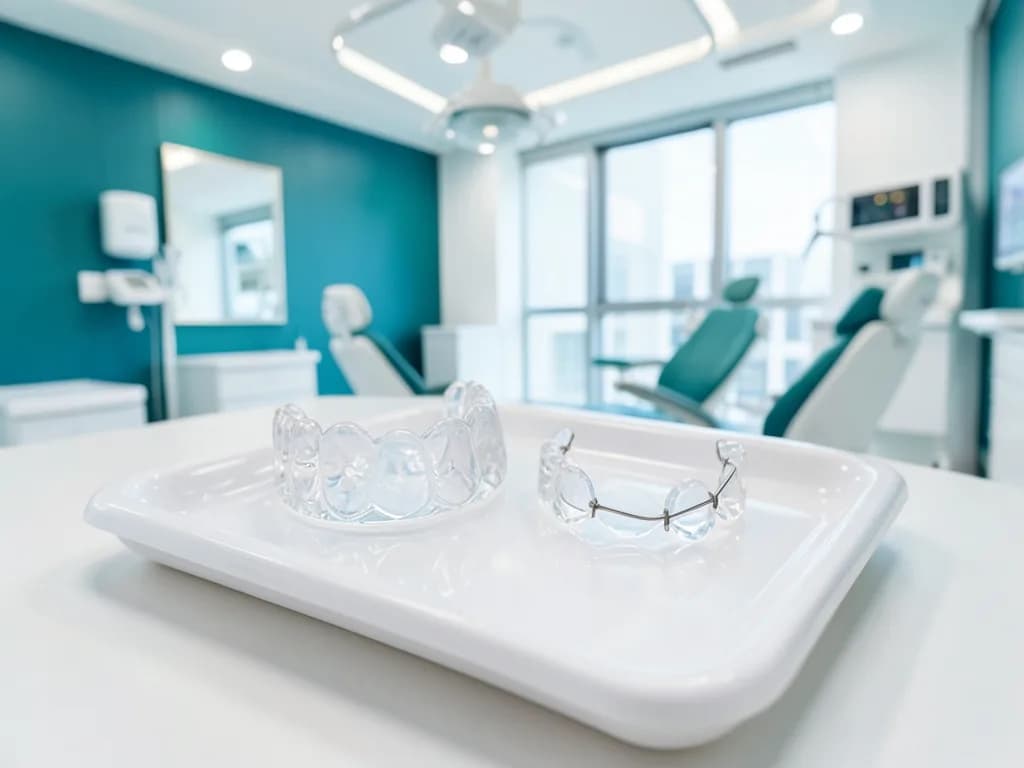
Types of Dental Retainers Available in Dubai
The right retainer depends on your orthodontic case, lifestyle preferences, compliance history, and whether you need maximum aesthetics or maximum durability. Most Dubai orthodontists offer all three main types. Your orthodontist will recommend the best option for your specific case.
The classic orthodontic retainer — a custom-moulded acrylic plate that sits against the roof of the mouth (or behind the lower teeth) with a thin metal wire that runs across the front of the teeth to hold them in position. The Hawley retainer is adjustable, meaning your orthodontist can tighten or modify the wire if minor tooth movement occurs. It is the most durable removable retainer and can last 5–10 years with proper care. The acrylic plate can be made in different colours or patterns, which is popular with younger patients. Because of the visible metal wire, some adults prefer less noticeable alternatives.
Advantages
- ✓ Adjustable — orthodontist can tighten the wire if teeth shift
- ✓ Most durable removable retainer (5–10 years)
- ✓ Allows natural tooth contact on biting surfaces
- ✓ Easy to clean with a toothbrush
- ✓ Can be repaired if the wire bends or breaks
Limitations
- ✗ Visible metal wire across the front teeth
- ✗ Can feel bulky initially due to the acrylic palatal plate
- ✗ May affect speech slightly during the first week
- ✗ Takes a few days to adjust to wearing
A thin, transparent plastic retainer that fits over the entire arch of teeth — similar in appearance to an Invisalign aligner. Essix retainers are virtually invisible when worn, making them the most popular choice among adults and image-conscious patients. They are made by vacuum-forming a clear thermoplastic sheet over a model of your teeth. The tight all-over fit provides excellent retention. However, because the plastic covers the biting surfaces, it prevents natural tooth settling and wears down faster than a Hawley retainer. Essix retainers typically need replacing every 1–3 years depending on wear habits and grinding.
Advantages
- ✓ Virtually invisible when worn
- ✓ Comfortable and slim profile
- ✓ No metal components — fully aesthetic
- ✓ Easy to insert and remove
- ✓ Quick and inexpensive to fabricate
Limitations
- ✗ Less durable — needs replacing every 1–3 years
- ✗ Cannot be adjusted if teeth shift
- ✗ Covers biting surfaces — prevents natural settling
- ✗ Can crack or warp if exposed to heat
- ✗ Prone to staining if not cleaned regularly
A thin stainless steel or braided wire permanently bonded (glued) to the back surface of the front teeth — usually the lower front six teeth, and sometimes the upper front teeth as well. Because the retainer is fixed, compliance is never an issue — your teeth are retained 24 hours a day without any effort on your part. Permanent retainers are the preferred choice for patients who had significant crowding before treatment, large gaps that were closed, or who are at high risk of relapse. The main challenge is oral hygiene — flossing requires a floss threader or superfloss to get under the wire, and plaque can build up around the bonding points if not cleaned carefully. The wire can debond from one tooth without the patient noticing, which can allow that tooth to shift. Regular dental check-ups are essential to verify the bonded retainer is fully intact.
Advantages
- ✓ No compliance needed — works 24/7 automatically
- ✓ Completely invisible (bonded behind the teeth)
- ✓ Excellent long-term retention for high-risk relapse cases
- ✓ Can last 10–20 years if bonding remains intact
- ✓ Does not affect speech or eating after initial adjustment
Limitations
- ✗ Harder to floss — requires floss threader or superfloss
- ✗ Plaque buildup risk around bonding points
- ✗ Wire can debond from a tooth without the patient noticing
- ✗ Cannot be removed for cleaning — professional cleanings are important
- ✗ May break if you bite into very hard foods
Vivera retainers are made by Align Technology (the company behind Invisalign) using the same 3D digital scanning and manufacturing process. They are clear removable retainers similar to Essix retainers but made from a proprietary material that Align Technology claims is 30% stronger than standard clear retainer material. Because they are made from your existing Invisalign digital scan, there is no need for a new impression — a significant convenience advantage if you completed Invisalign treatment. They are typically ordered in sets of 3 or 4 retainers at a time, so you always have a replacement available if one is lost or damaged.
Advantages
- ✓ Made from proprietary stronger material than standard Essix
- ✓ Uses your existing Invisalign digital scan — no new impressions
- ✓ Supplied in sets of 3–4 for convenient replacement
- ✓ Virtually invisible and comfortable
- ✓ Precise digital fit from 3D manufacturing
Limitations
- ✗ More expensive than standard clear retainers
- ✗ Only available if you had Invisalign treatment
- ✗ Still covers biting surfaces like all clear retainers
- ✗ Needs replacing every 1–3 years per retainer
Many patients who completed invisible braces or ceramic braces prefer a clear Essix retainer for aesthetic continuity. Patients who had more complex tooth movements — particularly significant rotations or gap closures — may benefit from the adjustability of a Hawley retainer or the reliability of a permanent bonded wire.
Dental Retainer Cost in Dubai 2026
Retainer prices in Dubai vary by type and clinic tier. Budget clinics are typically in areas such as Deira, Al Quoz, or International City. Mid-range clinics are in JLT, Business Bay, or Al Barsha. Premium clinics are in DIFC, Downtown Dubai, or JBR. Prices are per retainer or per arch unless otherwise noted.
| Retainer Type | Budget Clinic | Mid-Range Clinic | Premium Clinic |
|---|---|---|---|
| Essix (clear removable) | AED 500 | AED 700 | AED 1,000 |
| Hawley (wire removable) | AED 500 | AED 800 | AED 1,200 |
| Permanent bonded (per arch) | AED 800 | AED 1,200 | AED 2,000 |
| Vivera set (3–4 retainers) | AED 1,500 | AED 2,000 | AED 3,000 |
| Retainer replacement (Essix) | AED 300 | AED 500 | AED 800 |
| Bonded retainer repair | AED 200 | AED 400 | AED 600 |
Prices are approximate and based on 2026 data from Dubai dental clinics. Retainer costs are often included in the overall braces cost or Invisalign treatment package. Ask your orthodontist to confirm whether the retainer is included before paying separately.
Who Needs a Dental Retainer
Every patient who completes orthodontic treatment needs a retainer. The situations below indicate the level of urgency and retention risk.
Just completed braces or Invisalign treatment
Essential
Had significant crowding corrected during orthodontic treatment
Essential
Gap closure was a major part of your treatment plan
Essential
Previous retainer has been lost or broken
High priority
Teeth are beginning to shift after stopping retainer wear
High priority
Completed orthodontic treatment as an adult (higher relapse risk)
Essential
Lower front teeth showing early signs of crowding
Recommended
Want preventive retention even without prior orthodontics
Recommended
Important for Dubai residents: If you had orthodontic treatment abroad and have now relocated to Dubai, bring your retainer and any treatment records. A Dubai orthodontist can assess whether your current retainer still fits or if a replacement is needed. Patients with crooked teeth that have relapsed after previous treatment may need a short course of re-alignment before a new retainer can be effective.
How You Get a Dental Retainer in Dubai
The retainer process begins on the day your braces are removed or your final Invisalign aligner is completed. Here is what to expect at each stage.
Orthodontic Treatment Completion
Your orthodontist removes your braces or confirms your final Invisalign aligner has completed tooth movement. A thorough examination is done to verify that all teeth are in their target positions. Any remaining adjustments are made before proceeding to the retention phase. At this point, your orthodontist discusses which retainer type is most suitable based on your tooth positions, the complexity of your original case, and your lifestyle preferences.
Impressions or Digital Scan
Precise impressions of your teeth are taken using either traditional polyvinyl siloxane impression material or a 3D intraoral digital scanner. The scan or impression captures the exact position of every tooth in the corrected alignment. If you completed Invisalign treatment, your existing digital scan may be used for Vivera retainers without the need for a new impression. Accuracy at this stage is critical — the retainer must fit perfectly to maintain tooth positions.
Laboratory Fabrication
For removable retainers, the laboratory pours a stone model from your impression and fabricates the retainer. Essix retainers are vacuum-formed from clear thermoplastic sheets heated and pressed over the model. Hawley retainers involve bending a custom wire and embedding it in acrylic. Fabrication takes 3–7 working days at most Dubai orthodontic clinics. For permanent bonded retainers, the wire is pre-bent and fitted chairside on the day of placement — no laboratory step is required.
Fitting and Placement
At your fitting appointment, the orthodontist checks that the removable retainer seats firmly, does not rock or tilt, and the wire (Hawley) or plastic (Essix) contacts all teeth evenly. For permanent bonded retainers, the wire is bonded to the back surface of each tooth using dental composite adhesive — a process that takes about 20–30 minutes per arch. The orthodontist verifies the bonding at each tooth and checks that the wire does not interfere with your bite.
Wear Schedule and Instructions
For removable retainers, most orthodontists prescribe full-time wear (22 hours per day, removed only for eating and brushing) for the first 3–6 months after braces removal. After this stabilisation period, wear transitions to nighttime only — typically every night for at least 12 months, then a minimum of 3–5 nights per week indefinitely. Your orthodontist provides specific instructions based on your case complexity and relapse risk. For permanent retainers, no wear schedule is needed — the retainer is always in place.
Follow Up and Monitoring
Regular follow-up appointments (every 3–6 months in the first year, then annually) allow your orthodontist to monitor tooth stability, check retainer fit, and verify that permanent bonded retainers are fully intact at every bonding point. If any minor tooth movement is detected early, intervention is simple — an Essix retainer can be replaced, a Hawley wire can be adjusted, or a debonded wire can be re-bonded. Skipping follow-ups is one of the most common causes of undetected relapse.
Retainer vs Night Guard — Understanding the Difference
Patients often confuse retainers and night guards because both are custom-made dental appliances that can look similar. However, they serve fundamentally different purposes and are not interchangeable.
Dental Retainer
- • Purpose is to hold teeth in corrected alignment
- • Fits precisely to your exact tooth positions
- • Thin material — not designed to absorb grinding forces
- • Prescribed after orthodontic treatment
- • Can be removable or permanently bonded
Night Guard
- • Purpose is to protect teeth from grinding (bruxism)
- • Thicker material designed to absorb grinding forces
- • Often has a flat biting surface for jaw relaxation
- • Prescribed for bruxism — not for alignment retention
- • Always removable — worn only during sleep
If you grind your teeth and also need retention after orthodontic treatment, you should not rely on a retainer alone — the grinding forces will damage or destroy a thin clear retainer within weeks. Your orthodontist may recommend a permanent bonded retainer for retention combined with a separate custom night guard for bruxism protection. Alternatively, some specialists can design a thicker retainer that provides moderate grinding protection, though this is a compromise solution. For detailed information on night guard types and costs, see our night guard cost guide.
Key takeaway: Retainers and night guards are not substitutes for each other. A retainer maintains alignment; a night guard prevents grinding damage. Using the wrong appliance for the wrong purpose can result in broken appliances, unprotected teeth, or orthodontic relapse.
How to Clean and Maintain Your Retainer
Removable retainer daily care
- ✓ Rinse with cool water every time you remove it
- ✓ Brush gently with soft toothbrush and liquid soap
- ✓ Never use toothpaste — it scratches and creates bacterial grooves
- ✓ Never use hot water — it warps Essix plastic and acrylic
- ✓ Air-dry completely before storing in ventilated case
- ✓ Soak weekly in retainer cleaner or diluted denture tablet
- ✓ Never wrap in a napkin — the most common way retainers are lost
- ✓ Bring your retainer to every dental check-up for inspection
Permanent bonded retainer care
- ✓ Use floss threader or Superfloss to clean under the wire daily
- ✓ A Waterpik water flosser helps clean around bonding points
- ✓ Brush carefully around each bonded tooth with a soft brush
- ✓ Watch for plaque buildup around the bonding composite
- ✓ Avoid biting directly into very hard foods (ice, hard nuts)
- ✓ See your hygienist every 6 months for professional cleaning
- ✓ Check regularly that the wire feels firmly attached to every tooth
- ✓ Report any loose bonding to your orthodontist immediately
Retainer replacement timeline
1–3 years
Essix (clear) retainer replacement cycle
5–10 years
Hawley retainer typical lifespan
10–20 years
Permanent bonded retainer (if maintained)
Dubai climate note: Dubai's extreme summer heat can warp clear retainers if left in a car, handbag, or near a window. Always store your retainer in its case in a cool, dry location. Leaving an Essix retainer in a hot car (temperatures can exceed 60°C inside a parked vehicle in Dubai summers) will permanently distort the plastic, requiring a replacement at AED 300–800.
What Happens if You Do Not Wear Your Retainer
Orthodontic relapse is one of the most common and frustrating outcomes in dentistry. Understanding the consequences of inconsistent retainer wear can motivate long-term compliance. Here is what typically happens when patients stop wearing their retainer.
First 1–4 weeks without retainer
Teeth begin subtle shifting that may not be visible but is detectable on dental models. The periodontal ligament fibres — which were stretched during orthodontic treatment — begin to pull teeth back toward their original positions. You may notice your retainer feels tighter if you try to put it back in after a few weeks off.
1–3 months without retainer
Noticeable tooth movement becomes visible. Lower front teeth often begin to crowd as the lower jaw exerts natural pressure. Gaps that were closed during treatment may start reopening. At this stage, your original retainer may still fit with some pressure, or a new retainer may be needed. Some teeth may still be repositioned with a short course of clear aligners.
6–12 months without retainer
Significant relapse is likely. Multiple teeth may have shifted, crowding returns, and rotated teeth may begin rotating back. Your original retainer will almost certainly no longer fit. Correction at this stage usually requires orthodontic re-treatment — a partial or full course of braces or Invisalign, costing AED 8,000–25,000 and taking 6–18 months.
The cost of retainer wear (a few seconds to insert and remove each night) is insignificant compared to the financial and emotional cost of re-treatment. Protecting your investment in orthodontic work is one of the best decisions you can make for your dental health. To explore all your orthodontic options in Dubai, visit our comprehensive orthodontics guide.
Does UAE Insurance Cover Dental Retainers?
Retainer coverage depends on your orthodontic benefit
In most UAE insurance plans, the cost of an initial retainer is included in the orthodontic treatment benefit. If your plan covers braces or Invisalign, the retainer is typically bundled into the approved treatment plan and does not require a separate claim. However, replacement retainers — needed when a retainer is lost, broken, or worn out — are often not included in the original authorisation and may need to be claimed separately or paid out of pocket.
Coverage varies by insurer and plan tier. Daman enhanced plans that include orthodontic benefits generally cover the initial retainer. AXA, Bupa, and MetLife plans with orthodontic riders typically include retainer costs within the overall orthodontic benefit maximum (usually AED 5,000–15,000 per treatment course). Basic Essential Benefits Plans (EBP) in the UAE typically do not cover orthodontics or retainers unless medically necessary for a functional bite issue.
For a comprehensive guide to dental insurance in the UAE, including orthodontic coverage details for each major insurer, see our dental insurance Dubai guide.
Usually covered
- • Initial retainer as part of orthodontic treatment
- • Bonded retainer placement included in braces package
- • Follow-up adjustment appointments
Sometimes covered
- • Replacement retainers (varies by plan)
- • Bonded retainer repair or re-bonding
- • Second retainer for the other arch
Rarely covered
- • Retainers without prior orthodontic treatment
- • Cosmetic retainer upgrades (e.g. Vivera when Essix is sufficient)
- • Lost retainers claimed multiple times per year
Retainer Types Compared at a Glance
All four main orthodontic retainer types are available in Dubai. This table helps you compare the key factors — removability, durability, cleaning, and cost — so you can make an informed choice with your orthodontist.
| Factor | Hawley (wire+acrylic) | Essix (clear tray) | Vivera (Invisalign) | Bonded (fixed) |
|---|---|---|---|---|
| Type | Removable | Removable | Removable | Fixed (permanent) |
| AED cost (Dubai 2026) | AED 500 – 900 | AED 500 – 1,000 | AED 900 – 1,800 | AED 600 – 1,500 (arch) |
| Durability | 3 – 10 years | 1 – 3 years | 2 – 4 years | 5 – 20+ years if maintained |
| Visibility | Visible wire on front teeth | Nearly invisible | Nearly invisible | Hidden behind teeth |
| Ease of cleaning | Easy — removable, brush separately | Easy — soak in cleaner tablets | Easy — same as Essix | Harder — floss threader required |
| Wear schedule | 22 hrs/day (initial), nights only long-term | 22 hrs/day (initial), nights only long-term | Nights only (design intent) | Worn 24/7 automatically |
| Best for | Patients who want a durable, adjustable retainer | Patients wanting discretion, Invisalign completers | Post-Invisalign with manufacturer continuity | Lower front teeth, high relapse-risk patients |
| Retainer cleaning routine | Brush with soft brush + mild soap daily | Rinse + Efferdent soak weekly | Same as Essix; replace set if yellowed | Floss threader or proxy brush daily |
AED prices from Dubai orthodontic clinics, 2026. Bonded retainer costs are per arch (upper or lower).
How Long Do You Need to Wear a Retainer
The retainer wear schedule changes over time. Most patients begin with full-time wear and gradually transition to nights only — but "nights only forever" is the evidence-based standard for permanent retention.
Months 1 – 6 after braces or Invisalign
Full-time wear — 22 hours per dayTeeth have just moved into new positions and bone around the roots is still remodelling. The periodontal ligament has memory — it wants to pull teeth back. Full-time wear (removing only to eat and brush) is essential during this period.
Months 6 – 18
Nights only (8–10 hours)Once the bone has remodelled and the orthodontist confirms stability, most patients transition to night-time-only wear. This means wearing the retainer every night without exception. Skipping even a few nights during this phase can allow perceptible movement.
Year 2 onwards — lifelong retention
Nights only — permanentlyTeeth shift throughout life regardless of whether you had orthodontic treatment. Lifelong retainer wear on a nightly basis is the only way to guarantee your teeth stay in their corrected positions. This is not optional — it is a permanent commitment once orthodontic treatment ends.
Vivera retainer advantage: Invisalign's Vivera retainers are made from the same proprietary SmartTrack material as aligners and are 30% more durable than standard Essix retainers. They are issued in sets of four per arch — if one set cracks or warps, a replacement is ready. This makes Vivera the best long-term removable retainer choice for post-Invisalign patients in Dubai.
Retainer Care and Cleaning Guide
Proper retainer maintenance extends its lifespan, prevents bacterial build-up, and keeps it fitting correctly. Neglected retainers harbour bacteria that contribute to gum disease and bad breath.
Removable retainers (Hawley, Essix, Vivera)
- ✓ Rinse immediately after removal — before saliva dries on the surface
- ✓ Brush gently with a soft toothbrush and mild liquid soap (never toothpaste — too abrasive)
- ✓ Soak once a week in a diluted Efferdent or Polident tablet solution for 15–20 minutes
- ✓ Store in a ventilated hard case — never wrap in tissue (leads to accidental disposal)
- ✓ Keep away from hot water — can warp the acrylic or thermoplastic material
- ✓ Bring the retainer to every dental check-up for professional inspection
Bonded (fixed) retainers
- ✓ Brush normally — use a soft brush at the gumline where the wire meets the teeth
- ✓ Use a floss threader or orthodontic floss to thread floss under the wire daily
- ✓ Interproximal brushes (proxy brushes) help clean between teeth at the wire
- ✓ Water flossers are very effective for cleaning bonded retainer margins
- ✓ Avoid biting into hard foods directly with the bonded teeth — use the side teeth
- ✓ Annual orthodontic check-up to inspect for wire fractures or debonded teeth
Avoid ultrasonic cleaners for Essix and Vivera retainers — the vibration frequency can damage the thermoplastic material. Ultrasonic cleaners are safe for Hawley retainers with metal wire frameworks.
Retainer Replacement Costs in Dubai 2026
Lost or broken retainers are common — especially in the first year after treatment. Knowing the replacement cost in advance prevents the temptation to delay replacement, which can result in teeth shifting and requiring repeat orthodontic treatment.
| Retainer Type | Replacement Cost (AED) | Notes |
|---|---|---|
| Hawley retainer (per arch) | AED 500 – 900 | New impressions required; 5–7 day lab turnaround |
| Essix clear retainer (per arch) | AED 500 – 1,000 | Digital scan or impressions; 3–5 day lab turnaround at most Dubai clinics |
| Vivera replacement set (4 per arch) | AED 900 – 1,800 | Ordered through Invisalign system; 2–3 weeks delivery from US |
| Bonded retainer repair (per wire) | AED 300 – 600 | If wire is fractured or 1–2 teeth have debonded; straightforward procedure |
| Bonded retainer removal + replacement | AED 600 – 1,500 | Full rebonding after complete failure; new impressions needed |
AED prices from Dubai orthodontic clinics, 2026. Costs include clinical appointment and laboratory fees.
Compare retainer costs with other orthodontic expenses using our 2026 dental cost guide. For insurance coverage of replacement retainers, see our dental insurance Dubai guide.
What Happens If You Stop Wearing Your Retainer
This is the most underappreciated risk in orthodontics. Teeth are not fixed in bone — they are held by a network of elastic fibres (periodontal ligament) that remember their pre-treatment position for years.
Within days to 2 weeks
Minor positional changes begin
Particularly in the first 6 months post-treatment when bone remodelling is still ongoing. Front teeth are most susceptible. Spacing or crowding can begin returning within 1–2 weeks of consistent non-wear.
1 – 6 months without wearing
Noticeable relapse in most patients
The majority of patients who stop wearing their retainer for 1–6 months will notice measurable tooth movement — often the return of crowding in the lower front teeth or the re-emergence of a gap that was closed. The extent depends on the original severity of crowding.
Over 1 year without wearing
Significant relapse — may require repeat treatment
After 12+ months without retainer wear, relapse is often significant enough that the retainer no longer fits properly. At this stage, the patient may need new aligners or braces to re-correct tooth positions — at full treatment cost (AED 8,000–25,000 for braces or Invisalign). Prevention is clearly more cost-effective.
Lifelong risk
Natural age-related drift regardless of treatment
Even patients who wear retainers consistently experience some natural mesial drift (teeth pushing forward and crowding) as part of normal jaw development throughout adulthood. Lower front teeth are most affected. Retainers slow and manage this process — they do not eliminate it entirely.
If you have stopped wearing your retainer and notice movement, book a review with an orthodontist promptly. Early intervention with new aligners or a new tight-fitting retainer can sometimes recover minor relapse without full retreatment. See our orthodontist Dubai guide or clear aligners Dubai for retreatment options.
Frequently Asked Questions
How much does a dental retainer cost in Dubai in 2026?
Dental retainer prices in Dubai vary by type and clinic tier. A clear Essix retainer costs AED 500–1,000, while a Hawley wire retainer ranges from AED 500–1,200. Permanent bonded retainers cost AED 800–2,000 per arch. If you completed Invisalign treatment, Vivera retainers (a set of 3–4) cost AED 1,500–3,000. Premium clinics in areas such as DIFC, Downtown Dubai, or JBR may charge at the higher end of these ranges, while clinics in Deira, Al Quoz, or International City tend to offer more competitive pricing. Retainer costs are often included in the overall orthodontic treatment package — ask your orthodontist whether your retainer is bundled into your braces or Invisalign fee before paying separately. Replacement retainers if lost or broken typically cost AED 300–800 for a new Essix retainer and AED 200–600 for a bonded retainer repair.
How long do I have to wear my retainer after braces or Invisalign?
The short answer is indefinitely — but the wearing schedule changes over time. Immediately after braces removal or completing your last Invisalign aligner, most orthodontists prescribe full-time wear (22 hours per day) for the first 3–6 months. This critical stabilisation period allows the bone and periodontal ligament fibres around your teeth to remodel and solidify in their new positions. After stabilisation, you transition to nighttime-only wear — typically every night for at least 12 months. Beyond that first year, a minimum of 3–5 nights per week is recommended for long-term maintenance. Many orthodontists advise wearing your retainer every night for life to guarantee results. Teeth have a natural tendency to shift throughout your lifetime due to ongoing growth, ageing, and the elastic memory of periodontal ligament fibres — even teeth that were never orthodontically moved can drift. Without retainer wear, relapse is not a question of if but when.
What is the difference between a retainer and a night guard?
Retainers and night guards serve completely different purposes, although they may look similar if both are clear plastic appliances. A dental retainer holds your teeth in their corrected position after orthodontic treatment — it prevents relapse and tooth shifting. The retainer fits precisely to your current tooth alignment and applies gentle pressure to keep teeth stable. A night guard, in contrast, is designed to protect your teeth from the forces of grinding and clenching (bruxism) during sleep. Night guards are typically thicker and may have a flat biting surface to allow the jaw to slide freely. You cannot use a retainer as a night guard because retainers are not thick enough to absorb grinding forces — they will crack or wear through quickly. Similarly, a night guard does not maintain tooth position with the precision of a retainer. If you need both retention and bruxism protection, your orthodontist can sometimes design a dual-purpose appliance, or you may need separate devices. For more about bruxism protection, see our dental night guard guide.
What happens if I stop wearing my retainer?
If you stop wearing your retainer, your teeth will gradually shift back toward their original positions — a process called orthodontic relapse. The speed and severity of relapse depends on several factors: how much movement was done during treatment, how long ago treatment was completed, your age, and your individual biology. Lower front teeth are particularly prone to crowding relapse because the lower jaw continues to grow slightly throughout life, even in adults. Relapse can begin within weeks of stopping retainer wear, with noticeable shifting often visible within 3–6 months. Upper teeth with closed gaps may start reopening. Rotated teeth that were de-rotated during treatment are especially prone to rotating back. In severe cases, patients require a second round of orthodontic treatment — which means additional cost (AED 8,000–25,000 for a full re-treatment with braces or Invisalign), additional time (6–18 months), and the frustration of redoing treatment that was already completed successfully. Wearing your retainer as prescribed is by far the most cost-effective way to protect your orthodontic investment.
How do I clean and care for my dental retainer properly?
Proper cleaning extends retainer life and prevents bacteria buildup that causes odour and discolouration. For removable retainers (Essix and Hawley), rinse with cool or lukewarm water every time you remove the retainer. Never use hot water — heat warps Essix plastic and can damage acrylic. Brush the retainer gently with a soft toothbrush and mild liquid soap (not toothpaste — toothpaste contains abrasives that scratch the surface and create micro-grooves where bacteria accumulate). Once or twice per week, soak the retainer for 15–20 minutes in a retainer cleaning solution or a diluted denture cleaner tablet (Polident or Retainer Brite). Allow the retainer to air-dry completely before storing in its ventilated case. Never wrap your retainer in a napkin — this is the most common way retainers get thrown away accidentally. For permanent bonded retainers, use a floss threader or Superfloss to thread floss under the wire and clean between each tooth daily. A Waterpik water flosser is an excellent supplement for cleaning around bonded retainer wires. Visit your dental hygienist every 6 months for professional cleaning around the retainer.
Can I get a retainer without having had braces or Invisalign first?
In most cases, retainers are prescribed after orthodontic treatment to maintain the corrected tooth positions. However, there are some situations where a retainer-like appliance may be used without prior braces or Invisalign. If you had orthodontic treatment years ago but lost your retainer and your teeth have shifted only slightly, your orthodontist may be able to fabricate a new retainer to hold your current position and prevent further shifting — though it will not move teeth back. For very minor tooth movements (less than 1–2mm), some orthodontists use a series of clear aligners as short-term alignment followed immediately by a retainer. Additionally, some adults with mild lower front crowding who do not want full orthodontic treatment opt for a bonded retainer to prevent the crowding from worsening over time. This is a stabilisation strategy, not a treatment. If your teeth have shifted significantly, you will need orthodontic treatment before a retainer can be effective. Consult an orthodontist in Dubai to assess whether a retainer alone is appropriate for your situation.
Does dental insurance in Dubai cover retainers?
Coverage for dental retainers in the UAE depends on your insurance plan and whether the retainer is classified as part of orthodontic treatment. Most insurance plans that cover orthodontics (braces or Invisalign) include the cost of the initial retainer in the overall orthodontic benefit — so if your plan covers orthodontics, the retainer is typically included at no additional cost. However, replacement retainers (if lost, broken, or worn out) are often not covered or are subject to a separate claim. Plans from major UAE insurers such as Daman, AXA, Bupa, and MetLife vary significantly. Daman enhanced plans that include orthodontic coverage generally cover the initial retainer as part of the treatment package. Some plans have annual maximums for orthodontic benefits (typically AED 5,000–15,000) that must cover both the treatment and the retainer. Pre-authorisation is usually required for the orthodontic treatment, and the retainer is included in that authorisation. For standalone retainer requests (not part of an active orthodontic treatment plan), insurance coverage is less likely. Always verify with your insurer before assuming coverage, and ask your orthodontist to include the retainer cost in the treatment plan submission.
Find an Orthodontist in Dubai Today
Whether you need a new retainer, a replacement, or a bonded retainer check-up, connect with a verified orthodontist in Dubai who can help protect your smile.
Use our dental clinic directory to compare top-rated clinics across the UAE, read patient reviews, and book appointments online.