Invisible Braces in Dubai — Every Option Compared
Not all invisible braces are the same. Clear aligners, lingual braces, and ceramic braces each offer different levels of visibility, cost, and clinical capability. This guide compares every invisible teeth-straightening option available in Dubai so you can make an informed choice before your consultation.
For Invisalign-specific guidance, see our detailed Invisalign Dubai treatment guide. To compare clear aligners with traditional braces, read our Invisalign vs braces comparison.
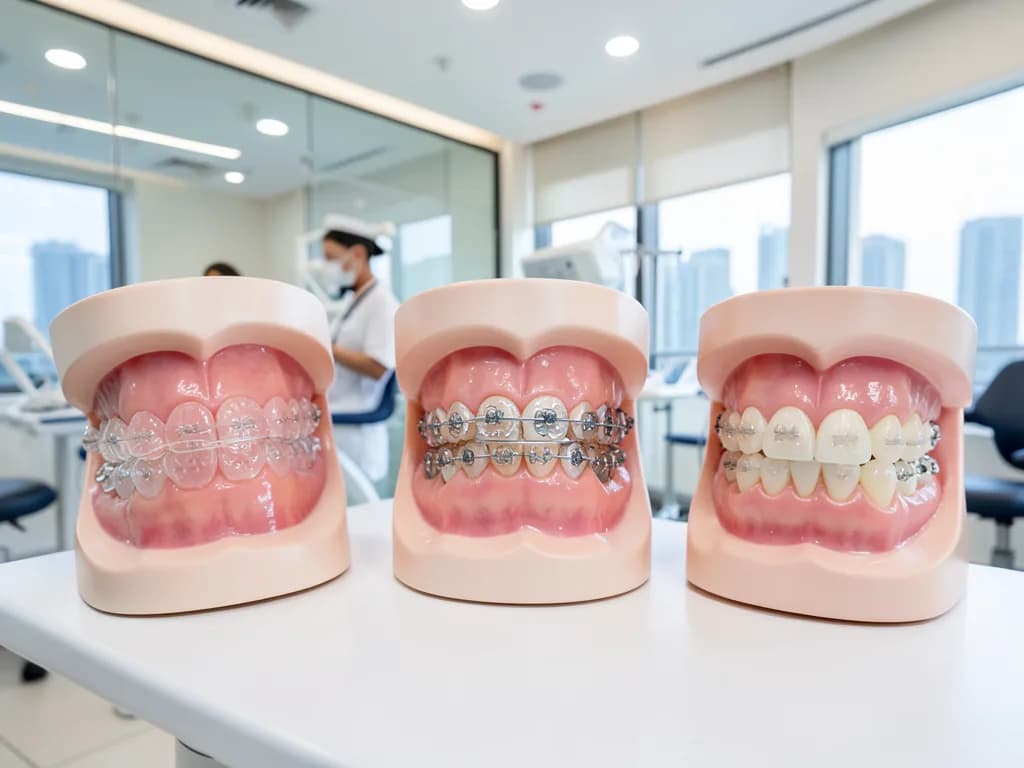
Every Type of Invisible Braces Available in Dubai
The term "invisible braces" covers a range of orthodontic systems designed to straighten teeth with minimal aesthetic impact. Some are truly invisible — hidden behind the teeth or made from clear plastic — while others are simply less visible than traditional metal brackets. Understanding the differences is essential because each system has distinct clinical capabilities, comfort profiles, and price points.
In Dubai, all orthodontic treatment must be performed or supervised by a DHA-licensed dentist or orthodontist. Whether you choose Invisalign clear aligners, lingual braces, or ceramic braces, ensure your provider is properly licensed and experienced with your chosen system.
Nearly invisible
Yes — remove to eat and brush
Mild to complex cases in adults and teens who want maximum discretion and convenience
Custom clear plastic trays manufactured by Align Technology using ClinCheck 3D simulation. Changed every 1–2 weeks. Requires 20–22 hours daily wear.
Nearly invisible
Yes — remove to eat and brush
Budget-conscious patients with mild to moderate crowding who want a clear aligner alternative to Invisalign
Clear aligner system by Straumann. Uses tri-layer ClearQuartz material. Treatment is planned digitally and aligners are swapped every 2 weeks.
Completely invisible from the front
No — fixed behind the teeth
Patients who need fixed appliance precision but cannot have any visible brackets, especially professionals and public-facing individuals
Custom metal brackets bonded to the back (tongue side) of each tooth. Wires apply force like traditional braces but are hidden behind the teeth.
Tooth-coloured brackets — less visible than metal
No — fixed on the front of teeth
Adults and teens who need fixed braces for complex cases but want a less visible option than metal brackets
Tooth-coloured or clear ceramic brackets bonded to the front of teeth with tooth-coloured or clear wires. Function identically to metal braces but blend with the tooth surface.
Nearly invisible
Yes — remove to eat and brush
Very mild crowding or spacing only — no complex bite issues
Impression kits or limited scanning, remote treatment monitoring with minimal or no in-person check-ups. Only suitable for the simplest cases.
How to Decide Between These Options
If your primary concern is total invisibility and you have the budget, lingual braces are the only option where nothing is visible from the front at any angle. If convenience and comfort matter most, clear aligners like Invisalign offer the best balance. If you need the mechanical precision of fixed braces at a moderate cost, ceramic braces provide excellent results with reduced visibility. For a direct comparison of Invisalign against ceramic braces specifically, read our Invisalign vs ceramic braces guide.
Invisible Braces Brand Comparison — Side by Side
A detailed technical comparison of the four main invisible braces systems available at Dubai clinics. Understanding material differences, clinical evidence, and maintenance requirements helps you have a more productive conversation with your orthodontist.
| Factor | Invisalign | ClearCorrect | Lingual Braces | Ceramic Braces |
|---|---|---|---|---|
| Material Technology | SmartTrack multi-layer polyurethane — most researched aligner material | ClearQuartz tri-layer material — good flexibility and stain resistance | Custom metal alloy brackets (Incognito uses gold alloy, WIN uses stainless steel) | Polycrystalline alumina or zirconia brackets — strong but can chip under heavy force |
| Treatment Planning Software | ClinCheck 3D — industry gold standard with largest clinical dataset | ClearPilot digital planning — solid but smaller clinical evidence base | Custom CAD/CAM design — highly precise for each bracket placement | Standard orthodontic planning — provider dependent, no proprietary software |
| Clinical Evidence | 25+ years, 17 million cases treated globally, most published research | Growing evidence base backed by Straumann Group research | Well-established technique — Incognito has 20+ years of clinical data | Decades of use — same biomechanics as metal braces with proven outcomes |
| Comfort Level | Smooth plastic — minimal soft tissue irritation | Smooth plastic — similar comfort to Invisalign | Tongue irritation common for first 2–4 weeks — most patients adapt | Similar to metal braces — brackets can irritate lips and cheeks |
| Dietary Restrictions | None — remove aligners to eat anything | None — remove aligners to eat anything | Yes — avoid hard and sticky foods that can break brackets | Yes — same restrictions as metal braces plus avoid staining foods |
| Maintenance Effort | Rinse aligners, brush normally — easy | Rinse aligners, brush normally — easy | Harder to clean — floss threaders and interdental brushes needed | Harder to clean — food traps around brackets require careful brushing |
| Visit Frequency | Every 6–8 weeks | Every 4–6 weeks | Every 4–6 weeks for wire adjustments | Every 4–6 weeks for wire adjustments |
Data compiled from manufacturer specifications and Dubai clinic surveys, 2026. For clear aligner options, see our dedicated guide.
Invisible Braces Cost Comparison in Dubai (AED)
Prices vary based on case complexity, clinic location, and provider experience. Budget clinics are typically in areas like Deira and Al Qusais. Mid-range clinics operate throughout Jumeirah, Al Barsha, and Business Bay. Premium clinics are concentrated in DIFC, Downtown Dubai, and JBR. For detailed Invisalign pricing, see our Invisalign cost Dubai guide.
| System | Budget Clinic | Mid Range Clinic | Premium Clinic | Typically Includes |
|---|---|---|---|---|
| Invisalign | AED 7,000 | AED 12,000 | AED 20,000 | Scan, all aligners, attachments, 1+ refinement rounds |
| ClearCorrect | AED 5,000 | AED 9,000 | AED 15,000 | Scan, all aligners, refinements (varies by plan) |
| Lingual Braces | AED 15,000 | AED 20,000 | AED 25,000 | Custom brackets, all wires, adjustments, retainer |
| Ceramic Braces | AED 7,000 | AED 10,000 | AED 15,000 | Brackets, wires, adjustments, removal and retainer |
| At Home Aligners | AED 3,500 | AED 5,500 | AED 8,000 | Impression kit, aligners, remote monitoring |
Who Needs Invisible Braces and Which Type Suits You
Not every orthodontic patient needs invisible braces — and not every invisible braces system works for every case. Use this triage guide to narrow your options before consulting an orthodontist in Dubai.
Ideal Candidates for Invisible Braces
- ✓ Adults in professional or client-facing roles who cannot wear visible metal brackets
- ✓ Teenagers with good compliance habits who can wear aligners 20+ hours daily
- ✓ Patients with mild to moderate crowding, spacing, or bite issues
- ✓ Individuals with crooked teeth seeking a discreet correction method
- ✓ Athletes who play contact sports and need a removable orthodontic option
- ✓ Brides, models, or performers who need treatment with zero visible appliance
- ✓ Patients who have experienced orthodontic relapse after previous treatment
- ✓ Expats who want to start and complete treatment during their Dubai posting
Cases Where Metal Braces May Be Better
- ✗ Severe skeletal jaw discrepancies that may require surgical orthodontics
- ✗ Very severe crowding requiring multiple tooth extractions with space closure
- ✗ Young children with primary teeth still erupting (too early for any braces)
- ✗ Patients who cannot commit to 20+ hours daily aligner wear (choose fixed option)
- ✗ Complex cases requiring very precise rotational or vertical tooth control
- ✗ Patients with untreated gum disease or active dental decay (treat first)
- ✗ Budget-conscious patients — metal braces start from AED 5,000 vs AED 7,000+ for invisible
Quick Decision Guide by Situation
Mild crowding, want removable option
Invisalign Lite or ClearCorrect
Moderate case, budget is a concern
ClearCorrect or ceramic braces
Complex bite, need total invisibility
Lingual braces (Incognito or WIN)
Complex case, moderate visibility OK
Ceramic braces
Simple spacing, minimal budget
At-home aligners (mild cases only)
Teen with compliance concerns
Ceramic braces (fixed, no compliance needed)
The Invisible Braces Treatment Process Step by Step
Regardless of which invisible braces system you choose, the treatment journey follows a similar eight-step process — from initial consultation through lifetime retention.
Initial Orthodontic Consultation
Your DHA-licensed orthodontist or certified provider takes panoramic X-rays, intraoral photographs, and a digital 3D scan of your teeth using an iTero or similar scanner. They assess your bite relationship, crowding severity, gum health, and jaw alignment. Based on this comprehensive evaluation, they recommend which invisible braces system is most clinically appropriate for your specific case — not all systems suit all cases.
Digital Treatment Planning and Simulation
For clear aligner systems like Invisalign and ClearCorrect, a 3D digital simulation maps every tooth movement from start to finish. You review and approve this visual plan before any aligners are manufactured. For lingual and ceramic braces, the orthodontist creates a detailed treatment plan including bracket placement positions, wire sequences, and estimated milestones. This planning stage typically takes 1–2 weeks.
Custom Appliance Fabrication
Clear aligners are manufactured at dedicated facilities using your approved digital plan — Invisalign aligners come from Align Technology and ClearCorrect from Straumann. Lingual braces like Incognito are custom-cast in gold alloy to fit the exact contours of each tooth's back surface. Ceramic brackets are selected from pre-made sizes and customised during bonding. Fabrication takes 2–4 weeks for aligners and 3–6 weeks for custom lingual brackets.
Fitting and Bonding Appointment
For clear aligners, your first set of trays is fitted and attachments (small tooth-coloured bumps) are bonded to specific teeth if needed. You receive instructions on insertion, removal, and cleaning. For lingual braces, each custom bracket is bonded to the inside surface of your teeth — this appointment takes 1.5–2 hours due to the precision required. Ceramic braces are bonded similarly to metal braces — typically 45–60 minutes.
Active Treatment Phase with Regular Monitoring
Clear aligner patients swap trays every 1–2 weeks and visit the clinic every 6–8 weeks for progress checks. Lingual and ceramic braces patients return every 4–6 weeks for wire changes and adjustments. During active treatment, your provider monitors tooth movement against the original plan and makes mid-course corrections if any teeth are not tracking as expected. This phase lasts 6–24 months depending on your case complexity and the system chosen.
Refinements and Mid Course Corrections
For aligner cases, refinement rounds involve taking new scans and manufacturing additional aligner sets to fine-tune the result. Most moderate to complex cases need at least one refinement round. For braces patients, wire changes and elastic configurations are adjusted to correct any remaining discrepancies. Refinements are a normal and expected part of orthodontic treatment, not a sign that something went wrong.
Debonding or Final Aligner and Retainer Fitting
When treatment is complete, braces are removed (debonded) and residual adhesive is polished off the tooth surface. Aligner patients simply stop wearing trays. Both groups are then fitted with retainers — either a removable clear retainer worn nightly or a thin fixed wire bonded behind the front teeth, or both. Retainers prevent teeth from shifting back to their original positions — a biological tendency called orthodontic relapse.
Lifetime Retention and Annual Check Ups
Teeth have a lifelong tendency to drift after orthodontic treatment. Retainers must be worn consistently — every night for removable retainers, permanently for bonded wires. Annual orthodontic check-ups are recommended to ensure retention is working and no relapse is occurring. The cost of retainers is often separate from the treatment fee at most Dubai clinics — budget AED 500–1,500 for removable retainers.
How Invisible Braces Affect Your Daily Life in Dubai
One of the biggest advantages of invisible braces over traditional metal braces is the reduced impact on your daily routine. However, each system has different lifestyle considerations that matter in a city like Dubai where social dining, outdoor activities, and professional appearance are important.
Eating and Dining Out
Clear aligners — remove before eating, no restrictions. Lingual and ceramic braces — avoid hard, sticky foods. In Dubai's restaurant culture, removable aligners offer the most flexibility for social dining without worrying about food getting stuck in brackets.
Professional Appearance
All invisible braces systems are designed to minimise visual impact. Lingual braces are completely invisible from the front. Invisalign and ClearCorrect are nearly undetectable. Ceramic braces are significantly less noticeable than metal — suitable for client-facing roles in DIFC and Downtown offices.
Sports and Fitness
Clear aligners can be removed during contact sports and replaced with a mouthguard. Lingual and ceramic braces require a custom orthodontic mouthguard for contact sports. Dubai's active lifestyle — from beach sports to gym workouts — is fully compatible with all invisible braces systems with proper precautions.
Travel Considerations for Dubai Residents
If you travel frequently for work or leisure, clear aligners offer the most flexibility — you can carry multiple sets and progress through treatment even while away from Dubai. Fixed systems like lingual and ceramic braces require in-person adjustment appointments every 4–6 weeks, which can be challenging for frequent travellers. Discuss your travel schedule with your orthodontist when choosing a system.
Oral Hygiene During Treatment
Clear aligners allow normal brushing and flossing — simply remove the trays, clean your teeth, rinse the aligners, and reinsert. Lingual and ceramic braces require more diligent oral care — interdental brushes, floss threaders, and possibly a water flosser to clean around brackets and wires. In Dubai's warm climate, staying hydrated helps prevent dry mouth which can increase cavity risk during orthodontic treatment.
Insurance Coverage for Invisible Braces in the UAE
Most UAE health insurance plans classify all forms of invisible braces — including Invisalign, ClearCorrect, lingual braces, and ceramic braces — as elective orthodontics. This means they are typically excluded from standard coverage. However, there are important exceptions worth investigating before you pay out of pocket.
Plans That Typically Exclude Invisible Braces
- ✗ Daman Enhanced (basic employer plans)
- ✗ Bupa Essential and Select tiers
- ✗ AXA Smart and Standard plans
- ✗ Most basic government-mandated plans
- ✗ Plans with dental riders that specifically exclude adult orthodontics
Plans With Partial Orthodontic Benefits
- ✓ Daman Thiqa — AED 5,000–7,000 lifetime orthodontic benefit
- ✓ Bupa Platinum — AED 3,000–5,000 lifetime orthodontic benefit
- ✓ MetLife Premium — up to AED 4,000 orthodontic coverage
- ✓ Children under 18 — better orthodontic benefits under family plans
- ✓ Some government employer plans with enhanced dental benefits
Payment Options When Insurance Does Not Cover Treatment
Most Dubai orthodontic clinics offer flexible payment plans to make invisible braces accessible. Common options include 0% instalment plans through Tabby or Tamara (splitting the cost into 4–12 monthly payments), in-house payment plans spread across the treatment duration, and credit card instalment programmes offered by major UAE banks. Some clinics offer a 5–10% discount for upfront full payment.
For a complete guide to which UAE insurance plans cover orthodontic treatment and how to maximise your benefits, read our dental insurance Dubai guide.
Honest Advantages and Disadvantages of Invisible Braces
Advantages Across All Invisible Systems
- ✓ Dramatically less visible than traditional metal braces
- ✓ Lingual braces are completely invisible from the front
- ✓ Clear aligners are removable — eat anything without restrictions
- ✓ Better oral hygiene during treatment (for removable systems)
- ✓ Fewer emergency appointments — no broken bracket urgencies for aligners
- ✓ More comfortable than metal braces (especially clear aligners)
- ✓ Digital treatment planning with 3D visualisation of expected results
- ✓ Suitable for adults and professionals in client-facing roles
Disadvantages to Consider
- ! Clear aligners require strict 20–22 hour daily compliance
- ! Lingual braces cause tongue irritation for the first 2–4 weeks
- ! Ceramic brackets can stain if exposed to coffee, tea, or turmeric
- ! All invisible options cost more than traditional metal braces
- ! Not all complex cases can be treated with clear aligners
- ! Lingual braces are the most expensive orthodontic option
- ! At-home aligners lack adequate professional oversight
- ! Retainers required for life after any orthodontic treatment
Still deciding between systems? Compare the leading options in our Invisalign vs braces guide or explore Invisalign vs ceramic braces for a focused comparison of the two most popular discreet options.
How to Choose the Right Invisible Braces Provider in Dubai
The quality of your invisible braces result depends as much on the provider as on the system itself. An experienced orthodontist can achieve excellent outcomes with almost any reputable system, while an inexperienced provider may deliver suboptimal results even with the best technology. Here is what to look for when choosing a provider in Dubai.
DHA Licence Verification
Every orthodontic provider in Dubai must hold a valid DHA (Dubai Health Authority) licence. Verify your provider's credentials on the DHA website before committing to treatment. For complex cases, a specialist orthodontist licence provides an extra layer of assurance.
System Specific Certification
For Invisalign, check the provider's tier status — Diamond and Platinum providers have the most experience. For lingual braces, confirm the orthodontist has specific training in lingual technique — it requires different skills than conventional braces. Ask for before-and-after photos of similar cases.
Case Volume and Portfolio
Ask how many cases of your chosen system the provider has completed. High case volume correlates with better outcomes and more efficient treatment management. A provider who has treated 200+ Invisalign cases will manage complications and refinements more confidently than one who has treated 20.
Transparent Pricing Structure
Request an itemised quote that clearly states what is included — initial scan, all aligners or brackets, adjustments, refinements, retainers, and any additional fees. The best clinics offer all-inclusive treatment fees with no hidden costs.
Ready to start your search? Use our directory to browse verified dental clinics in Dubai with patient reviews and insurance information. You can also explore our list of top-rated dental clinics in the UAE for trusted recommendations.
Invisible Braces Types Compared
The term “invisible braces” covers four distinct invisible orthodontic treatment systems. Each uses different technology, suits different case types, and comes at a different cost. This comparison covers Invisalign, lingual braces, ceramic braces, and clear aligners so you can match the system to your priorities.
| System | Visibility | Cost (AED) | Duration | Best For |
|---|---|---|---|---|
| Invisalign | Nearly invisible | 12,000–25,000 | 12–24 months | Most cases; removable for eating |
| ClearCorrect / Spark | Nearly invisible | 8,000–18,000 | 12–24 months | Budget-conscious clear aligner therapy |
| Lingual braces | Completely invisible | 11,000–32,000 | 14–24 months | Professionals needing total discretion |
| Ceramic braces | Low-visibility (front teeth) | 8,000–22,000 | 12–22 months | Complex cases; more discreet than metal |
Invisalign remains the most popular clear aligner therapy in Dubai due to brand recognition and the ClinCheck 3D treatment planning software, which gives patients a visual simulation of expected results before treatment begins. iTero digital scans replace messy impressions at most Invisalign providers. For a detailed price breakdown by system, visit our Invisalign cost Dubai guide.
Technology Behind Modern Invisible Braces
The quality of invisible orthodontic treatment has been transformed by 3D treatment planning software and digital scanning. Understanding the technology involved helps you evaluate providers and ask the right questions at your consultation.
iTero Digital Scanner
Replaces physical dental impressions with a 3D digital scan taken in under five minutes. The iTero scanner is required for Invisalign and produces the digital model used to design your aligner trays. Clinics using iTero represent a higher level of investment in modern invisible orthodontic treatment infrastructure.
ClinCheck 3D Planning
Invisalign's proprietary software that maps every tooth movement across the entire treatment plan. You can see a before-and-after simulation of your expected result before agreeing to treatment. ClinCheck allows your orthodontist to plan aligner attachments — small tooth-coloured buttons that help aligners grip and rotate teeth.
Aligner Attachments and IPR
Attachments are small composite buttons bonded to specific teeth to enable precise movements clear aligner therapy cannot achieve with trays alone. Interproximal reduction (IPR) — micro-slimming of teeth — creates space for alignment without extractions. Both are standard tools in Invisalign and Spark aligner treatment.
Refinement Trays
After completing the initial aligner series, refinement trays fine-tune the result. Invisalign Full includes unlimited refinements within a five-year window. ClearCorrect and Spark have similar policies depending on the tier purchased. Refinements are particularly valuable for adult cases where certain teeth respond unpredictably.
Clinics with iTero scanners and ClinCheck access represent the technology benchmark for invisible orthodontic treatment in Dubai. You can explore orthodontic clinics in Dubai that offer digital scanning as part of the consultation process.
What Invisible Braces Results Look Like
Invisible braces deliver comparable clinical results to metal braces for mild to moderate cases. Here is an honest summary of what each system achieves and what its limitations are in real-world Dubai patient outcomes.
Mild crowding and spacing
All four invisible systems achieve excellent results. Invisalign and clear aligners are the most predictable for straightforward alignment. Treatment typically 8–14 months. Before-and-after photos from reputable clinics consistently show near-perfect alignment.
Overbite and overjet correction
Clear aligner therapy (Invisalign) now corrects moderate overbites using precision bite ramps and mandibular advancement features. Severe bite issues still respond better to fixed lingual or ceramic braces with elastics.
Tooth rotations
Clear aligners are less efficient at rotating teeth than fixed appliances. Attachments significantly improve rotation control, but complex rotations remain the strength of ceramic brackets with tooth-coloured brackets providing adequate anchorage.
Relapse correction
Invisalign Lite is highly effective for adult relapse — teeth that shifted after teenage braces. Most relapse cases complete in 6–12 months with very satisfying before-and-after transformations.
Always ask to see before-and-after photos of completed cases at your chosen clinic. Explore verified invisible braces providers in Dubai with patient reviews and treatment photos.
How Long Do Invisible Braces Take in Dubai
Invisible orthodontic treatment timelines range from 6 months for minor cases to 24 months for comprehensive bite correction. Your specific duration depends on case complexity, the system chosen, and — for clear aligners — your compliance with 20 to 22 hours of daily wear.
Short cases
6–10 months
Mild crowding, Invisalign Lite, relapse
Moderate cases
10–18 months
Moderate crowding and spacing, most adults
Complex cases
18–24 months
Bite correction, lingual braces, severe crowding
Clear aligner compliance is the biggest variable. Missing hours daily adds months to treatment. Fixed lingual and ceramic braces work continuously, removing this compliance variable entirely. For timeline and system comparisons, visit our Invisalign Dubai guide or orthodontics Dubai overview.
Risks and Complications of Invisible Braces
All orthodontic systems carry some risk. Invisible braces have a distinct risk profile compared to metal braces — understanding these helps you have a frank conversation with your provider before starting invisible orthodontic treatment.
Aligner Compliance Failure
Medium riskThe most common invisible aligner pitfall. Patients who wear trays fewer than 20 hours per day experience delayed tooth movement and extended treatment timelines. This is a patient behaviour risk, not a clinical one — fixed lingual or ceramic braces eliminate it entirely.
Ceramic Bracket Staining
Low riskTooth-coloured ceramic brackets and ligatures can discolour with coffee, tea, turmeric, or red wine. Metal ligatures and self-ligating ceramic brackets reduce this risk significantly. Proper brushing after meals prevents most staining.
Lingual Braces Tongue Irritation
Temporary riskLingual brackets sit on the tongue side of teeth, causing temporary irritation and a mild lisp for the first 2–4 weeks. Orthodontic wax and a short adaptation period resolve this in virtually all patients.
Root Resorption
Low riskAll orthodontic treatment — including clear aligner therapy — can cause mild root shortening. The risk is monitored via X-rays. Severe resorption is rare and more associated with prolonged excessive force levels than with clear aligners.
Choosing a certified Invisalign provider or an experienced orthodontist minimises all of the above risks. Browse orthodontic clinics in Dubai and confirm DHA licencing and system certification before booking.
Frequently Asked Questions
What are the best invisible braces options available in Dubai?
Dubai offers five main categories of invisible braces, each with distinct advantages. Invisalign is the most widely available and clinically proven clear aligner system, with the largest network of certified providers and the most published research data. ClearCorrect by Straumann is a strong alternative that often costs AED 2,000–5,000 less than Invisalign while using comparable tri-layer aligner material. Lingual braces such as Incognito and WIN are the only truly invisible fixed option — brackets are bonded behind the teeth and completely hidden from view, making them ideal for professionals and public-facing individuals. Ceramic braces use tooth-coloured brackets that blend with the tooth surface, offering a less visible alternative to metal braces while providing the same fixed-appliance biomechanics needed for complex cases. Finally, direct-to-consumer at-home aligner brands offer the lowest cost but are only appropriate for very mild crowding with no bite issues. The right choice depends on your case complexity, budget, lifestyle priorities, and how important total invisibility is to you. A DHA-licensed orthodontist can evaluate your specific situation and recommend the most clinically appropriate system during a consultation.
How much do invisible braces cost in Dubai in 2026?
Invisible braces in Dubai range from AED 3,500 for basic at-home aligner kits to AED 25,000 for premium custom lingual braces. Invisalign costs AED 7,000–20,000 depending on the product line — Invisalign Lite for mild cases starts around AED 7,000 while Invisalign Comprehensive for complex cases reaches AED 20,000. ClearCorrect aligners cost AED 5,000–15,000, making them a more budget-friendly clear aligner option. Ceramic braces cost AED 7,000–15,000, roughly comparable to Invisalign pricing but with the advantage of being a fixed system that works 24 hours a day without relying on patient compliance. Lingual braces are the most expensive invisible option at AED 15,000–25,000 because each bracket is custom-manufactured to fit the unique contour of each tooth's inner surface. Most Dubai clinics offer interest-free instalment plans through Tabby, Tamara, or in-house financing that spread the total cost over 6–12 months. Always confirm what is included in the quoted price — scans, all aligners or brackets, adjustments, refinements, and retainers should ideally be part of one comprehensive fee rather than itemised separately.
Are invisible braces as effective as traditional metal braces?
For mild to moderate cases including crowding, spacing, and minor bite corrections, modern invisible braces — particularly Invisalign and ClearCorrect — deliver results comparable to traditional metal braces. Clinical studies show that clear aligners are highly effective for alignment and spacing correction, with success rates above 90 percent for these case types. However, for severe malocclusion, complex bite relationships involving significant overbite, underbite, or crossbite, or cases requiring substantial vertical tooth movement, traditional fixed braces still offer more predictable control. Lingual braces provide the same biomechanical capabilities as metal braces because they use the same bracket-and-wire system — they are simply placed on the tongue side of the teeth instead of the front. Ceramic braces are mechanically identical to metal braces and handle complex cases equally well, though the ceramic material is slightly more fragile under extreme force. The key differentiator is not whether invisible braces work — they do — but whether the specific invisible system chosen is clinically appropriate for the specific case. An experienced orthodontist will recommend the system that gives the most predictable result for your particular alignment and bite situation.
How long does invisible braces treatment take in Dubai?
Treatment duration varies significantly depending on the invisible braces system chosen and the complexity of your case. Clear aligners like Invisalign Lite handle mild cases in 3–6 months, while Invisalign Full and Comprehensive cases take 12–24 months for moderate to complex alignment. ClearCorrect treatment typically runs 6–18 months. Ceramic braces follow the same timeline as traditional metal braces, averaging 12–24 months for most cases, because the biomechanics are identical — only the bracket material differs. Lingual braces also take 12–24 months and may occasionally take slightly longer than front-mounted braces because adjustments are more technically demanding from the lingual side. At-home aligner brands typically promise 4–6 months but are strictly limited to very mild cases. The single biggest factor affecting treatment duration is patient compliance — for clear aligners, wearing trays for fewer than 20 hours daily causes tracking failures that delay completion by months. For fixed systems like lingual and ceramic braces, keeping scheduled adjustment appointments every 4–6 weeks is critical. Regardless of the system, most patients should budget 12–18 months for a typical adult case with moderate complexity.
Do invisible braces hurt more or less than regular braces?
Pain and discomfort levels vary by invisible braces type, but most patients find clear aligners less painful overall than fixed braces. With Invisalign or ClearCorrect, you experience pressure and mild soreness for 2–3 days each time you switch to a new aligner tray — then the discomfort subsides until the next tray change. There are no sharp wires or bracket edges to irritate your cheeks, lips, or tongue, and no painful tightening appointments. Ceramic braces produce a similar discomfort profile to metal braces — soreness after each wire adjustment lasting 3–5 days, with occasional irritation from bracket edges against the inner cheeks. Dental wax helps manage bracket irritation. Lingual braces have the steepest comfort learning curve — brackets on the tongue side of the teeth cause significant tongue irritation for the first 2–4 weeks, and many patients report a temporary lisp during this adjustment period. However, most lingual braces patients report that their tongue adapts within a month and discomfort becomes manageable. Across all systems, over-the-counter pain relievers like ibuprofen effectively manage orthodontic soreness. The initial 1–2 weeks of any invisible braces treatment tend to be the most uncomfortable, with progressive adaptation after that.
Can I get invisible braces if I have crowns, veneers, or missing teeth?
Yes, in most cases you can still get invisible braces even with dental restorations, but the treatment plan requires careful modification. Teeth with porcelain crowns or veneers can wear clear aligners, though composite attachments may not bond as reliably to porcelain surfaces — your provider may use alternative attachment techniques or position attachments on natural teeth only. Ceramic and lingual braces brackets can be bonded to crowns and veneers using specialised adhesives designed for porcelain bonding, though there is a slightly higher risk of bracket detachment compared to natural enamel. Missing teeth create gaps that change the force dynamics of tooth movement — your orthodontist must plan around these spaces, deciding whether to close them during treatment, maintain them for future implants, or use them strategically to resolve crowding. Patients with extensive bridgework connecting multiple teeth face more limitations because bridged teeth cannot move independently. Large fillings, root canal treated teeth, and dental implants all require specific planning considerations. The critical step is to complete any needed restorative work — such as replacing old fillings, treating decay, or addressing gum disease — before starting invisible braces treatment. A DHA-licensed orthodontist will evaluate your existing dental work during the consultation and advise which invisible braces system works best around your restorations.
Does dental insurance in the UAE cover invisible braces?
Most standard UAE health insurance plans classify invisible braces as elective orthodontics and exclude them from coverage entirely. This applies to all invisible braces types — Invisalign, ClearCorrect, lingual braces, and ceramic braces are all typically categorised as cosmetic or elective orthodontic treatment. However, there are notable exceptions. Daman Thiqa, the government-backed plan for UAE nationals, includes a lifetime orthodontic benefit of AED 5,000–7,000 that can offset a meaningful portion of invisible braces costs. Some Bupa Platinum and MetLife premium plans also include adult orthodontic benefits ranging from AED 3,000–5,000. Children under 18 generally have better orthodontic coverage than adults under family plans, as paediatric orthodontics is more frequently classified as medically necessary rather than elective. If your insurance does not cover invisible braces, most Dubai clinics offer zero-percent instalment plans through Tabby and Tamara, splitting the total cost into 4–12 monthly payments with no interest. Some clinics also offer in-house payment plans tailored to the treatment duration. Always request a pre-authorisation from your insurer before starting treatment to confirm exactly what is and is not covered. For a complete breakdown of which UAE insurance plans cover orthodontics, read our dental insurance Dubai guide.
What is the difference between Invisalign and other clear aligner brands?
Invisalign is the original clear aligner brand with over 25 years of development and more than 17 million cases treated worldwide. Its key differentiators are SmartTrack material — a proprietary multi-layer polyurethane that applies more consistent and gentle force than single-layer alternatives — and ClinCheck 3D planning software, which has the largest clinical dataset informing its tooth movement algorithms. ClearCorrect, now owned by dental giant Straumann, uses ClearQuartz tri-layer material and ClearPilot planning software. While newer than Invisalign, ClearCorrect benefits from Straumann's extensive research resources and offers comparable results for mild to moderate cases at a lower price point, typically AED 2,000–5,000 less than equivalent Invisalign treatment. Other brands like Spark, Angel Align, and SureSmile each have their own material technologies and digital planning platforms, but none match Invisalign's volume of published clinical evidence. At-home brands like Byte and SmileDirectClub offer the lowest prices but provide minimal professional oversight — treatment is monitored remotely rather than in person, which limits the ability to detect and correct tracking issues early. For simple cases, the difference between premium and budget clear aligners may be minimal. For moderate to complex cases, the combination of Invisalign's material technology, planning software, and highly trained certified providers provides a meaningful clinical advantage that justifies the higher cost.
How do I choose between invisible aligners and lingual braces?
The choice between invisible aligners and lingual braces depends on four factors — case complexity, lifestyle needs, budget, and compliance ability. Clear aligners like Invisalign work best for patients who can reliably wear trays 20–22 hours daily, prefer the convenience of removing appliances to eat and brush, and have mild to moderate orthodontic needs. Lingual braces are better suited for patients who need the precision of fixed braces for complex cases but cannot tolerate any visible appliance — they work 24 hours a day regardless of patient compliance, making them ideal for people who travel frequently, have irregular schedules, or simply know they would struggle with consistent aligner wear. Cost is a significant differentiator — lingual braces in Dubai cost AED 15,000–25,000 versus AED 7,000–20,000 for Invisalign, reflecting the intensive customisation and specialised skills required. Lingual braces require an orthodontist with specific lingual technique training, which is less common than Invisalign certification in Dubai. The comfort trade-off also matters — aligners cause minimal soft tissue irritation while lingual braces cause tongue soreness for 2–4 weeks as your tongue adapts to the brackets. If total invisibility with no compromise is your priority and budget allows, lingual braces are the gold standard. If convenience, comfort, and moderate cost matter more, clear aligners are typically the better fit.
Find an Invisible Braces Provider in Dubai
Use our dental clinic search to compare providers offering Invisalign, ClearCorrect, lingual braces, and ceramic braces across Dubai.
Browse verified orthodontic clinics, read real patient reviews, compare pricing, and find a provider who offers the invisible braces system that matches your needs and budget — no registration required.