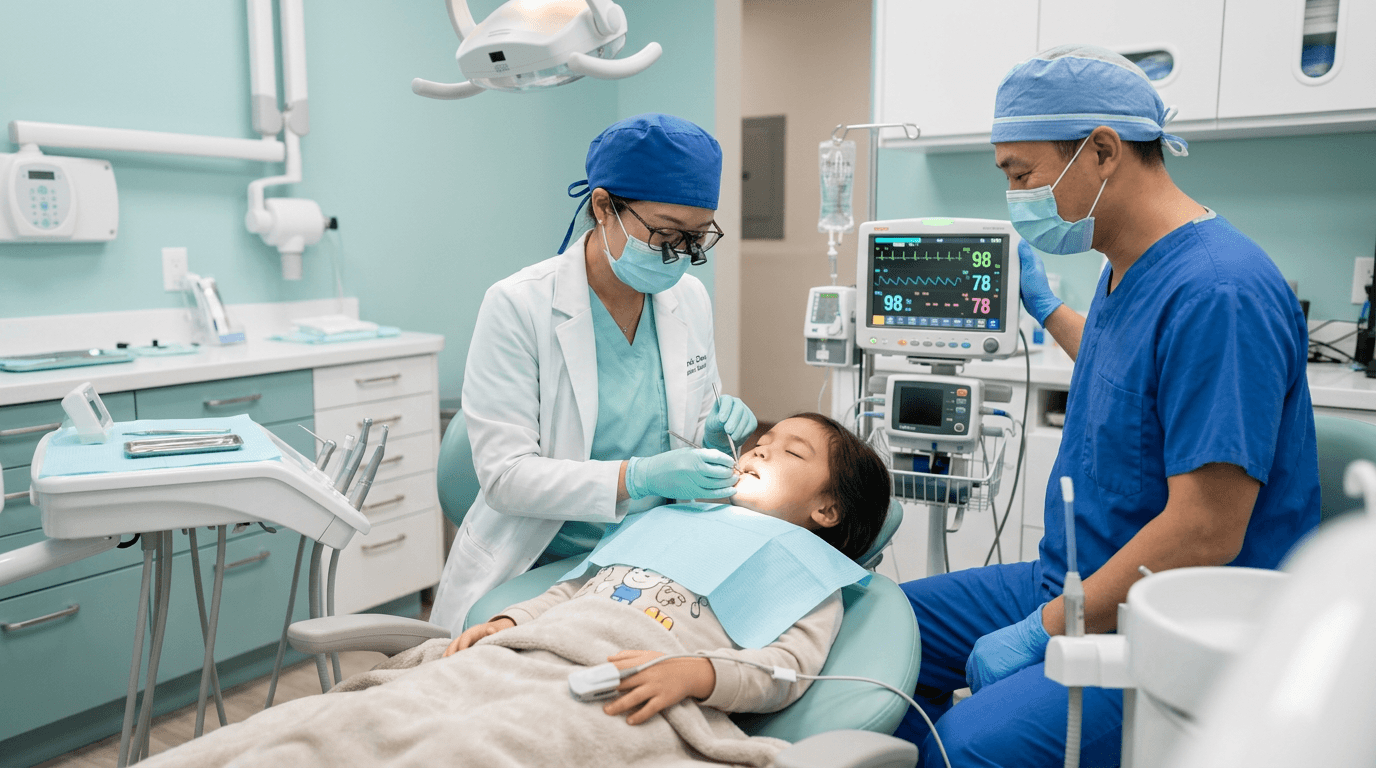
Pediatric dental emergencies can strike without warning — a fall on the playground, a collision during football, or biting into something unexpectedly hard. When your child is crying in pain with a knocked-out tooth or a bleeding mouth, knowing exactly what to do in those first critical minutes can mean the difference between saving a permanent tooth and losing it forever. This comprehensive guide covers every type of child tooth emergency you might face in Dubai, with step-by-step first aid protocols, when to rush to the ER versus a dental clinic, and current treatment costs in AED verified for March 2026.
What Is a Pediatric Dental Emergency?
A pediatric dental emergency is any sudden dental injury, infection, or pain episode in a child that requires immediate professional attention. Unlike routine dental issues that can wait for a scheduled appointment, emergencies involve active bleeding, severe pain, risk of permanent tooth loss, or signs of spreading infection. Understanding the difference is critical because delayed treatment can lead to complications that affect your child's dental health for decades.
The Dubai Health Authority (DHA) classifies dental emergencies as conditions requiring same-day treatment, including avulsed (knocked-out) teeth, fractured teeth with exposed pulp, dental abscesses with facial swelling, and uncontrolled oral bleeding. For children, these situations are particularly urgent because their developing teeth and jawbones respond differently to trauma than adult dentition.
According to dental trauma research, between 0.5% and 16% of all dental injuries in school-aged children involve tooth avulsion — a completely knocked-out tooth. The peak risk periods are toddlerhood (18 to 40 months), when children are learning to walk and frequently fall, and the preadolescent and adolescent period (ages 7 to 11), when sporting injuries become more common. Boys experience dental trauma nearly twice as often as girls, and the upper front teeth are the most frequently affected.
Types of Pediatric Dental Emergencies in Dubai
Not every dental problem is an emergency, but parents often struggle to tell the difference when their child is in distress. Here is a breakdown of genuine child tooth emergencies that require immediate action versus situations that can wait for a regular appointment.
True Emergencies Requiring Immediate Care
- Knocked-out permanent tooth — Time-critical. Every minute counts for reimplantation success.
- Fractured tooth with visible pink or red tissue — The pulp (nerve) is exposed and needs protection within hours.
- Dental abscess with facial swelling — Infection can spread to the airway if untreated. Look for sudden fever, swollen gums, or a bad taste in the mouth.
- Uncontrolled oral bleeding — Bleeding that does not stop after 15 to 20 minutes of steady pressure.
- Broken or dislocated jaw — Usually from a fall or impact; requires emergency room care.
- Severe blow to the head with dental injury — Concussion risk takes priority over dental treatment.
Urgent but Not Immediately Life-Threatening
- Chipped tooth without pain — See a dentist within 24 to 48 hours.
- Loose tooth from trauma — Monitor and visit the dentist the same day if possible.
- Object stuck between teeth — Try gentle flossing first; see a dentist if it will not come out.
- Lost filling or crown — Temporary dental cement from a pharmacy can hold until the appointment.
- Mild to moderate toothache — Manage with over-the-counter pain relief and see a dentist within 24 hours.
If you are ever unsure whether your child's situation is a true emergency, call a pediatric dentist in Dubai for phone triage. Most clinics have after-hours lines specifically for this purpose.
Knocked-Out Tooth in Children — Baby Tooth vs Permanent Tooth
This is the single most important distinction every parent must understand: the protocol for a knocked-out baby tooth is completely different from a knocked-out permanent tooth. Getting this wrong can cause serious harm to your child's developing teeth.
Knocked-Out Baby (Primary) Tooth — Do NOT Reimplant
If your child loses a baby tooth due to trauma, do not attempt to put it back in the socket. This is a critical point that many parents get wrong. Reimplanting a baby tooth can damage the permanent tooth developing beneath the gums. The force of pushing the baby tooth back in can injure the tooth bud of the adult tooth waiting to erupt, potentially causing malformation, discolouration, or failure to erupt entirely.
What to do instead:
- Stay calm and comfort your child — Dental injuries look dramatic because mouths bleed heavily, but most are manageable.
- Control the bleeding — Have your child bite down on a clean, damp gauze pad or cloth for 15 minutes with steady pressure.
- Apply a cold compress — Place a cold cloth or ice pack wrapped in a towel on the outside of the cheek to reduce swelling.
- Save the tooth — Even though it will not be reimplanted, bring it to the dentist to confirm it is a baby tooth and that no fragments remain in the gum.
- Visit your pediatric dentist within 24 hours — They will check for damage to surrounding teeth and the developing permanent tooth underneath.
A lost baby tooth from trauma usually does not require a space maintainer unless it was lost very early (before age 4), in which case your orthodontist in Dubai may recommend one to prevent neighbouring teeth from shifting into the gap.
Knocked-Out Permanent Tooth — Act Within 30 Minutes
A knocked-out permanent tooth is a true dental emergency where every minute matters. Research by Andreasen demonstrated that 90% of avulsed permanent teeth can be successfully reimplanted if treatment occurs within the first 30 minutes. After one hour, the survival rate drops below 50%. After two hours, reimplantation becomes unlikely to succeed because the periodontal ligament cells on the root surface die.
Step-by-step emergency protocol:
- Find the tooth immediately — Pick it up by the crown (the white chewing surface), never by the root. Touching the root damages the delicate periodontal ligament cells needed for reattachment.
- Rinse gently if dirty — Hold the tooth under lukewarm water for no more than 10 seconds. Do not scrub, use soap, or wrap it in tissue.
- Try to reinsert the tooth — If your child is old enough to cooperate (typically age 7 and up), gently push the tooth back into the socket facing the correct direction. Have them bite on a gauze pad to hold it in place.
- If reinsertion is not possible, store the tooth properly — Place it in one of these solutions, listed from best to worst:
- Save-A-Tooth solution (available at some pharmacies)
- Cold milk (whole milk is best)
- Your child's own saliva (have them spit into a clean container and place the tooth in it)
- Saline solution (contact lens solution works)
- Never store the tooth in plain tap water — The chlorine and inconsistent pH damage root cells.
- Get to a dentist within 30 minutes — Call ahead so they are prepared. If your regular dentist is unavailable, go to an emergency dentist in Dubai or the nearest hospital with a dental department.
After reimplantation, the dentist will typically splint the tooth to neighbouring teeth for 7 to 14 days to stabilise it. Your child will need follow-up appointments at 2 weeks, 4 weeks, 3 months, 6 months, and annually for up to 5 years to monitor for complications like root resorption or ankylosis.
Broken or Chipped Tooth Emergency in Children
A broken tooth is one of the most common pediatric dental emergencies, especially among active children. The severity ranges from a minor cosmetic chip to a serious fracture exposing the nerve. Treatment and urgency depend entirely on how deep the break goes.
Types of Tooth Fractures in Children
| Fracture Type | What It Looks Like | Urgency Level | Treatment |
|---|---|---|---|
| Enamel chip (minor) | Small piece missing, no pain | See dentist within 48 hours | Smoothing or composite bonding |
| Enamel-dentin fracture | Larger piece missing, yellow layer visible, sensitivity | See dentist same day | Composite bonding or crown |
| Pulp exposure | Pink or red dot visible in break, significant pain | Emergency — within 2 hours | Pulp capping or partial pulpotomy |
| Root fracture | Tooth feels loose, pain on biting | Emergency — immediate | Splinting, possible extraction |
| Crown-root fracture | Tooth split vertically, severe pain | Emergency — immediate | Extraction likely needed |
First aid for a broken tooth:
- Rinse with warm water — Gently clean the mouth to remove debris and blood.
- Save any tooth fragments — Place them in milk. A dentist can sometimes reattach large pieces.
- Apply a cold compress — 10 minutes on, 10 minutes off to manage swelling.
- Cover sharp edges — If the broken tooth has a sharp edge cutting your child's tongue or lip, cover it with sugar-free chewing gum or orthodontic wax as a temporary measure.
- Manage pain — Age-appropriate ibuprofen or paracetamol. Never place aspirin directly on the gum.
For any broken tooth emergency in Dubai, acting within the first hour gives the best outcome. If the pulp is exposed (you can see a pink or red spot inside the break), this becomes a time-critical emergency requiring treatment within 2 hours to preserve the tooth's vitality.
Severe Toothache in Children — When Pain Means Emergency
Not every toothache is an emergency, but certain signs indicate your child needs urgent care. A child tooth emergency involving pain requires careful assessment because children often cannot accurately describe or locate their discomfort.
Signs a Child's Toothache Is an Emergency
- Pain that wakes them from sleep — Night pain suggests nerve involvement or abscess.
- Facial swelling — Swelling around the jaw, cheek, or under the eye indicates spreading infection.
- Fever above 38 degrees Celsius with dental pain — A sign the infection may be systemic.
- Pain unresponsive to over-the-counter medication — If ibuprofen or paracetamol provides no relief after 30 to 60 minutes.
- Difficulty opening the mouth (trismus) — Suggests deep-space infection.
- Difficulty swallowing or breathing — This is a medical emergency. Go to the ER immediately.
- Pain lasting more than 12 consecutive hours — Prolonged unrelieved pain warrants urgent evaluation.
Home Care for a Child's Toothache Before the Dentist Visit
- Rinse with warm salt water — Mix half a teaspoon of salt in a cup of warm water. Have your child swish gently and spit. This reduces bacteria and soothes inflamed tissue.
- Check for trapped food — Gently floss around the painful tooth. Sometimes a piece of food wedged between teeth causes intense pain that resolves immediately once removed.
- Apply a cold compress externally — 10 minutes on, 10 minutes off. Never place ice directly inside the mouth on the tooth.
- Give age-appropriate pain relief — Ibuprofen (Brufen) is generally more effective for dental pain than paracetamol because it reduces inflammation. Follow dosing guidelines based on your child's weight.
- Elevate the head — Prop up pillows at bedtime to reduce blood flow to the area and decrease throbbing.
- Avoid hot, cold, and sweet foods — These trigger sensitivity and worsen pain.
If your child is experiencing a severe toothache, a toothache specialist in Dubai can provide same-day assessment and relief. Many clinics offer walk-in dental appointments specifically for pain emergencies.
When to Take Your Child to the Emergency Room for a Dental Problem
Most pediatric dental emergencies are best handled by a dentist, not a hospital ER. Emergency rooms can prescribe antibiotics and pain medication, but they typically cannot perform dental procedures like reimplantation, splinting, or pulp therapy. However, there are specific situations where the ER is the correct first stop.
Go to the ER Immediately If Your Child Has
- Difficulty breathing or swallowing — A dental infection can cause swelling that compromises the airway. This is life-threatening and needs immediate medical intervention.
- Uncontrollable bleeding — If oral bleeding does not stop after 15 to 20 minutes of firm, constant pressure with gauze.
- Suspected broken jaw — Signs include inability to close the mouth, severe pain when moving the jaw, visible misalignment, and numbness in the lower lip or chin.
- Head injury accompanying dental trauma — If your child hit their head during the fall or collision that caused the dental injury, concussion assessment takes priority.
- High fever (above 39 degrees Celsius) with facial swelling — Indicates the infection may be spreading dangerously and could require IV antibiotics.
- Facial trauma with multiple injuries — Car accidents, severe falls, or sports collisions involving the face need comprehensive ER evaluation.
Go to a Dental Clinic (Not ER) For
- Knocked-out tooth (dentist can reimplant; ER usually cannot)
- Broken tooth without head injury
- Severe toothache without breathing difficulty
- Loose tooth from mild impact
- Lost filling or crown
- Dental abscess without airway compromise
Dubai has excellent 24-hour dental clinics that handle after-hours emergencies. If the injury occurs at night, on a weekend, or during a public holiday, these clinics are often a better option than the ER for dental-specific injuries. Many hospitals in Dubai, including Mediclinic, American Hospital, and Emirates Hospital, also have on-call dentists who can be summoned for true dental emergencies presenting at the ER.
Pediatric Dental Emergency Treatment Costs in Dubai (2026 Prices)
Understanding the costs of emergency dental treatment for children in Dubai helps you make informed decisions without delay during a crisis. Here are current price ranges verified for March 2026.
| Emergency Treatment | Average Cost (AED) | Price Range (AED) |
|---|---|---|
| Emergency consultation and examination | 250 | 150 – 350 |
| Dental X-ray (periapical or panoramic) | 150 | 100 – 250 |
| Tooth reimplantation and splinting | 1,200 | 800 – 2,000 |
| Composite bonding (chipped or broken tooth) | 800 | 500 – 2,500 |
| Pulp capping (exposed nerve) | 600 | 400 – 1,000 |
| Pulpotomy (partial nerve treatment) | 800 | 500 – 1,200 |
| Pediatric tooth extraction (baby tooth) | 350 | 200 – 700 |
| Stainless steel crown (baby tooth) | 700 | 500 – 1,000 |
| Dental abscess drainage | 600 | 400 – 1,000 |
| Sedation (nitrous oxide per session) | 500 | 300 – 800 |
| After-hours emergency surcharge | 200 | 100 – 500 |
Prices verified March 2026 via Dubai dental clinic surveys. Actual costs vary by clinic location, severity, and whether sedation is required.
For a complete breakdown of dental pricing, see our guide to dental treatment costs in Dubai for 2026. Pediatric specialists typically charge 10% to 20% more than general dentists due to additional training and child-friendly equipment, but the investment in specialised care is worthwhile for young patients.
Does Insurance Cover Pediatric Dental Emergencies in Dubai?
The good news is that most health insurance plans in Dubai include coverage for pediatric dental emergencies. The DHA mandates that all residents have health insurance, and emergency dental treatment falls under essential healthcare services in most policies.
Coverage by Major Insurers
- Daman (National Health Insurance Company) — Thiqa and Enhanced plans cover emergency dental treatment for children. The Essential plan covers emergency-only dental care with network restrictions. Annual dental limits typically range from AED 3,000 to AED 10,000.
- AXA Gulf — Comprehensive family plans include paediatric emergency dental coverage. Some plans offer direct billing at network clinics with zero co-pay for emergency visits.
- Bupa Global — International and regional plans cover emergency dental for dependants. Reimbursement typically at 80% to 100% after deductible depending on the plan tier.
- Cigna — SmartCare and Global plans include accident-related dental treatment for children. Enhanced plans add routine dental coverage.
- MetLife — Dental plans through employer groups typically cover emergency procedures at 80% to 100%. Individual plans may have waiting periods for non-emergency procedures but cover emergencies from day one.
Children's medical insurance in the UAE starts from approximately AED 872 per year, while comprehensive family plans with dental coverage range from AED 6,200 to AED 28,000 annually. For detailed comparisons, read our dental insurance guide for Dubai and insurance plan comparison.
Important Insurance Tips for Dental Emergencies
- Keep your insurance card accessible — Store a photo on your phone. In an emergency, you do not want to waste time searching for it.
- Know your network clinics — Pre-identify 2 to 3 paediatric dental clinics in your area that accept your insurance via direct billing.
- Emergency coverage is usually immediate — Even plans with waiting periods for routine dental work typically cover emergencies from the policy start date.
- Document everything — Take photos of the injury, save the tooth if applicable, and keep all receipts for reimbursement claims.
- Pre-authorisation may be waived — Many insurers waive pre-authorisation requirements for genuine emergencies. Confirm this with your provider.
Check whether your plan covers specific providers by visiting our pages for Daman-covered dentists and Cigna dental network clinics in Dubai.
Common Causes of Dental Injuries in Children in Dubai
Understanding the most frequent causes of child tooth emergencies can help you take preventive steps. In Dubai, the common causes closely mirror global patterns but with some local considerations.
Leading Causes by Age Group
| Age Group | Most Common Causes | Most Common Injuries |
|---|---|---|
| Toddlers (1 to 3 years) | Falls while learning to walk, tripping on furniture, falls from beds and chairs | Knocked-out or displaced baby teeth, lip and gum lacerations |
| Preschool (3 to 5 years) | Playground falls, collisions with other children, tricycle and scooter accidents | Chipped front teeth, loosened teeth |
| School age (6 to 11 years) | Sports injuries (football, basketball, swimming pool incidents), bicycle accidents, rough play | Knocked-out permanent teeth, root fractures |
| Adolescents (12 to 17 years) | Contact sports, skateboarding, trampoline accidents, motor scooter incidents | Complex crown fractures, jaw injuries, multiple tooth avulsion |
Dubai-Specific Risk Factors
- Outdoor sports in community parks — Dubai's extensive parks and sports facilities mean children are highly active, increasing trauma risk.
- Swimming pool injuries — Slipping on wet pool decks is a common cause of facial and dental trauma in Dubai's many residential and club pools.
- Trampoline parks — Extremely popular in Dubai, trampoline parks are a significant source of dental and facial injuries in children aged 5 to 15.
- School sports programs — Many Dubai schools have extensive sports programs including football, rugby, and martial arts where mouthguards are not always mandatory.
For families with active children, investing in a custom-fitted mouthguard from a dental clinic in Dubai is one of the most effective ways to prevent sports-related dental injuries. Custom mouthguards from a dentist cost between AED 500 and AED 1,500 and offer significantly better protection than off-the-shelf varieties.
Step-by-Step Emergency Action Plan for Parents
When a pediatric dental emergency happens, panic is natural. Having a clear action plan committed to memory helps you respond effectively. Print this out and keep it on your refrigerator or save it on your phone.
The 5-Minute Emergency Protocol
- Minute 0 to 1 — Assess and calm — Check if your child is conscious and breathing normally. Assess for head injury. Comfort them verbally while you evaluate the dental injury.
- Minute 1 to 2 — Control bleeding — Apply firm pressure with clean gauze or cloth. If the child is old enough, have them bite down on the gauze.
- Minute 2 to 3 — Find and preserve any tooth or fragment — If a tooth was knocked out, locate it immediately. Handle by the crown only. If it is a permanent tooth, attempt reinsertion or store in milk.
- Minute 3 to 4 — Decide destination — Dental clinic for dental-only injuries. ER for head trauma, breathing difficulty, uncontrolled bleeding, or suspected broken jaw.
- Minute 4 to 5 — Call ahead and go — Phone the dental clinic or ER so they can prepare. Bring the tooth, fragments, your child's insurance card, and a container of milk (for tooth storage in transit).
Emergency Dental Kit for Families
Every family in Dubai should have a small dental emergency kit at home. Here is what to include:
- Sterile gauze pads — For controlling bleeding and holding reimplanted teeth in place.
- Save-A-Tooth kit — Contains a balanced salt solution that preserves knocked-out teeth for up to 24 hours. Available at select pharmacies in Dubai.
- Small container with lid — For storing a knocked-out tooth in milk if you do not have Save-A-Tooth solution.
- Cold pack (instant) — The type that activates when squeezed, no freezer needed.
- Children's ibuprofen — For pain and inflammation management.
- Orthodontic wax — To cover sharp broken tooth edges and prevent soft tissue cuts.
- Sugar-free chewing gum — Temporary cover for broken teeth or lost fillings.
- Your pediatric dentist's emergency number — Written down, not just saved in your phone (phones can die at the worst moments).
Dental Abscess in Children — Recognising the Danger Signs
A dental abscess is a pocket of pus caused by a bacterial infection in or around a tooth. In children, abscesses can develop rapidly and escalate from a minor issue to a serious pediatric dental emergency within hours. This is particularly dangerous because children's immune systems, while developing, may not contain the infection as effectively as an adult's.
Warning Signs of a Dental Abscess in Your Child
- Sudden onset of severe, throbbing pain that may radiate to the ear, jaw, or neck
- Visible swelling on the gum, appearing as a red or white bump (sometimes called a gum boil or parulis)
- Facial swelling, especially around the cheek or under the eye
- Fever, particularly if it develops suddenly alongside dental pain
- Foul taste in the mouth or bad breath
- Refusal to eat or drink due to pain
- Difficulty opening the mouth fully
- Swollen lymph nodes under the jaw or in the neck
Critical warning: If your child has facial swelling that is spreading, difficulty swallowing, difficulty breathing, or a temperature above 39 degrees Celsius, go to the emergency room immediately. A spreading dental infection (Ludwig's angina or orbital cellulitis) can become life-threatening. Do not wait for a dental appointment.
Treatment for a dental abscess typically involves antibiotics to control the infection, drainage of the abscess, and either root canal treatment or extraction of the affected tooth. For children with dental abscess symptoms in Dubai, same-day treatment is available at most paediatric dental clinics.
Sedation Options for Pediatric Dental Emergencies in Dubai
Emergency dental treatment on a frightened, injured child presents unique challenges. Dubai clinics offer several sedation options to ensure safe and effective treatment during a child tooth emergency.
Sedation Types Available for Children in Dubai
| Sedation Type | How It Works | Best For | Cost Range (AED) |
|---|---|---|---|
| Nitrous oxide (laughing gas) | Inhaled through a nose mask, mild relaxation | Minor procedures, anxious children | 300 – 800 |
| Oral sedation | Liquid medication taken 30 to 60 minutes before treatment | Moderate anxiety, longer procedures | 500 – 1,500 |
| IV sedation | Medication delivered through IV, deeper sedation | Complex or lengthy procedures, severe anxiety | 1,500 – 4,000 |
| General anaesthesia | Full unconsciousness in hospital setting | Very young children, multiple procedures, severe trauma | 3,000 – 8,000 |
Sedation costs verified March 2026. Prices vary by clinic, duration, and patient age.
The DHA requires that paediatric sedation and general anaesthesia be administered only by qualified anaesthesiologists or dentists with specific sedation certification. Always verify that your clinic has the appropriate DHA credentials. For more about sedation options, visit our guide to sedation dentistry in Dubai and IV sedation for dental procedures.
Children with dental anxiety may benefit from visiting a specialist pediatric dentist in Dubai who has child-friendly treatment rooms with distraction tools, ceiling-mounted TVs, and trained paediatric nursing staff.
How to Choose a Clinic for Pediatric Dental Emergencies in Dubai
Not all dental clinics are equipped to handle pediatric dental emergencies. Before an emergency happens, identify clinics in your area that meet these criteria:
Essential Clinic Features for Pediatric Emergencies
- DHA-licensed pediatric dentist on staff — General dentists can treat children, but a specialist paediatric dentist has 2 to 3 years of additional training in child-specific treatment techniques, behaviour management, and growth and development considerations.
- After-hours emergency availability — The clinic should offer an emergency phone line or after-hours service. Dental injuries rarely happen during office hours.
- Paediatric sedation capability — If your child needs sedation, the clinic must have the equipment and certified personnel on site.
- Digital X-ray equipment — Digital X-rays use up to 80% less radiation than traditional film and provide instant images, which is especially important for children.
- Child-friendly environment — A clinic designed for children reduces anxiety and makes emergency treatment significantly easier.
- Direct insurance billing — In an emergency, the last thing you want is to deal with reimbursement paperwork. Choose a clinic that bills your insurer directly.
Browse verified paediatric dental clinics near you using our clinic finder tool. You can filter by specialty, location, and insurance accepted to find the right match before an emergency arises.
Questions to Ask a Potential Emergency Clinic
- Do you have a paediatric dentist available for same-day emergencies?
- What are your after-hours emergency protocols?
- Do you offer sedation for children, and what types?
- Which insurance plans do you accept with direct billing?
- What is the typical wait time for emergency cases?
- Is your clinic equipped for tooth reimplantation?
For guidance on selecting the right dental professional, see our resource on how to choose a dentist in Dubai and check DHA-licensed dental clinics in your area.
Preventing Dental Emergencies in Children
While you cannot prevent every accident, proactive measures significantly reduce the risk of child tooth emergencies. Prevention is especially important in Dubai where children participate in year-round outdoor sports and activities.
Top Prevention Strategies
- Custom-fitted mouthguards for sports — Essential for any contact sport or activity with fall risk. Custom mouthguards from a dentist (AED 500 to 1,500) provide vastly superior protection compared to store-bought boil-and-bite guards. They are especially important for football, basketball, rugby, martial arts, skateboarding, and cycling.
- Childproof your home — Cover sharp furniture corners, secure rugs to prevent slipping, and use safety gates for toddlers. Many dental injuries in children under 3 happen at home.
- Supervise pool time — Enforce the no-running rule on pool decks. Wet tile is the leading surface for face-first falls causing dental trauma in Dubai.
- Car seat and seatbelt compliance — Proper restraints prevent facial injuries in vehicle accidents. The UAE mandates car seats for children under 4 and seatbelts for all passengers.
- Regular dental check-ups — Routine visits every 6 months allow your dentist to identify weakened teeth, cavities that could fracture, or bite issues that increase injury risk. Schedule with a dental check-up clinic in Dubai.
- Address protruding front teeth early — Children with prominent upper front teeth (overjet) are significantly more likely to experience dental trauma. Early orthodontic evaluation (by age 7) can identify if intervention is needed to reduce this risk.
- Teach safe play habits — No running with objects in the mouth (pens, lollipop sticks), no using teeth to open packages, and appropriate behaviour on trampolines and climbing structures.
For comprehensive preventive care, explore our children's dental care guide for Dubai and the complete paediatric dental care checklist.
Long-Term Follow-Up After a Pediatric Dental Emergency
The emergency treatment is only the beginning. Dental injuries in children require long-term monitoring because complications can develop months or even years after the initial trauma. This is especially true for injuries to developing permanent teeth.
Follow-Up Schedule After Dental Trauma
- 1 to 2 weeks — Splint removal (if applicable), initial healing check, soft tissue assessment
- 4 weeks — Vitality testing of injured teeth, X-ray to check root and bone
- 3 months — Repeat vitality testing, check for signs of infection or root resorption
- 6 months — Comprehensive review including X-rays, check for colour changes indicating nerve death
- 1 year — Full assessment of healing, check permanent tooth development if baby tooth was injured
- Annually for 5 years — Ongoing monitoring for late complications including root resorption, ankylosis, pulp canal obliteration, and arrested root development
Possible Complications to Watch For
- Tooth discolouration — A tooth turning grey or dark yellow may indicate nerve death. In baby teeth, this sometimes resolves on its own; in permanent teeth, root canal treatment may be needed.
- Root resorption — The body breaks down the root of the reimplanted tooth. This is the most common cause of eventual tooth loss after reimplantation.
- Ankylosis — The tooth fuses to the bone, preventing normal growth and eruption of neighbouring teeth. More common in children because their jaws are still growing.
- Damage to developing permanent teeth — Injuries to baby teeth can affect the permanent teeth forming beneath, causing enamel defects, delayed eruption, or abnormal positioning.
- Psychological impact — Dental trauma can cause lasting fear of dentists. Address anxiety early with a dental anxiety specialist in Dubai.
Dental Emergencies in Children with Special Needs
Children with special needs — including autism spectrum disorder, cerebral palsy, Down syndrome, and other developmental conditions — may face additional challenges during a pediatric dental emergency. Communication difficulties can make it harder to assess pain levels, and sensory sensitivities may make emergency treatment more distressing.
In Dubai, several clinics specialise in treating children with additional needs. These clinics have:
- Staff trained in behaviour management for children with developmental conditions
- Sensory-friendly treatment rooms with reduced lighting and noise
- Access to general anaesthesia for children who cannot tolerate dental treatment while awake
- Longer appointment slots to allow for desensitisation and adjustment
For special needs dental care, consult a special needs dentist in Dubai and establish a relationship before an emergency occurs. Having a dentist who already knows your child's medical history, sensory profile, and communication style makes emergency treatment significantly smoother.
Frequently Asked Questions About Pediatric Dental Emergencies
Should I put a knocked-out baby tooth back in my child's mouth?
No, you should never attempt to reimplant a knocked-out baby tooth. Pushing a baby tooth back into the socket can damage the permanent tooth developing underneath the gum. Instead, control the bleeding with gauze, save the tooth for the dentist to examine, and schedule a visit within 24 hours to ensure no fragments remain and the permanent tooth bud is unaffected.
How quickly do I need to get to a dentist for a knocked-out permanent tooth?
Within 30 minutes for the best chance of saving the tooth. Research shows a 90% reimplantation success rate within 30 minutes. After one hour, the success rate drops below 50%. Store the tooth in milk, saline, or the child's saliva during transit — never in plain water. If possible, gently reinsert the tooth into the socket yourself before heading to the dentist.
Can I give my child aspirin for dental pain?
No, never give aspirin to children under 16 due to the risk of Reye's syndrome, a rare but serious condition. Use children's ibuprofen (Brufen) or paracetamol (Panadol) instead. Ibuprofen is generally preferred for dental pain because it also reduces inflammation. Always dose according to your child's weight, not age.
How much does emergency dental treatment for children cost in Dubai?
Emergency consultation fees range from AED 150 to AED 350. Treatment costs vary by procedure: composite bonding for a broken tooth is AED 500 to AED 2,500, tooth reimplantation and splinting costs AED 800 to AED 2,000, and a baby tooth extraction is AED 200 to AED 700. After-hours surcharges of AED 100 to AED 500 may apply. Most insurance plans in Dubai cover emergency dental treatment for children.
When should I take my child to the ER instead of a dentist for a dental emergency?
Go to the emergency room if your child has difficulty breathing or swallowing, uncontrollable bleeding lasting more than 20 minutes, suspected broken jaw, head injury accompanying the dental trauma, or a high fever above 39 degrees Celsius with facial swelling. For dental-only injuries like a knocked-out tooth or broken tooth without other trauma, go directly to a dental clinic because ERs typically cannot perform dental procedures.
Does my dental insurance in Dubai cover pediatric dental emergencies?
Most comprehensive health insurance plans in Dubai, including those from Daman, AXA, Bupa, Cigna, and MetLife, cover emergency dental treatment for children. Emergency coverage typically applies from the policy start date even if the plan has waiting periods for routine dental work. Coverage typically ranges from 80% to 100% depending on your plan tier. Always check whether your clinic is within your insurance network for direct billing.
My child chipped a small piece off their tooth but is not in pain. Is this an emergency?
A small chip without pain is urgent but not an immediate emergency. Schedule a dental appointment within 24 to 48 hours. In the meantime, if the broken edge is sharp, cover it with orthodontic wax or sugar-free chewing gum to prevent it from cutting the tongue or lips. Save any tooth fragments in milk as a dentist may be able to reattach them. If pain, swelling, or sensitivity to temperature develops, upgrade to a same-day emergency appointment.
What is the best way to store a knocked-out tooth while getting to the dentist?
The best storage option is a Save-A-Tooth preservation kit if you have one. If not, cold whole milk is the next best option as it has a compatible pH and osmolality that keeps the periodontal ligament cells alive. The child's own saliva in a clean container is another option. Saline solution or contact lens solution also works. Never store the tooth in plain tap water, which damages root cells due to chlorine and pH differences.
Key Takeaways
- Baby tooth knocked out — do not reimplant. Control bleeding and see a pediatric dentist in Dubai within 24 hours to protect the developing permanent tooth.
- Permanent tooth knocked out — reimplant within 30 minutes. Store in milk if reinsertion is not possible. Every minute matters for saving the tooth.
- Emergency dental treatment for children in Dubai costs AED 150 to AED 2,500 depending on the procedure, and most insurance plans cover paediatric emergencies.
- Go to the ER for breathing difficulty, uncontrolled bleeding, head injury, or broken jaw. For dental-only injuries, an emergency dentist is the better choice.
- Prevention works: Custom mouthguards, childproofing, and regular dental check-ups significantly reduce the risk of child tooth emergencies.
- Build your emergency plan now: Identify a 24-hour dental clinic near you, assemble a dental first aid kit, and know the difference between baby and permanent tooth protocols before an emergency happens.
- Find a verified paediatric dentist in your area using our clinic search tool and explore the top-rated dental clinics in the UAE.